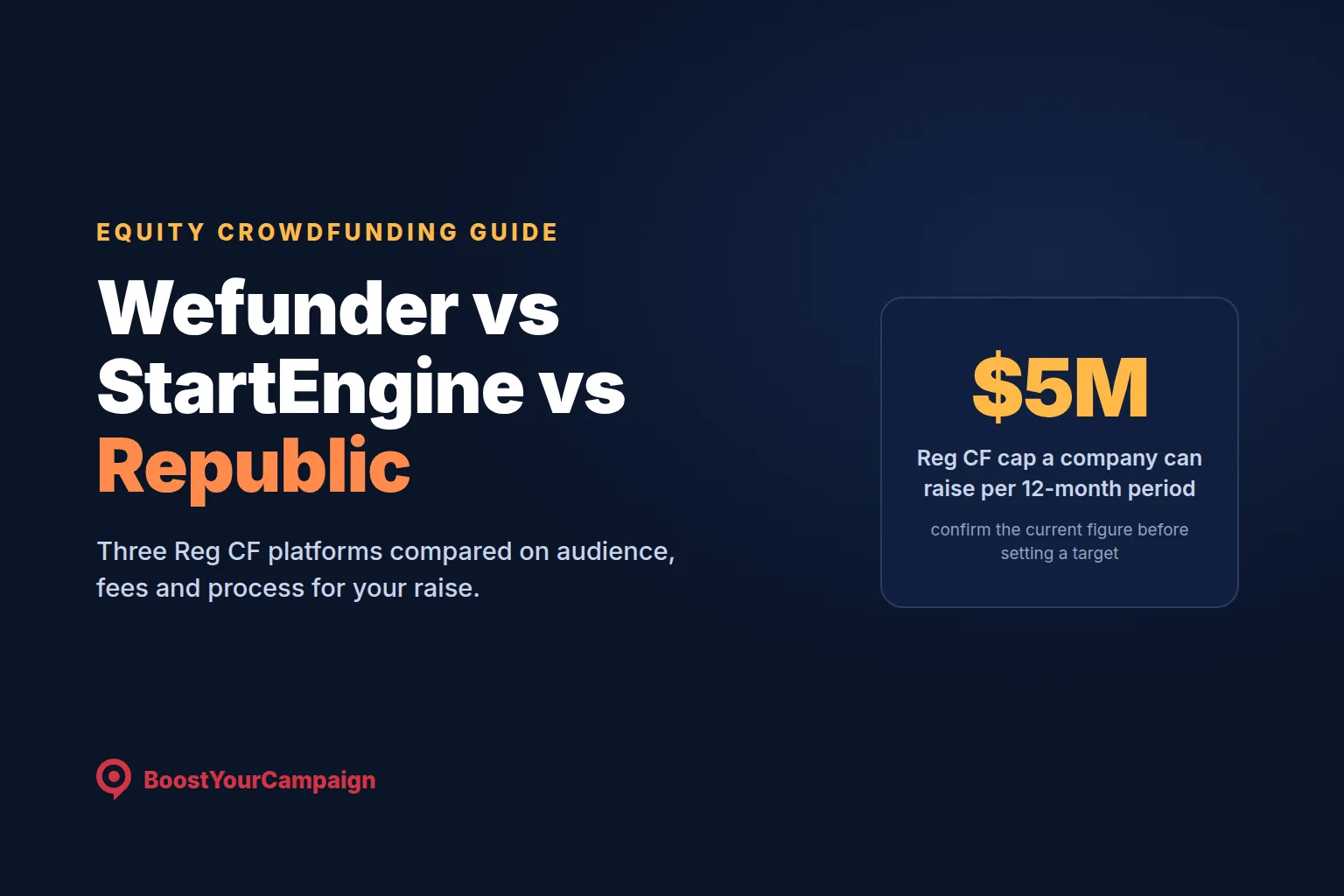
Wefunder, StartEngine, and Republic are the three platforms most US founders compare first when they decide to raise money from the public instead of, or alongside, venture capital. If you're weighing which one fits your company and your raise, talk with BoostYourCampaign about your product, your traction, and your timeline.
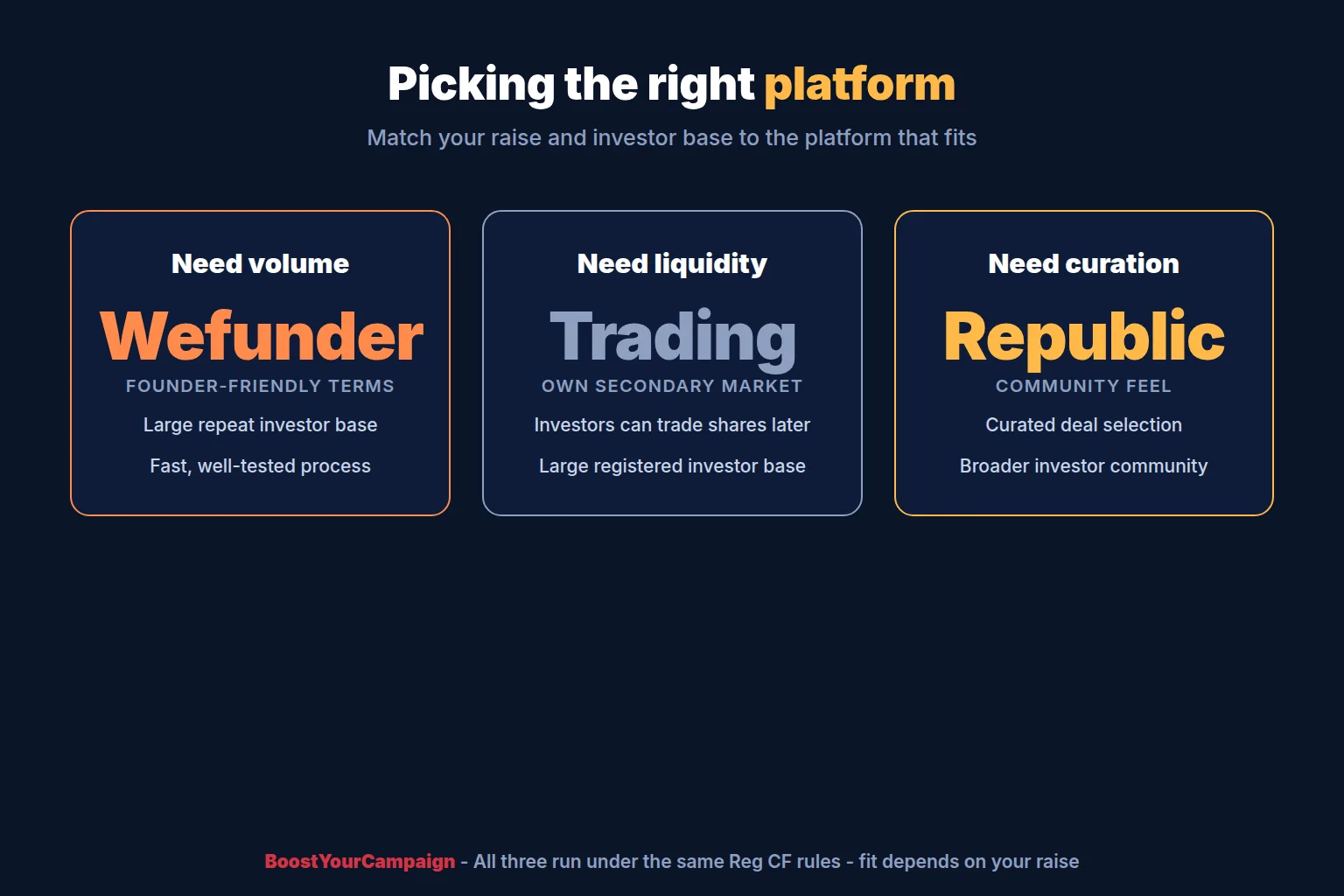
Wefunder, StartEngine, and Republic all run raises under Regulation Crowdfunding, letting a company sell equity or a similar security to the public - including non-accredited investors - up to a $5 million cap in any 12-month period. Wefunder tends to run the largest volume and is generally seen as founder-friendly on terms, StartEngine has built a large investor base and runs its own secondary market for trading shares after a raise, and Republic leans toward a curated deal flow and a broader community feel. Fees on all three run roughly a percentage of funds raised plus, in some cases, additional investor or equity fees - confirm the current terms directly with each platform before committing, since these numbers change and vary by deal structure.
- All three operate under the same federal rule - Regulation Crowdfunding, with a $5M cap per 12-month period and real disclosure obligations.
- Positioning differs more than mechanics - Wefunder on volume and founder terms, StartEngine on investor base and its secondary market, Republic on curation.
- Fees are roughly similar in shape across all three - a percentage of funds raised, sometimes plus equity or investor-side fees - confirm current terms before you commit.
- Form C is the same regardless of platform - the SEC filing and disclosure process doesn't change based on which site hosts your raise.
- Ads for a security are compliance-constrained - equity marketing can't promise returns the way a product ad can promise satisfaction.
- Sequencing matters - a rewards crowdfunding raise before an equity one gives investors real traction evidence to evaluate.
1) What Regulation Crowdfunding actually allows
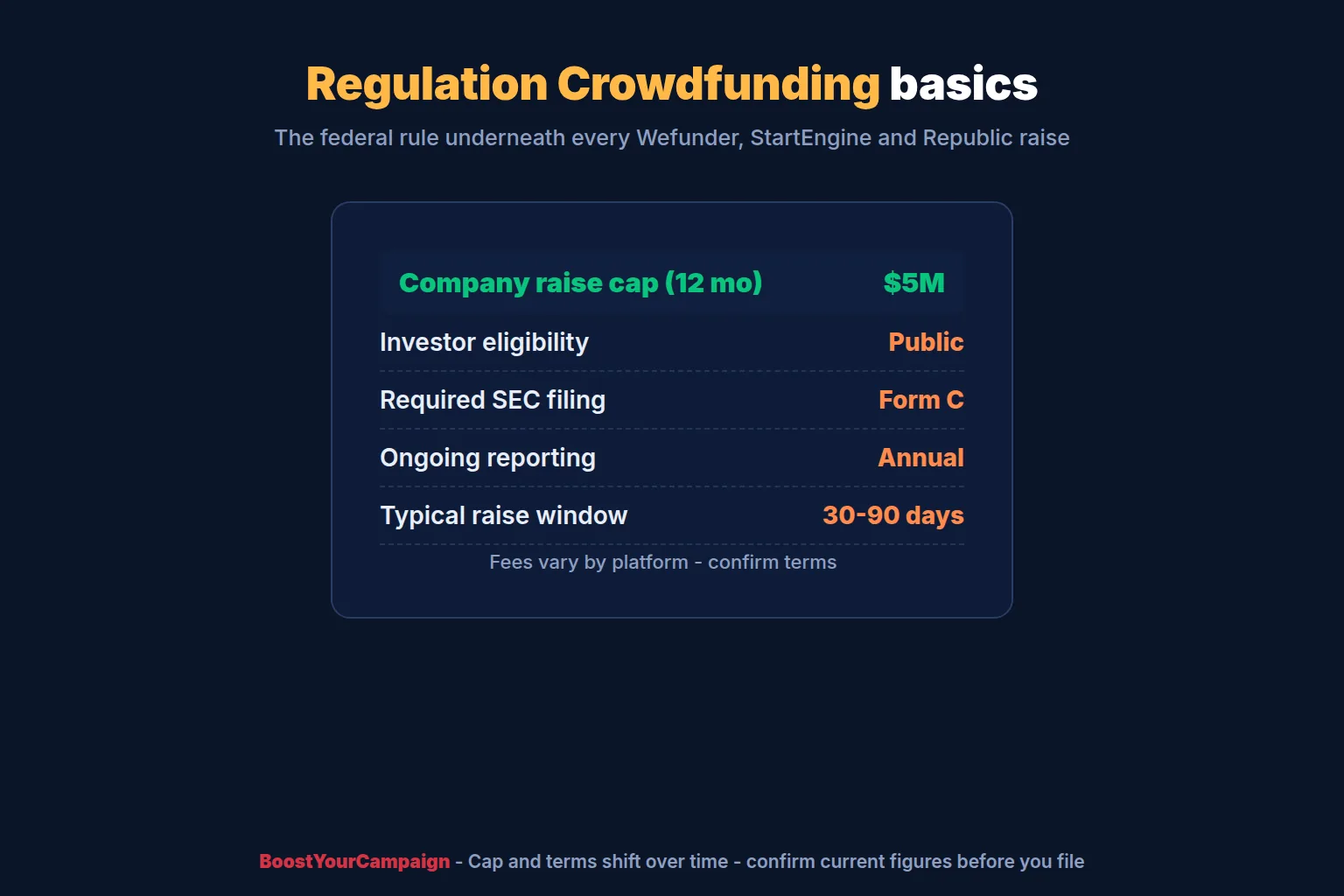
Regulation Crowdfunding, usually shortened to Reg CF, is the federal rule that lets a private US company raise money from the general public, including people who aren't accredited investors, in exchange for equity, debt, or a revenue-share instrument, through a registered funding portal or broker-dealer. It's the legal foundation underneath every raise run on Wefunder, StartEngine, or Republic, and the rule itself, not the platform, sets most of the boundaries a founder has to work inside.
As of this writing, a company can raise up to $5 million under Reg CF in any rolling 12-month period. That cap has been raised before by regulatory action and could change again, so confirm the current figure with a securities attorney or directly with a platform before setting a fundraising target - do not plan a raise size off a number you read in an article, including this one, without checking it's still current.
In exchange for public access to capital, Reg CF comes with real obligations: a Form C filing with the SEC before the raise opens, specific financial disclosure requirements that scale with how much you're raising, and ongoing annual reporting once the raise closes, for as long as certain thresholds are met. None of the three platforms in this comparison can waive or shortcut these requirements, since they're a function of federal securities law, not platform policy.
2) Wefunder, StartEngine, and Republic: how they're positioned
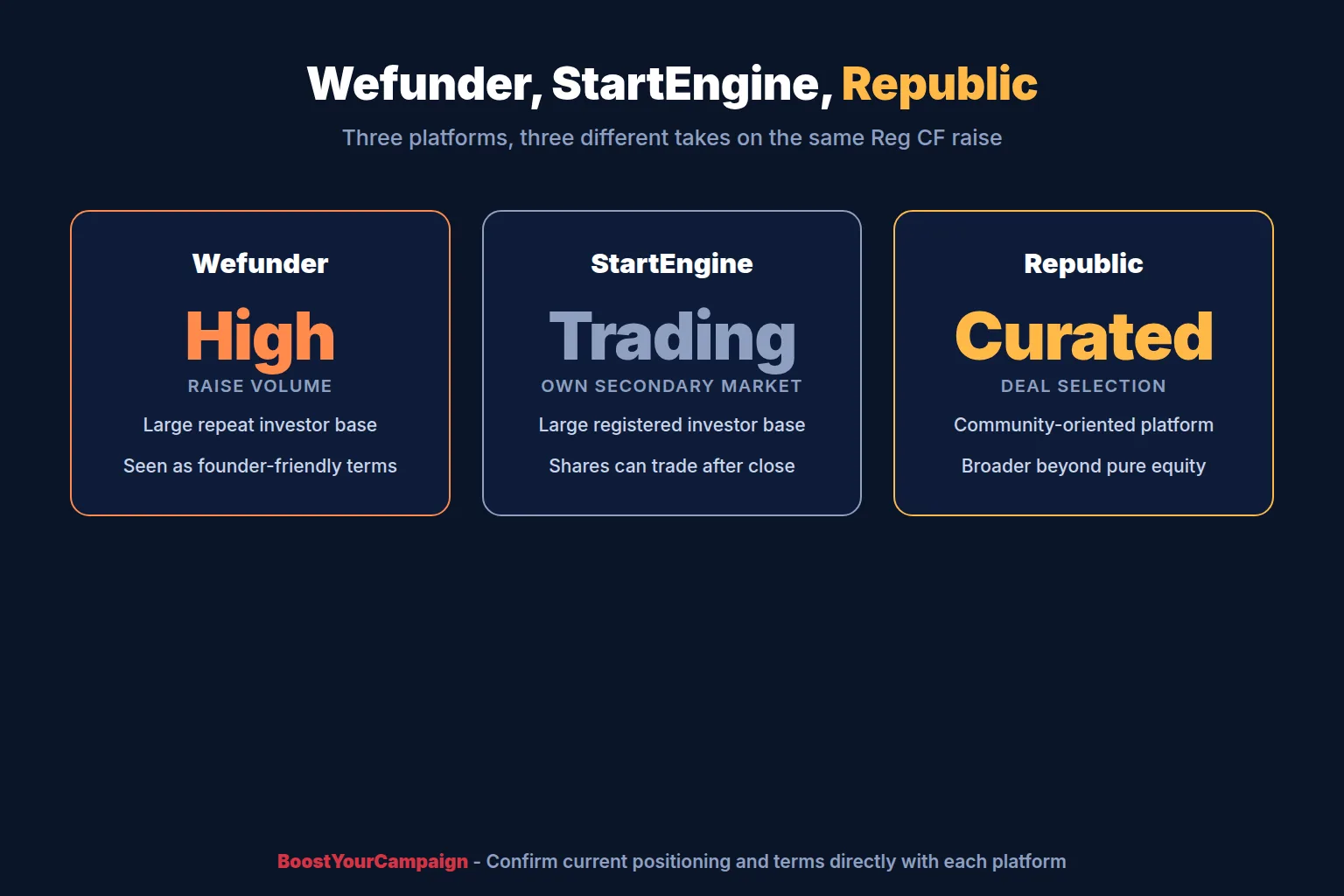
Wefunder has generally run some of the highest raise volume among Reg CF platforms and is often described as founder-friendly on deal terms, with a large base of retail investors who've backed multiple companies through the platform over time. It's frequently the first platform founders check when comparing options, partly because of that volume and partly because its process is seen as relatively straightforward to get through. Confirm current volume and market share directly with the platform, since standing between these three shifts from year to year and any specific ranking is a snapshot, not a permanent fact.
StartEngine has built a large registered investor base of its own and, distinctively among the three, operates its own secondary marketplace where shares from past raises can trade after the initial offering closes. That secondary market matters to some investors specifically because Reg CF securities are otherwise very illiquid - there's often no easy way to sell a stake before an exit event - and a platform-run trading venue is one of the more concrete answers to that liquidity problem in the Reg CF space, though it doesn't guarantee an active or liquid market for any specific company's shares.
Republic tends to lean toward a more curated approach to which deals appear on the platform, alongside a broader community and content layer around the investing experience. It's also expanded into adjacent areas like crypto and international offerings over time, giving it a somewhat different flavor than a platform focused purely on domestic Reg CF equity deals. As with the other two, exact positioning and deal criteria shift, so review Republic's current stated approach directly before assuming last year's description still applies.
None of these differences are large enough to make one platform obviously correct for every company. The better approach is checking each platform's current investor base, deal criteria, and published terms against your specific company and raise size, rather than picking based on general reputation alone.
3) Fee models: what roughly comes out of a Reg CF raise
All three platforms charge in roughly the same shape: a percentage of the total funds raised, taken at the close of a successful offering, similar in structure to how rewards crowdfunding platforms charge a percentage of the funded amount. Some platforms and deal structures also involve an additional fee paid in equity or warrants rather than cash, and some charge the investor side a separate fee on top of what the company pays. The exact percentages and which fee types apply to a given raise vary by platform, by deal size, and sometimes by which specific offering terms a company chooses, so treat any specific number you see quoted elsewhere as something to confirm directly with the platform rather than as a fixed industry rate.
Beyond the platform's own fee, a Reg CF raise typically involves payment processing costs on the investor transactions themselves, and often third-party costs for legal review, a Form C preparation service, and sometimes an independent financial review or audit once the raise size crosses certain thresholds. None of these costs are unique to one platform - they're a function of running a compliant Reg CF offering at all - but they add up, and a founder budgeting a raise should model total cost, not just the headline platform percentage, before setting a fundraising target.
Our Kickstarter and Indiegogo fees guide walks through the equivalent fee stack for rewards crowdfunding, which is useful context for comparing cost structures even though the specific numbers and fee types differ between rewards and equity raises.
4) Investor minimums and timelines
Minimum investment amounts on all three platforms are generally set low enough to let non-accredited retail investors participate, often in the range of a few hundred dollars, though the exact minimum varies by specific offering and can be set higher by the company running the raise. A company choosing its own minimum investment amount is trading off two things: a lower minimum widens the pool of people who can participate and can build broader social proof and word-of-mouth, while a higher minimum reduces the administrative overhead of managing a very large number of small investors on the cap table afterward.
Timelines run longer than a typical rewards crowdfunding campaign. Between legal prep, Form C filing, and the platform's own review process before a raise goes live, founders should generally expect weeks to a few months of pre-launch work, followed by an active raise window that commonly runs 30 to 90 days depending on the platform and how the offering is structured, sometimes with an extension if the company is close to its target near the deadline. That's a meaningfully longer total timeline than a typical 30-day Kickstarter campaign, and it's worth planning for from the start rather than assuming an equity raise moves at the same pace as a rewards launch.
5) The Form C process, from filing to close
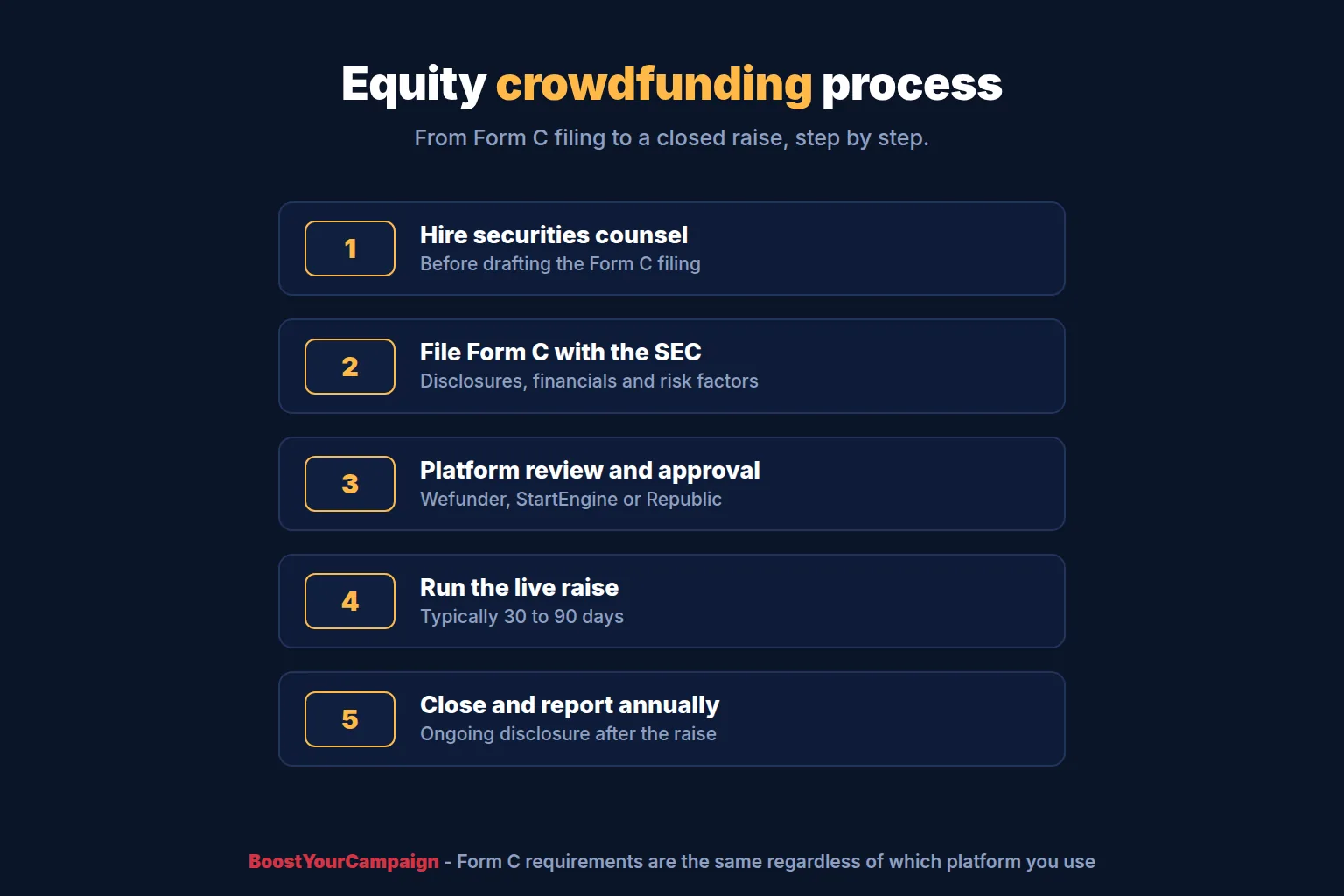
Form C is the SEC disclosure document every Reg CF offering has to file before it can accept investment, and the process around it is largely the same regardless of which platform hosts the raise, since it's a federal filing requirement rather than a platform-specific step. It covers the company's business description, use of proceeds, risk factors, ownership and capital structure, and financial statements at a level of detail that scales with how much the company is raising - larger raises require more extensive, and in some cases independently reviewed or audited, financials.
Getting this right takes real lead time. Most founders work with a securities attorney and, often, a Form C preparation service to build the filing, gather financials in the right format, and make sure risk disclosures are complete and accurate, since an incomplete or inaccurate Form C creates real legal exposure, not just a delayed launch. Budgeting several weeks for this stage before a target launch date is a reasonable planning assumption, and starting it earlier rather than later is one of the more common pieces of advice from founders who've been through the process before.
Once the Form C is filed and the platform has approved the offering, the raise goes live and runs its active window, with the platform tracking committed investments against the funding target and processing investor onboarding (identity verification, payment, signing the offering documents) as commitments come in. At close, the company receives the funds net of the platform's fee, and ongoing annual reporting obligations begin, typically continuing until specific exit or threshold conditions are met.
6) Marketing an equity raise: compliance limits and the role of a lead investor
Marketing a security is not the same exercise as marketing a product, and the constraints are real, not just a formality. Ads generally cannot promise a specific return, imply a guaranteed outcome, or make claims that aren't supportable by the company's actual disclosed financials and traction. That doesn't mean equity marketing has to be dry - traction proof, a credible founder on camera, and an honest account of the opportunity and its risks can be genuinely persuasive - but every claim needs to hold up against what's in the Form C and the offering materials, and copy should generally point to those official documents for specific numbers rather than restating them loosely in an ad where they can drift out of context.
A lead investor - someone who commits a meaningful check early and is often named publicly on the raise page - plays an outsized role in a Reg CF campaign's momentum. A visible lead investor signals to smaller, less experienced investors that someone with more diligence capacity has already done the work of evaluating the company, which measurably lowers the perceived risk for everyone who comes after. Founders who can secure a lead investor commitment before the raise goes fully public, even informally, tend to see stronger early momentum once the offering opens.
Investor updates after the raise closes matter for reasons beyond goodwill. Many platforms and a meaningful share of investors expect regular, honest updates on company progress, and that ongoing communication is part of what keeps a shareholder base engaged enough to participate in a future raise or refer other investors. Treating post-raise communication as optional is one of the more common mistakes founders make once the pressure of the live raise window is behind them.
7) Sequencing: rewards crowdfunding before equity
For a company with a physical or clearly demonstrable product, running a rewards crowdfunding campaign on Kickstarter or Indiegogo before an equity raise is a pattern that tends to strengthen the equity raise significantly. A funded rewards campaign is public, verifiable proof that real people paid real money for the product, and that evidence is exactly what investors on Wefunder, StartEngine, or Republic are trying to assess when they decide whether to commit a check. Our crowdfunding platforms for startups guide covers that sequencing decision in more depth, including which product types fit rewards crowdfunding well enough to make this path worthwhile.
The traction from a rewards campaign carries directly into equity marketing creative: backer counts, repeat purchase rate, organic pickup versus paid traffic, and on-time fulfillment are all specific, checkable numbers that make for far stronger investor-facing proof than a projection slide. A company that skips straight to an equity raise without that kind of evidence is pitching mostly on the strength of a deck and a prototype, which is a harder sell to a retail investor base that's learned to look for concrete traction.
Choosing between Wefunder, StartEngine, and Republic matters less than most founders initially assume relative to the strength of the traction story going into the raise. A well-prepared company with real numbers to show tends to do reasonably well on any of the three, while a company without traction evidence will likely struggle regardless of which platform hosts the offering.
Wefunder, StartEngine, and Republic, compared
| Platform | General positioning | Notable feature | Best fit |
|---|---|---|---|
| Wefunder | High raise volume, seen as founder-friendly on terms | Large repeat investor base across many past raises | Founders prioritizing volume and a straightforward process |
| StartEngine | Large registered investor base | Runs its own secondary market for post-raise trading | Companies where investor liquidity is a selling point |
| Republic | Curated deal flow, community-oriented | Broader platform beyond pure Reg CF equity deals | Companies wanting a curated, community-driven raise |
How BoostYourCampaign fits
BoostYourCampaign runs equity crowdfunding marketing (/services/equity-crowdfunding) alongside its core rewards crowdfunding services, which matters directly here because the two disciplines are complementary rather than separate: a rewards campaign builds the traction story, and the equity raise is where that story gets converted into an investor pipeline. The agency runs a skin-in-the-game ad model, investing its own money alongside a client's ad budget with fixed fees rather than a percentage-of-raise commission, and can share ad spend or re-launch a campaign that misses its target.
For an equity raise specifically, BYC focuses on building the investor pipeline in the weeks before the raise opens, since a Reg CF campaign that opens cold to a thin list tends to stall in a way that's harder to recover from than a slow rewards campaign. That includes founder-led investor video production, compliance-aware ad creative built with the offering's actual disclosed terms in mind, and a nurture sequence that moves a reservation toward an actual committed check. The agency has run since 2010 across 4,600+ campaigns with $734M+ raised and a 4.9/5 score across 300+ verified reviews. For companies planning to sequence a rewards raise ahead of an equity one, see our crowdfunding platforms for startups guide, and for post-campaign revenue that strengthens the traction story further, our guide to selling after crowdfunding closes.
Choosing between Wefunder, StartEngine, and Republic: quick checklist
| Question | Why it matters |
|---|---|
| Have you confirmed the current Reg CF cap and each platform's current fees directly? | The $5M cap and fee structures have changed before and can change again. |
| Do you have a securities attorney lined up before starting Form C? | An incomplete or inaccurate Form C creates real legal exposure, not just a delay. |
| Do you have traction evidence - rewards campaign, revenue, or waitlist - to point to? | Investors read concrete, checkable traction far more favorably than a projection alone. |
| Have you identified a potential lead investor before the raise opens? | A visible lead investor commitment measurably strengthens early momentum. |
| Does investor liquidity (a secondary market) matter to your likely investor base? | Only StartEngine currently runs its own secondary market among these three. |
| Is your ad creative built around the offering's actual disclosed terms? | Equity marketing can't promise returns and needs to stay supportable against the Form C. |
For a broader look at rewards crowdfunding platforms as a different capital route entirely, see our crowdfunding platforms for startups guide, and for the BackerKit side of rewards crowdfunding specifically, see our BackerKit crowdfunding guide. If a rewards campaign in your sequencing plan involves tabletop or a heavier reward tier structure, our Kickstarter vs Gamefound vs BackerKit comparison, Gamefound guide, and pledge manager and late pledges guide cover that side of the funnel in depth. You can see the full range of what BYC runs, rewards and equity together, on our services page.
Frequently Asked Questions
Which is better, Wefunder, StartEngine, or Republic?
There's no universally correct answer - each platform has a somewhat different investor base and positioning, and the better fit depends on your company, raise size, and whether features like StartEngine's secondary market matter to your investors. Reviewing each platform's current terms and investor base directly against your specific raise is more useful than picking based on general reputation alone.
How much can a company raise through Regulation Crowdfunding?
As of this writing, up to $5 million in any rolling 12-month period. This cap has changed before through regulatory action and could change again, so confirm the current figure with a securities attorney or directly with a platform before setting a fundraising target.
What fees do Wefunder, StartEngine, and Republic charge?
All three charge roughly a percentage of the funds raised, and some deal structures involve additional equity-based or investor-side fees on top of that. The exact percentages vary by platform and by deal, so confirm current terms directly with each platform rather than relying on a fixed number from an outside source.
Do I need a lawyer to run a Reg CF raise?
Yes. Form C involves real disclosure obligations and ongoing annual reporting, and getting the filing wrong creates legal exposure that's far more costly to fix after the fact than getting it right before the raise opens. A securities attorney should be involved from the start of the process, not brought in after a problem shows up.
Should I run a Kickstarter campaign before an equity crowdfunding raise?
For a company with a physical or clearly demonstrable product, yes, generally. A funded rewards campaign gives investors concrete, verifiable traction evidence that a pitch deck alone can't provide, and that evidence tends to strengthen an equity raise on Wefunder, StartEngine, or Republic considerably.
How long does a Reg CF raise take from start to close?
Plan for weeks to a few months of pre-launch legal and Form C preparation, followed by an active raise window commonly running 30 to 90 days depending on the platform and offering structure. That's meaningfully longer than a typical 30-day rewards crowdfunding campaign.
Can non-accredited investors participate in these raises?
Yes, that's one of the defining features of Regulation Crowdfunding - it opens investment to the general public, not just accredited investors, subject to certain investment limits based on the individual investor's income and net worth.
What is a lead investor and why does it matter?
A lead investor is someone who commits a meaningful check early in a raise, often named publicly on the campaign page. Their visible commitment signals to smaller investors that someone has already done real diligence on the company, which tends to strengthen early momentum once the raise goes fully public.
Can an LLC or other business entity invest in a Reg CF raise?
Generally yes. Wefunder, StartEngine and Republic all support entity accounts, so an LLC, corporation, partnership or trust can invest in its own name once the platform verifies the entity and a controlling person. A sole proprietorship is not a separate legal entity, so its owner invests as an individual. Our guide on whether an LLC can invest in a crowdfunding campaign covers the details and limits.
If you're weighing an equity crowdfunding platform or planning how to sequence it with a rewards campaign, reach out through /contact and we'll help map out the timeline and the platform fit together.
Want results like these for your campaign?
We've helped 4,600+ creators raise over $734M. Let's pressure-test your launch plan and find the highest-leverage fixes before you go live.
Talk to an expert →Get the free 87-step launch checklist
The exact pre-launch, live-campaign and fulfillment steps we use across 4,600+ launches. Free PDF, emailed instantly.
You're in - check your inbox. Open the checklist now ->