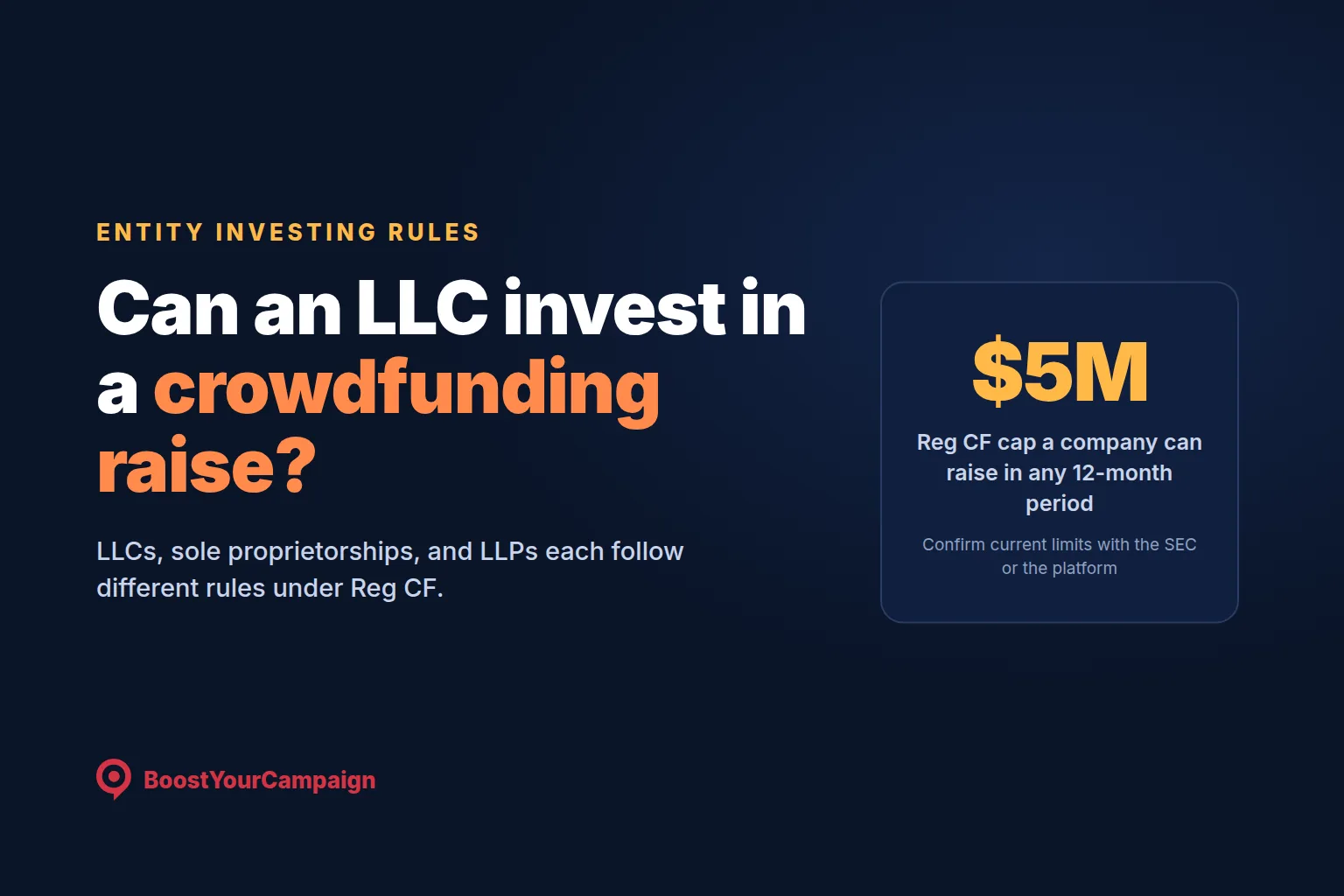
"Can I invest in a crowdfunding campaign" means two different things depending on which kind of crowdfunding you mean, and mixing them up is where most of the confusion about entities and paperwork starts. This guide separates backing a product on Kickstarter or Indiegogo from investing in a company's equity raise on a platform like Wefunder, StartEngine, or Republic, then walks through how an LLC, a sole proprietorship, an LLP, or a corporation fits into the equity side.
Yes, generally - an LLC, corporation, partnership, or trust can invest in an equity crowdfunding raise (a Regulation Crowdfunding offering on Wefunder, StartEngine, or Republic) through an entity investor account, once its formation documents and a controlling person are verified. A sole proprietorship isn't a separate legal entity, so a sole proprietor invests in their own name as an individual, and an LLP can typically invest as the partnership itself with authorization from the partners. Backing a rewards campaign on Kickstarter or Indiegogo is different - it's a purchase, not a security, so any person or business with a card can back a project with no entity paperwork and no limits. This is general information, not legal or tax advice - confirm your situation with the platform and your own attorney or accountant before committing entity funds.
- Two different things share the word "invest" - backing a rewards campaign is a purchase; buying equity in a Reg CF raise is a security.
- Entities can generally invest in equity raises - LLCs, corporations, partnerships, and trusts can open entity accounts on Wefunder, StartEngine, and Republic.
- Sole proprietorships aren't separate entities - the owner invests personally, in their own name, even if they think of it as investing "through the business."
- LLPs invest as the partnership - with authorization from the partners and a signature from someone with authority to bind it.
- Reg CF limits are generally personal - non-accredited investor limits are income and net-worth based and apply per person across all Reg CF raises in a rolling 12 months.
- Confirm the details before you commit - check current thresholds and document requirements with the platform and a professional first.
1) The two very different things people mean by "investing" in a crowdfunding campaign
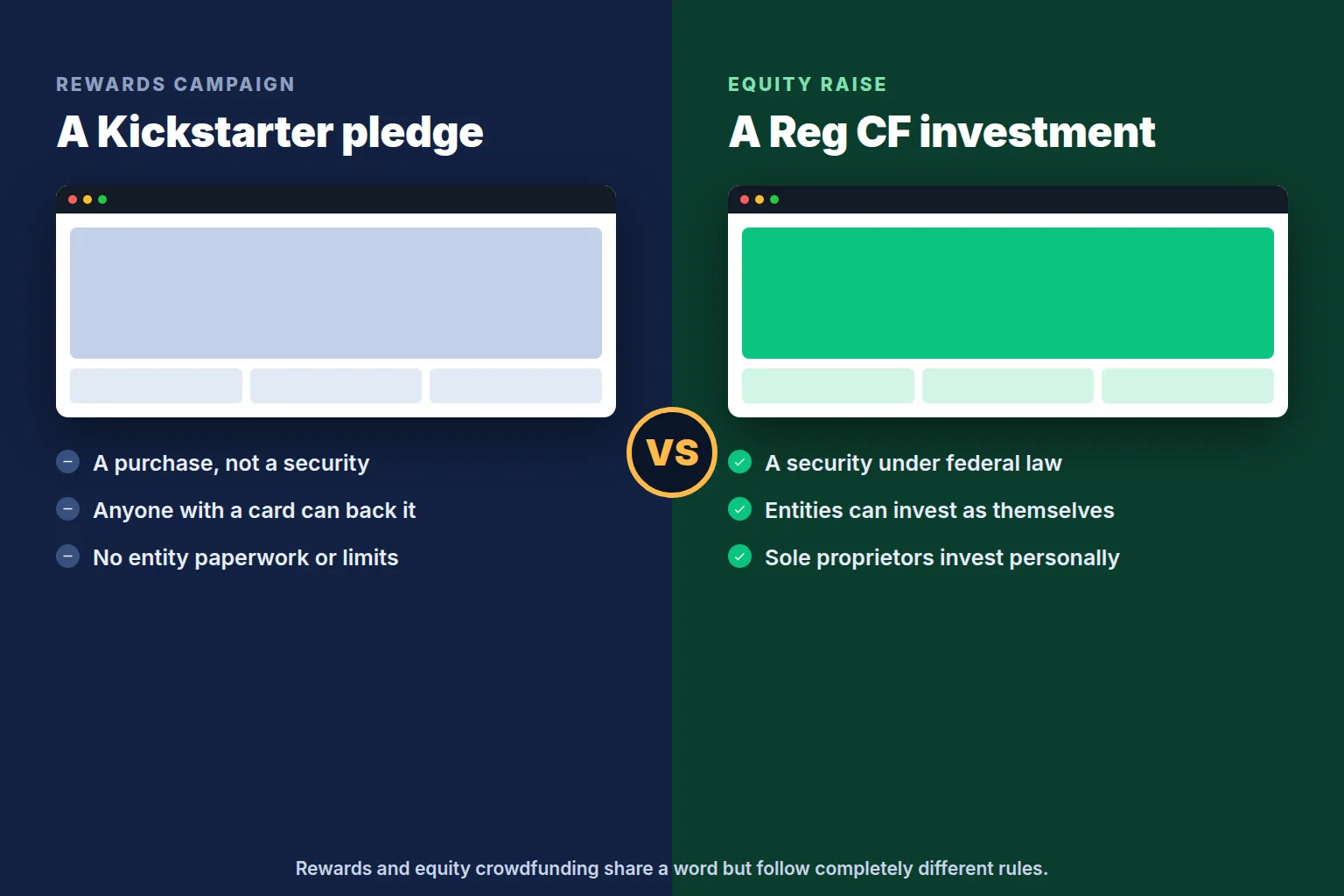
When someone backs a project on Kickstarter or Indiegogo, they're making a purchase. They pledge money now in exchange for a product later, a discount, or a thank-you reward, and no ownership stake or security changes hands. Anyone with a payment card can back a rewards campaign, including a business paying with a company card for a batch of units. There's no accreditation check, investment limit, or entity paperwork, because nothing being sold is a security under federal law.
Equity crowdfunding is different. On a platform like Wefunder, StartEngine, or Republic, a company sells actual securities - equity, a debt instrument, or a revenue-share note - under Regulation Crowdfunding (Reg CF), a federal exemption letting private companies raise from the public, including non-accredited investors, up to $5 million in any rolling 12-month period. Because a security is involved, the raise comes with disclosure obligations (a Form C filing with the SEC), identity verification, and dollar limits for non-accredited investors. Our equity vs rewards crowdfunding guide covers that split. The rest of this article covers the equity side, since that's where entity type changes what happens - a business backing a rewards campaign works like any other purchase.
2) Which entity types can invest in an equity crowdfunding raise, and in whose name
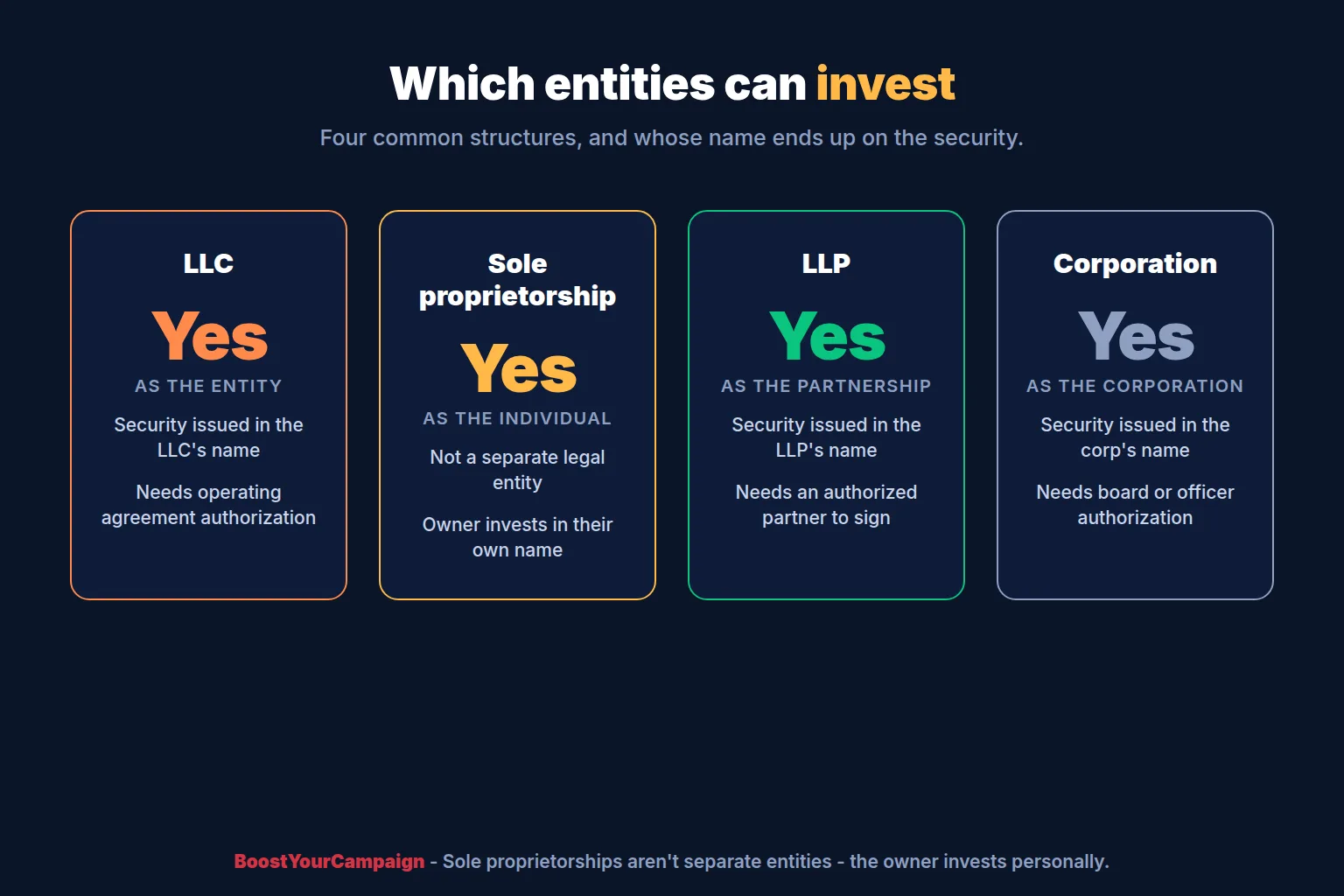
LLCs, corporations, general and limited partnerships, LLPs, and trusts can generally invest in a Reg CF raise as the entity itself, through a business or entity account type rather than a personal one, with the security issued in the entity's legal name rather than any individual member's name.
To open that account, platforms typically ask for the entity's formation document, an EIN, and identification of a controlling person - the manager, general partner, trustee, or officer with authority to commit the entity's funds, who goes through the same identity verification an individual investor would. Requirements vary by platform, so confirm the current list directly. Because the entity's name is on the security, tax reporting generally flows to the entity first, then out to its owners - a K-1 for a pass-through LLC, for example, rather than a 1099 to an individual member, one more reason to loop in an accountant before an entity commits money.
3) Investing personally as an LLC member vs. the LLC investing itself
This is the question behind "can I invest in a crowdfunding campaign if I'm a member of an LLC," and there are two separate paths. In the first, you invest personally, in your own name and funds - simple paperwork, counting toward your personal Reg CF limit if you're not accredited. Being a member of an LLC doesn't restrict this; the LLC itself just has no role in the transaction.
In the second, the LLC invests using company funds, and the LLC's name appears on the cap table. This generally needs authorization - operating agreement language that already covers it, or a specific approval from the members or manager - and an authorized person signs the subscription documents on the LLC's behalf. Investing personally is simpler but ties up personal money against your own limit; investing through the LLC keeps the position on the company's books but adds authorization and entity-level tax steps.
4) A sole proprietorship isn't a separate entity, so you invest as an individual
This is the question behind "can I invest in a crowdfunding campaign if I have a sole proprietorship," and the answer comes down to one fact: a sole proprietorship has no legal existence separate from its owner. There's no distinct entity to open an account, hold a security, or sign anything, because the business and the person are, legally speaking, the same thing. A DBA (doing-business-as) name doesn't change this - it's a registered trade name, not a separate legal entity.
So even if someone thinks of it as investing through their business, a platform treats that investment as personal. The security goes in the individual's own name, tied to their own Social Security number, and counts toward their personal Reg CF limit. If someone wants an investment to be entity-owned, the fix is forming an actual LLC or corporation first, then investing through it - a decision worth a conversation with an accountant or attorney.
5) LLPs: investing as the partnership
This is the question behind "can I invest in a crowdfunding campaign if I'm in an LLP." A limited liability partnership is a separate legal entity from its individual partners, and it generally follows a path similar to an LLC: an LLP can open an entity investor account and invest as the partnership itself, with the security issued in the partnership's name.
What the LLP needs first is authorization consistent with the partnership agreement - existing language covering this kind of investment, or a specific decision by the partners - plus a signature from a partner who has authority to bind the LLP. Platforms typically ask for the partnership agreement or LLP registration certificate, an EIN, and ID for the authorized signing partner, though the precise list is worth confirming with the platform directly. As with an LLC, investing as the LLP keeps the position on the partnership's own books, while a partner investing personally keeps it simple but counts against that partner's own limit.
6) Investment limits under Reg CF
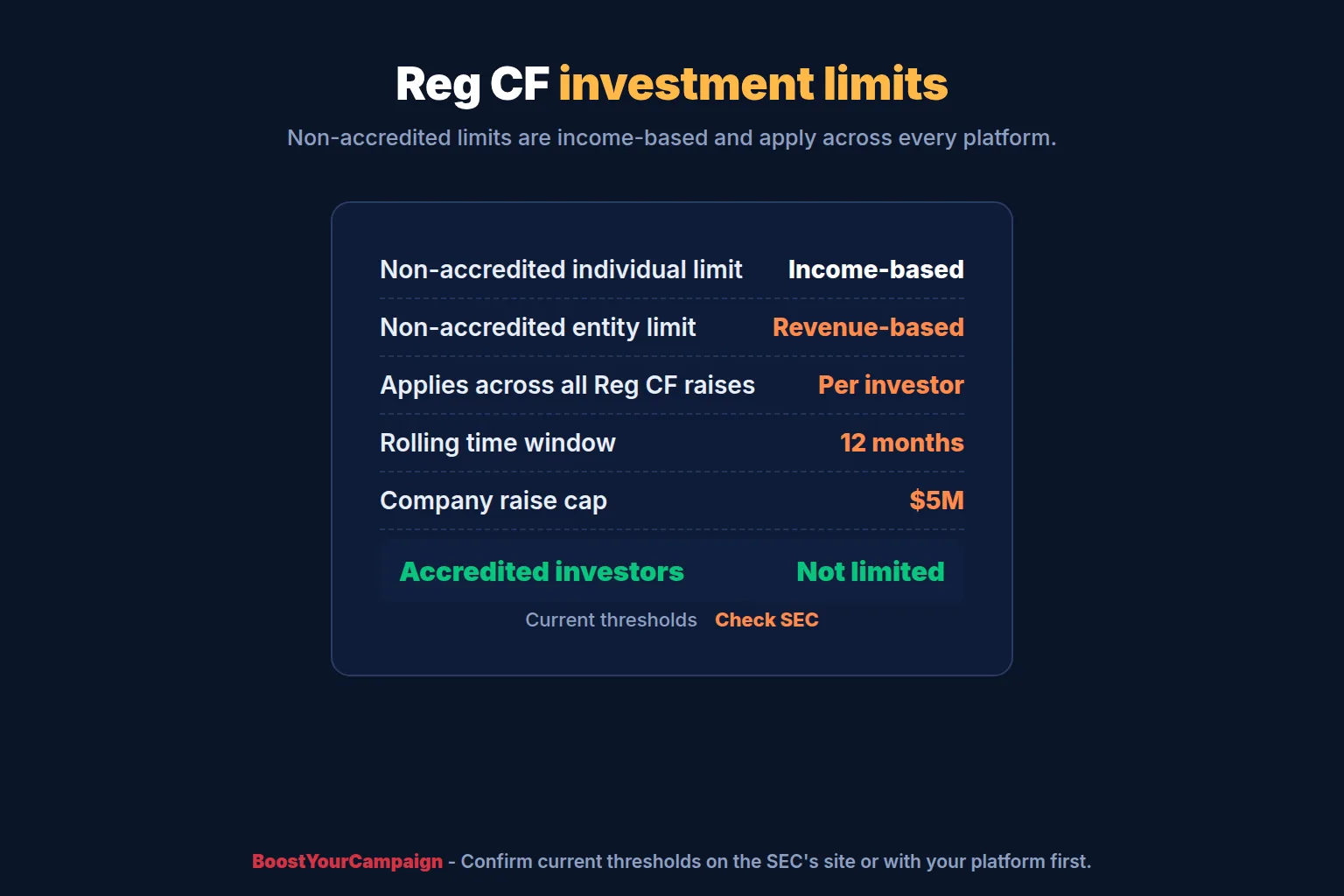
Reg CF sets investment limits for non-accredited investors over a rolling 12-month period, generally calculated from the investor's income and net worth rather than one flat figure for everyone. These thresholds have been adjusted before through regulatory action and could change again, so confirm current numbers on the SEC's site or with whichever platform you're using rather than relying on a figure from an outside article, including this one.
A detail that trips people up: the limit applies per person, across all Reg CF investments in that rolling 12-month window, not per platform - investing on Wefunder in January and StartEngine in June counts toward the same personal cap. Accredited investors generally aren't subject to these limits at all.
Whose limit applies when an entity invests as itself, rather than a person investing personally, is more platform- and situation-specific. Some entities can themselves qualify as accredited under their own criteria (certain trusts and entities with total assets above a stated threshold, for example), which can affect whether the individual limits apply at all - confirm this with the platform and a securities attorney before an entity commits a specific amount.
7) Entity-level considerations once you've decided to invest as an entity
Authorization comes first - the operating agreement, bylaws, or partnership agreement should already cover this kind of investment, or the members, board, or partners should formally approve it before funds move. Tax reporting generally runs through the entity first, then out to its owners under the entity's own filing (a K-1, in most pass-through structures), which is worth planning with an accountant before the investment closes. Reg CF securities also carry a resale restriction of roughly one year from purchase in most cases, applying the same way to an individual or an entity holder, and the underlying risk doesn't change with structure - an early-stage company's equity can lose its entire value, so this is illiquid, high-risk capital, not working capital that might be needed back on short notice.
8) How founders should think about entity investors
From the founder's side of a raise, entity investors are worth planning for specifically. An LLC, a family investment vehicle, or an investment club pooling money through a partnership often writes a larger check than a typical individual retail backer, since it's often deploying pooled or company capital rather than one person's savings. A raise that's easy for individuals to sign up for but awkward for an entity to get through risks losing bigger checks to friction at the wrong moment. On the cap table, entity investors show up under the entity's own name, not the members' or partners' names behind it - it's worth asking each entity investor for a designated contact person, and flagging accreditation status early, since it affects how much the entity can commit.
9) Practical steps to invest as an entity
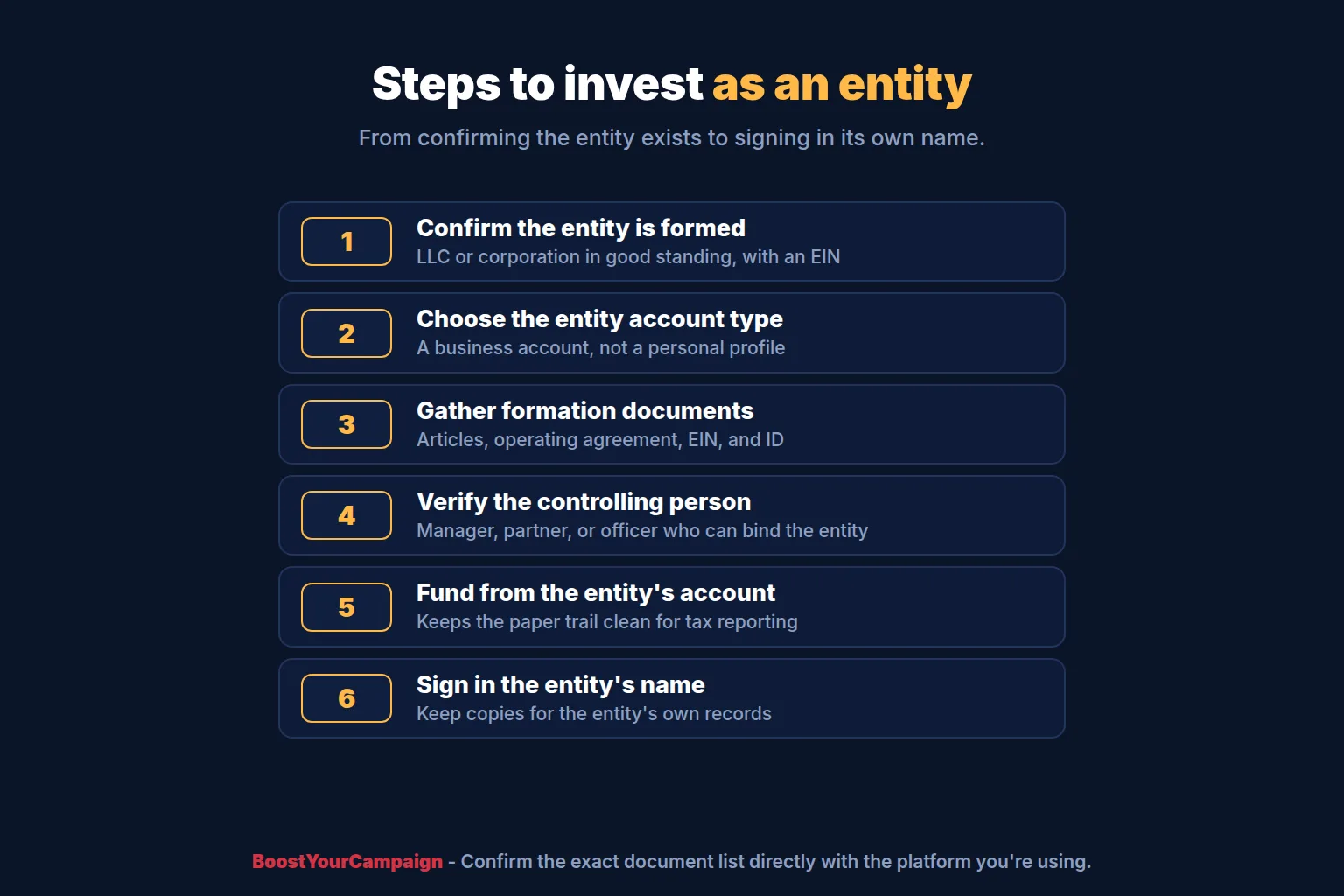
First, confirm the entity actually exists and is in good standing - formed, with an EIN, not a sole proprietorship or an unregistered idea for a company. Second, choose the business or entity account type on the platform rather than starting a personal profile. Third, gather the documents the platform will likely request: the formation document, EIN confirmation, operating agreement or bylaws showing who can act for the entity, and government ID for the controlling person.
Fourth, identify and verify that controlling person - whoever can legally commit the entity's funds and will go through the platform's identity check. Fifth, fund the investment from the entity's own bank account, not a personal one, so the paper trail stays clean. Sixth, sign the subscription agreement in the entity's name and keep copies for the entity's own records and its accountant.
| Entity type | Can invest | In whose name | Typical documents | Notes |
|---|---|---|---|---|
| Individual | Yes | The individual's own name | Government ID, SSN or personal tax ID | Counts toward personal Reg CF limit if non-accredited |
| LLC | Yes, as the LLC | The LLC's legal name | Articles of organization, operating agreement, EIN, controlling person ID | Needs authorization from members or the manager |
| Sole proprietorship | Yes, but as the owner personally | The individual owner's name | Same as individual - a DBA doesn't create a separate account | Not a distinct legal entity, so there's nothing separate to invest through |
| LLP | Yes, as the partnership | The LLP's legal name | Partnership agreement or certificate, EIN, authorized partner ID | Needs authorization under the partnership agreement |
| Corporation | Yes, as the corporation | The corporation's legal name | Articles of incorporation, bylaws, EIN, officer ID or board resolution | Needs board or officer authorization consistent with the bylaws |
How BoostYourCampaign fits
BoostYourCampaign runs equity crowdfunding marketing (/services/equity-crowdfunding) alongside its core rewards crowdfunding services, and part of that work is helping founders build an investor pipeline that holds up once it's live - one that lets entity investors, and individuals, get through onboarding without friction. A raise page and follow-up sequence built only for a single retail investor tends to lose the larger checks that come from LLCs, family offices, and investment clubs simply because the process wasn't built with them in mind.
The agency runs a skin-in-the-game ad model, investing its own money alongside a client's ad budget with fixed fees rather than a percentage-of-raise commission. BYC has been active since 2010 across 4,600+ campaigns with $734M+ raised and a 4.9/5 score across 300+ verified reviews. For founders comparing where to run a raise once traction is in place, see our Wefunder vs StartEngine vs Republic comparison, and for the full range of what BYC runs, see our services page.
Before you invest as an entity: a quick checklist
| Question | Why it matters |
|---|---|
| Is the entity actually formed and in good standing? | A sole proprietorship or an unformed idea has no separate legal existence to invest as. |
| Does your operating agreement, bylaws, or partnership agreement authorize this investment? | Avoids a manager, officer, or partner acting outside their actual authority. |
| Do you know who the platform will treat as the controlling person? | That person's identity verification is required before the entity account is approved. |
| Have you confirmed current Reg CF limits and whether they apply to you personally or to the entity? | Thresholds have changed before and vary by accreditation status. |
| Are you funding the investment from the entity's own account? | Keeps the paper trail clean for the entity's own tax reporting. |
| Have you talked with an accountant about how this shows up on the entity's return? | Reporting differs by entity type and affects each owner's own filing. |
If you're a founder weighing where to run a raise beyond the three platforms above, our crowdfunding platforms for startups guide covers the rewards side too, and our Kickstarter vs Indiegogo guide is a useful starting point if you haven't decided whether a rewards campaign should come before an equity raise. Our equity vs rewards crowdfunding guide covers that sequencing question directly.
Frequently Asked Questions
Can I invest in a crowdfunding campaign if I'm a member of an LLC?
Yes, in two ways. You can invest personally, which is simple and counts toward your own Reg CF limit, or the LLC can invest as the entity itself, using company funds and appearing on the cap table under the LLC's name, provided the operating agreement or the members authorize it and an authorized signer submits the documents.
Can I invest in a crowdfunding campaign if I have a sole proprietorship?
Yes, but as an individual, not as a separate business entity. A sole proprietorship has no legal existence apart from its owner, so there's no separate account to open - the security is issued in your own name and counts toward your personal Reg CF limit.
Can I invest in a crowdfunding campaign if I'm in an LLP?
Yes, generally. An LLP is a separate legal entity and can typically invest as the partnership, with the security issued in the LLP's name, once the partnership agreement authorizes it and an authorized partner signs on the partnership's behalf.
Can a business back a Kickstarter campaign?
Yes. Backing a rewards campaign is a purchase, not a security, so any business or individual with a payment card can back a project - no entity paperwork, accreditation requirement, or investment limit involved.
Can an LLC invest on Wefunder?
Yes. Wefunder, along with StartEngine and Republic, offers a business or entity account type. An LLC can open that account, submit its formation documents and controlling person's ID, and invest as the entity, with the security issued in the LLC's name.
Is there a limit on how much I can invest in Reg CF?
For non-accredited individual investors, yes - a limit based on income and net worth over a rolling 12-month period, applied per person across every Reg CF raise in that window, not per platform. Accredited investors generally aren't subject to it. Confirm current thresholds on the SEC's site or with your platform, since they've changed before.
What documents does an LLC need to invest in an equity crowdfunding raise?
Most platforms ask for the LLC's articles of organization, its operating agreement (or the relevant authorization language), an EIN, and ID for the controlling person signing on the LLC's behalf. The exact list varies by platform, so confirm it directly first.
Is this legal or tax advice?
No. This article is general information about how entity investing typically works on equity crowdfunding platforms, not legal or tax advice for your situation. Confirm document requirements, current limits, and tax treatment with the platform and your own attorney or accountant before an entity commits funds.
If you're a founder building an investor pipeline that needs to work for entity investors as well as individuals, reach out through /contact and we'll help map out the onboarding flow and the raise timeline together.
Want results like these for your campaign?
We've helped 4,600+ creators raise over $734M. Let's pressure-test your launch plan and find the highest-leverage fixes before you go live.
Talk to an expert →Get the free 87-step launch checklist
The exact pre-launch, live-campaign and fulfillment steps we use across 4,600+ launches. Free PDF, emailed instantly.
You're in - check your inbox. Open the checklist now ->