Weighing a Kickstarter or Indiegogo launch as a German, Austrian, or Swiss brand? Talk with BoostYourCampaign about your product, your platform choice, and your fulfillment plan.
German and wider DACH brands start a Kickstarter or Indiegogo launch with a real trust asset: a reputation for precision and engineering quality that Western backers already associate with the region, particularly in tools, optics, and technical hardware. The practical questions are different from that reputation, though. Should the campaign run on Kickstarter or Indiegogo for global reach, or start on Startnext for a domestic audience first? Should the page be written in English or German? And because most DACH brands are already inside the EU's customs area, the harder fulfillment question usually isn't Europe, it's the US side of the audience. This guide covers those decisions directly.
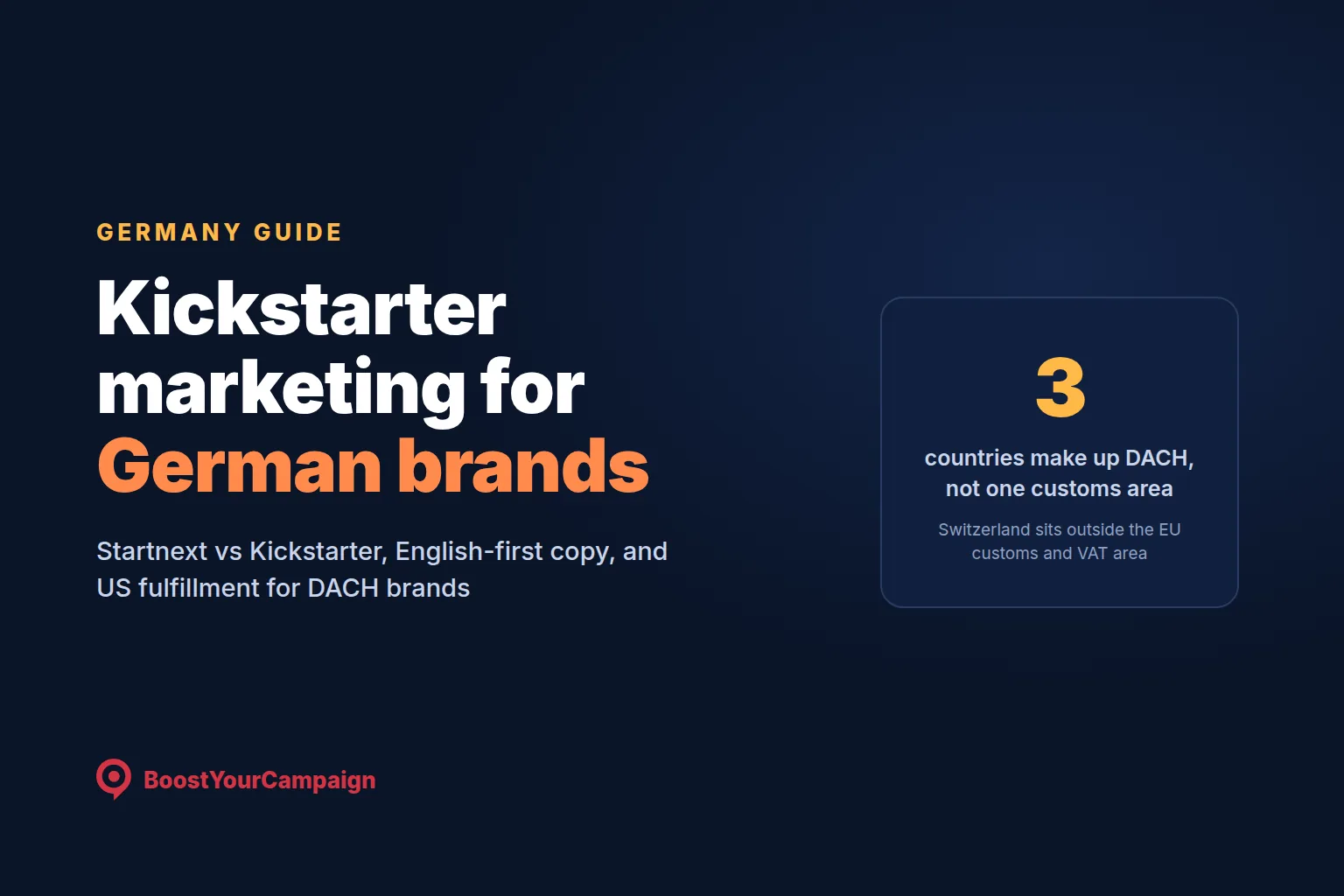
- DACH is three countries, not one market - Germany and Austria share the euro and EU membership; Switzerland uses CHF and sits outside the EU customs area entirely.
- Engineering reputation is a real asset, earned by category - it does the most work in tools, optics, and technical hardware, less in categories without an obvious precision angle.
- Startnext reaches DACH; Kickstarter and Indiegogo reach the world - the platform choice depends on whether the goal is a domestic community or global backers.
- English-first copy, German-responsive updates - the campaign page should be built for reach, with DACH backers served through localized FAQ and comment responses.
- The EU side of fulfillment is already solved by geography - a DACH-based brand ships to EU backers as a domestic EU shipment; the real fulfillment question is the US.
- GDPR shapes how the pre-launch list gets built - it's a real constraint on ad and email tooling, not a blocker to running a campaign.
1) DACH is three eligible countries, not one market
Germany, Austria, and Switzerland are all eligible creator countries on Kickstarter, and the three are commonly grouped together as "DACH" because they share German as a working language and a broadly similar business culture. That grouping is useful shorthand, but it hides a real structural difference worth planning around before launch.
Germany and Austria are both EU members using the euro, which puts them inside the EU's single customs and VAT area along with every other EU country. Switzerland is neither in the EU nor in the eurozone. A Swiss creator's payouts run in CHF, and goods moving between Switzerland and the EU, in either direction, cross an actual customs border with its own VAT and duty treatment, similar in structure to what a UK creator now deals with post-Brexit. A campaign built around "DACH" as a single audience needs to treat the Swiss backer segment as its own case, not fold it into the EU logistics plan by assumption.
2) The engineering reputation is a real asset, earned by category
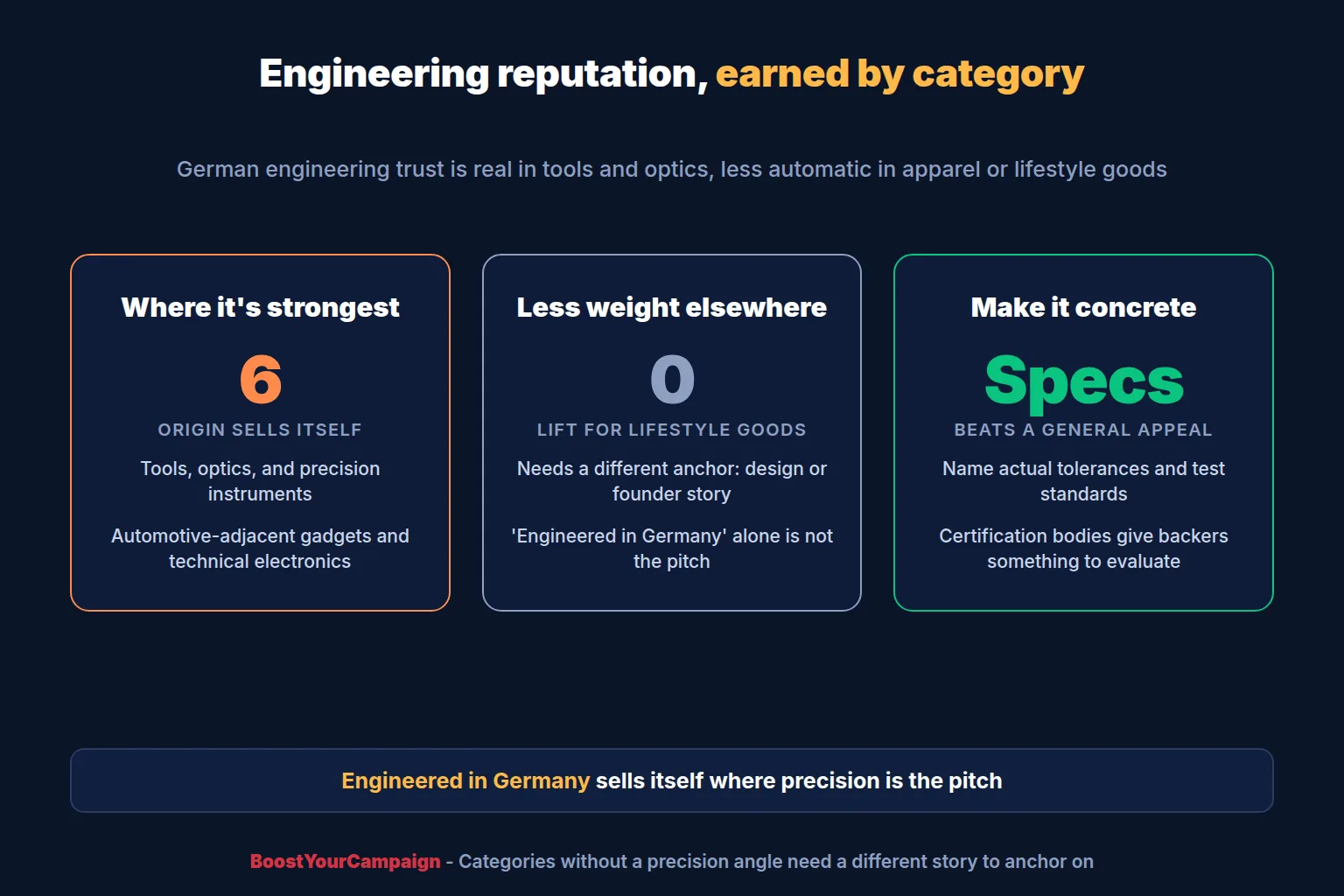
Western backers hold a specific, positive association with German engineering: tight tolerances, mechanical reliability, and products that are built to work correctly rather than simply look good. That association is strongest in categories where precision is the actual selling point: power tools, optics, precision instruments, automotive-adjacent gadgets, kitchen equipment with real mechanical or thermal engineering behind it, and technical electronics. A campaign in one of these categories can lead with country of origin as a credibility signal without having to build that trust from a standing start.
The association carries less weight in categories without an obvious engineering or precision angle, apparel or general lifestyle goods among them. Those campaigns can still succeed as DACH-origin products, but the pitch needs a different anchor, design philosophy, a specific material story, or a founder narrative, since "engineered in Germany" doesn't do independent work for a product where engineering isn't the point.
Where the category fits, it's worth being specific rather than relying on the country association alone. Naming actual tolerances, test standards, or certification bodies gives backers something concrete to evaluate, and it reads as more credible than a general appeal to national reputation.
3) Startnext or Kickstarter: domestic community versus global reach
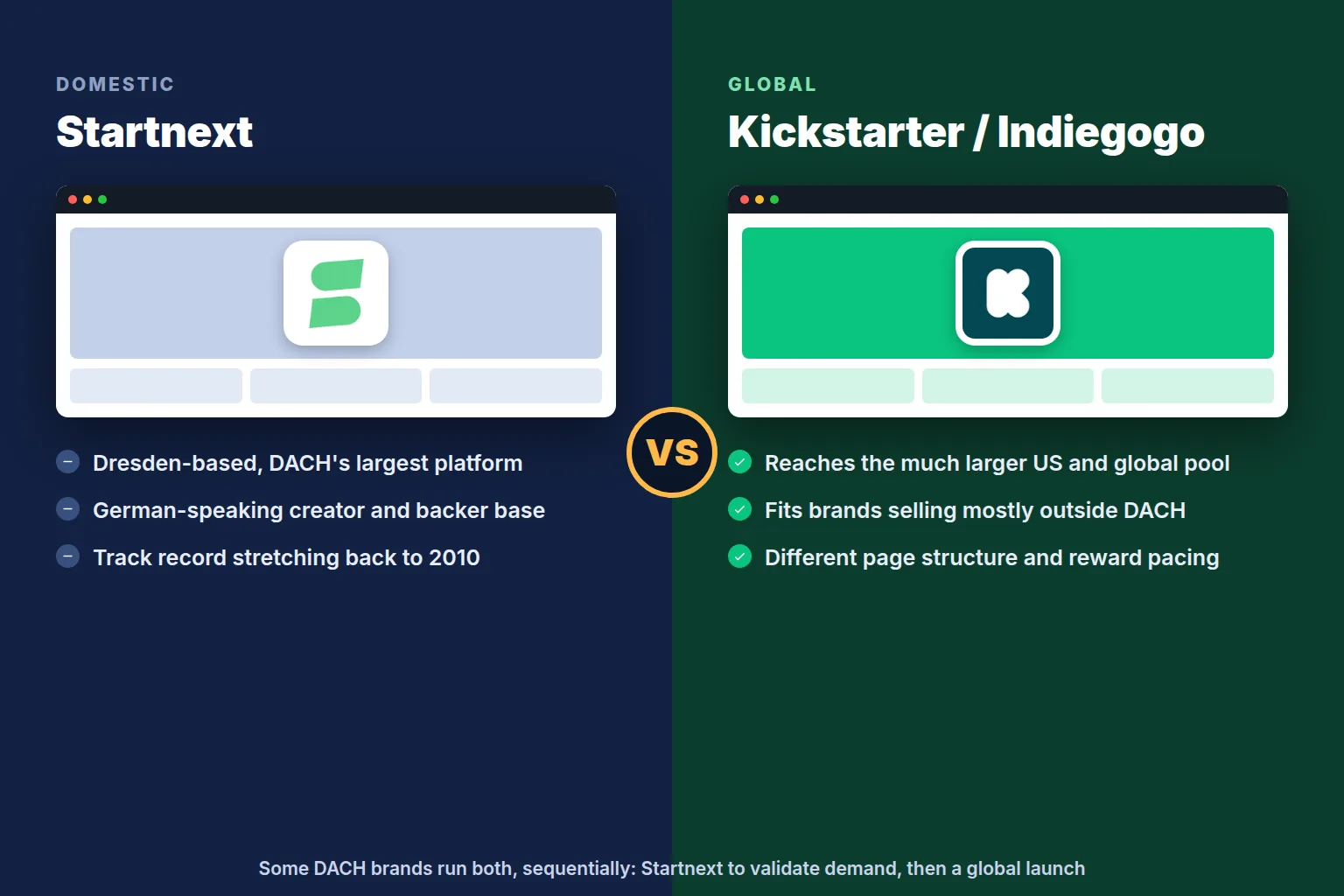
Startnext, based in Dresden, is the largest reward-based crowdfunding platform for the DACH region, with a community built specifically around German-speaking creators and backers and a track record stretching back to 2010. It's a genuinely useful option for a brand whose first priority is a domestic launch, local press coverage, or building initial traction with a German-speaking audience before going further.
Kickstarter and Indiegogo solve a different problem: reaching the much larger pool of US and international backers who don't use Startnext at all. For a hardware or consumer product brand whose addressable market is mostly outside DACH, going straight to Kickstarter or Indiegogo usually makes more sense than starting domestically and translating a Startnext campaign later, since the two platforms reward different page structures, pacing, and reward mechanics.
Some DACH brands run both, sequentially rather than simultaneously, using a Startnext campaign to validate demand and build a domestic following before a larger Kickstarter or Indiegogo launch aimed at the US and broader international audience. That approach adds real planning overhead and isn't right for every brand, but it's worth considering deliberately rather than defaulting to one platform without weighing what each actually reaches.
4) English-first copy, German-responsive updates
For a Kickstarter or Indiegogo campaign targeting a global audience, the main page should be written in English. Most backers, including the majority of DACH backers active on these platforms, read English campaign pages without friction, and English gives the campaign access to the full US and international audience rather than limiting reach to German speakers.
That doesn't mean DACH backers should be treated as an afterthought. Comments and questions from German-speaking backers are worth answering in German when that's the language they used, and campaign updates can include a German summary or a fully bilingual version for backers who prefer it. This is a lighter lift than translating the entire campaign page, and it signals directly to DACH backers that the campaign is paying attention to them specifically, not just running an English-only operation that happens to accept their money.
The FAQ section is a good place to invest this effort specifically, since it's where DACH backers are most likely to ask detailed, technical questions, covered more in the documentation section below, and a thorough German-language response builds exactly the kind of trust this audience responds to.
5) The EU fulfillment advantage, and where it runs out: the US side
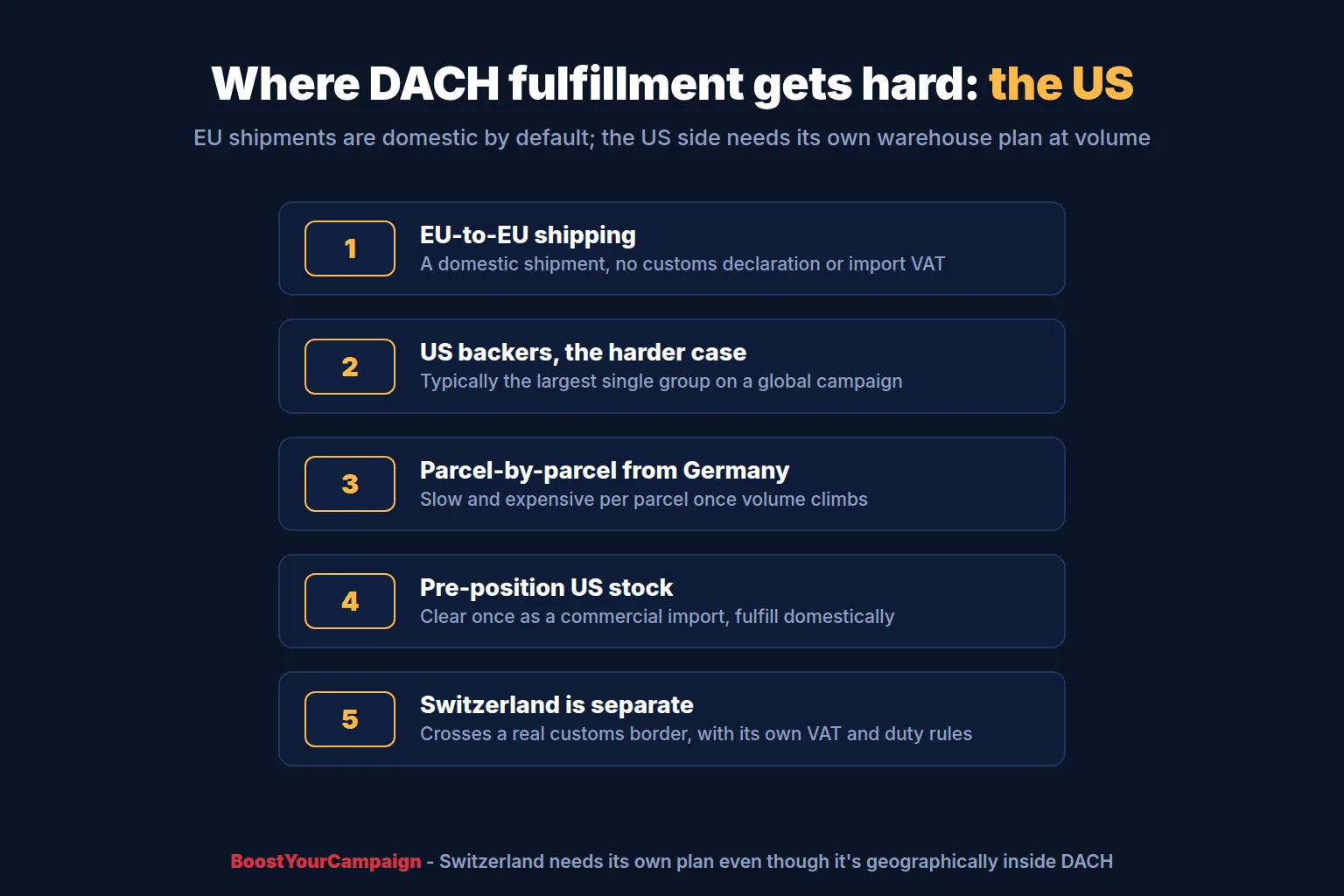
A DACH-based brand shipping to backers across the EU already has the advantage that creators in the UK, Australia, or Japan spend real effort trying to build: goods moving from Germany or Austria to a backer in France, Italy, or Poland are a domestic EU shipment, not an international one, with no customs declaration or import VAT event at the border. That's a genuine structural head start covered from the other direction in our guide to shipping Kickstarter rewards to Europe, written for non-EU creators trying to replicate exactly what a DACH creator already has by default.
The harder question for a DACH brand is the US side, since the US is typically the largest single backer group on a global-facing campaign and shipping individually from Germany to hundreds or thousands of US addresses is slow and expensive per parcel once volume climbs. The fix mirrors what UK and Australian creators already do in reverse: pre-position bulk stock in a US warehouse, clear it once as a commercial import, then fulfill individual US orders domestically, the model covered in more depth in our fulfillment companies guide.
Swiss backers need their own line item in this plan even though they're geographically inside DACH, since shipments from an EU warehouse into Switzerland cross the same kind of customs border a UK or US shipment would, with Swiss VAT and duty rules applying rather than EU ones.
6) GDPR and pre-launch list building: real friction, not a blocker
Building a pre-launch email list, typically the single highest-leverage activity before a campaign goes live, works differently for a DACH-based brand than it does for a US-based one. GDPR requires explicit, informed consent before someone's data enters a marketing list, no default opt-in, and no pre-checked consent boxes, which changes how a lead-generation ad or landing page has to be built for DACH-targeted traffic specifically compared to what many US-first marketing tools assume by default.
This isn't a reason to skip pre-launch list building. It's a reason to make sure the ad platform, landing page, and email tool in use are actually configured for GDPR-compliant consent collection, particularly for the portion of the list coming from German, Austrian, or other EU ad traffic. Campaigns targeting mostly US backers with DACH as a secondary audience have an easier version of this problem, since the bulk of the list-building activity happens under less restrictive rules to begin with, but any DACH-facing ad spend still needs the consent flow handled correctly.
7) DACH backers read the spec sheet: how technical the page can be
A pattern that shows up consistently with DACH backers, and with German-speaking backers on Kickstarter more broadly, is a genuine appetite for detailed technical documentation that a US-first campaign page often skips in favor of a punchier, benefit-led pitch. Specific tolerances, material specifications, test results, and engineering diagrams that might feel like too much detail for a general US audience tend to land well with this segment specifically.
The practical answer isn't to make the entire campaign page more technical, since that risks losing the broader US and international audience that responds better to a benefit-first opening. It's to give the detail-oriented segment of the audience, DACH backers prominently among them, a dedicated place to find it: a technical specifications section, a downloadable spec sheet, or a thorough FAQ that goes deeper than the main pitch. Backers who want that level of detail will find it and read all of it; backers who don't can skip straight past it without the main page ever feeling overloaded.
8) EUR pricing, and the Swiss wrinkle
A Kickstarter campaign from Germany or Austria runs in EUR by default, and the same currency-conversion consideration that applies to CAD or GBP-priced campaigns applies here: a reward priced cleanly in euros can convert to an odd, specific number in USD, which is the currency most backers are actually mentally pricing against given the US typically makes up the largest backer segment. Stating an approximate USD value directly in the reward description, rather than relying on the platform's built-in conversion note, removes a small point of friction for that audience.
Swiss creators face a further wrinkle, since a campaign run from a Swiss entity may involve CHF rather than EUR, adding a second currency conversion layer for both EU and US backers to mentally process. There's no way to fully eliminate that friction, but naming both approximate values, EUR and USD, directly in reward copy keeps it from becoming a real barrier to pledging.
9) Video that proves engineering claims instead of asserting them
Campaign video for a DACH hardware or precision product performs best when it shows the engineering rather than describing it. A test rig putting a product through a stress test, a slow-motion shot of a mechanism operating, or a measurement device confirming a stated tolerance does more to support an engineering-quality claim than narration alone, because it gives backers something verifiable to watch rather than a claim to take on trust.
This is a different visual approach from the workshop and craftsmanship footage that tends to work well for brands leaning on artisanal or material-quality positioning. A DACH engineering story is usually better served by demonstration and measurement than by atmosphere, and campaigns that invest in this kind of footage specifically, rather than defaulting to generic product beauty shots, tend to convert better with an audience that already expects a certain level of technical proof.
How BoostYourCampaign fits
BoostYourCampaign runs campaign marketing, video production, and fulfillment as a single done-for-you engagement, with owned production studios and owned fulfillment warehouses in both the US and EU. For a DACH-based brand, that means the US fulfillment gap described above has a direct answer already in place, and campaign video, including the demonstration and test-rig footage that works well for engineering-led products, is handled as part of the same engagement rather than sourced separately.
The agency has operated since 2010, working across more than 4,600 campaigns that have raised over $734 million combined, with a 4.9 out of 5 rating across more than 300 verified reviews on the reviews page. Its ad model puts BYC's own money into the campaign budget alongside the client's spend, with fixed fees rather than a share of what the campaign raises, and it holds Indiegogo Approved Agency status along with Google Premier Partner, Facebook Marketing Partner, official Shopify Partner, and Amazon Partner recognitions.
BYC also offers in-house MVP development for products still in progress (/services/mvp-development) and has helped clients land retail introductions to major retailers including Best Buy. Client products have gone on to Shark Tank coverage documented on the press page, and Kevin O'Leary has recorded a video testimonial about the agency, also on the reviews page. See our guide for Japanese brands and our guide for Chinese brands for how similar reputation-driven positioning plays out in other manufacturing-strong countries, and this pricing guide for cost context.
Before you launch from Germany, Austria, or Switzerland: a quick checklist
| Question | Why it matters |
|---|---|
| Is the goal a domestic launch on Startnext, a global one on Kickstarter or Indiegogo, or both? | Each reaches a genuinely different audience with different page and reward expectations. |
| Is the main page in English, with German-language FAQ and update support? | English maximizes reach; a German-responsive layer keeps DACH backers well served without a full translation. |
| Is US fulfillment planned as direct-ship or pre-positioned warehouse stock? | The EU side of fulfillment is largely solved by geography; the US side usually isn't. |
| Is Switzerland treated as its own customs case, separate from the EU plan? | Switzerland sits outside the EU customs and VAT area despite being part of DACH. |
| Is pre-launch ad and list-building traffic set up for GDPR-compliant consent? | Default opt-in and pre-checked consent boxes aren't compliant for DACH-targeted traffic. |
| Does the page offer a technical spec section for detail-oriented backers? | DACH backers respond well to detailed documentation that a purely benefit-led page often skips. |
The US-side import rules that apply once stock is pre-positioned are covered in customs documentation for crowdfunding shipments, and the fulfillment process itself in the Kickstarter fulfillment guide.
Frequently Asked Questions
Can a brand based in Germany, Austria, or Switzerland launch directly on Kickstarter?
Yes. All three countries are eligible creator countries on Kickstarter, subject to the platform's standard identity and bank account verification requirements for each country.
Is Startnext better than Kickstarter for a DACH brand?
They serve different goals. Startnext reaches a German-speaking domestic audience efficiently and has a strong track record in that community. Kickstarter and Indiegogo reach the much larger US and international backer pool, which matters more for a brand whose addressable market extends beyond DACH.
Does the campaign page need to be written in German?
Generally no, for a campaign targeting a global audience. English-first copy reaches the largest addressable backer pool, including most DACH backers active on Kickstarter and Indiegogo. Responding to comments and questions in German, and offering a German summary of major updates, keeps DACH backers well served without a full page translation.
Does Switzerland count as part of the EU fulfillment advantage?
No. Switzerland is not an EU member and sits outside the EU customs and VAT area, so shipments between an EU warehouse and Swiss backers cross an actual customs border, similar in structure to shipments into the UK post-Brexit.
What's the biggest fulfillment gap for a DACH-based brand?
Usually the US side. EU-to-EU fulfillment is already a domestic shipment for a DACH-based brand, but the US, typically the largest single backer group, still needs a plan, usually a pre-positioned US warehouse once backer volume justifies bulk freight.
How does GDPR affect pre-launch marketing for a DACH-based campaign?
It requires explicit, informed consent before adding someone to a marketing list, with no default opt-in. Ad platforms, landing pages, and email tools used for DACH-targeted traffic need to be configured for that consent flow specifically, though this doesn't block pre-launch list building generally.
How does Indiegogo's Late Pledge phase work for DACH creators?
Late Pledge, formerly called InDemand, extends the ordering window past the main campaign's close. It functions the same way regardless of where the creator is based, and it pairs naturally with a US warehouse leg already set up for the main campaign, since the extra orders can ship from the same stock.
If you want a direct read on whether your product and timeline are ready for a global launch, reach out through /contact.
Want results like these for your campaign?
We've helped 4,600+ creators raise over $734M. Let's pressure-test your launch plan and find the highest-leverage fixes before you go live.
Book a free strategy call →Get the free 87-step launch checklist
The exact pre-launch, live-campaign and fulfillment steps we use across 4,600+ launches. Free PDF, emailed instantly.
You're in - check your inbox. Open the checklist now ->