Kickstarter collects the pledge and processes the payment, but delivering the physical reward is entirely the creator's job. Once a campaign funds, backers stop caring about the pitch video and start caring about one question: where is my reward and when does it arrive. Fulfillment is the part of the process that decides whether a successful raise turns into a five-star reputation or a comment section full of "where is my stuff" posts. If you want the cost and timeline modeled correctly before you make a delivery promise, talk with BoostYourCampaign about your reward mix and backer map.
Kickstarter fulfillment is the sequence that moves a reward from the factory to a backer's door after a campaign closes: a pledge manager survey locks final addresses and add-ons, the manufacturer finishes production, finished goods travel by freight to one or more regional warehouses, and a fulfillment team picks, packs, and ships each order with tracking. Per-unit cost typically runs from a few dollars for a light item shipped domestically to $25-50 or more for a heavy item shipped internationally, once pick/pack fees, packaging, and postage are added together. Creators who split inventory between a US and an EU warehouse instead of shipping everything from one country cut that international cost sharply and avoid most customs delays. Budget 2-3 months of buffer between "production done" and "last backer delivered" - that gap is what keeps a delivery promise realistic.
- Fulfillment starts with data, not boxes - a pledge manager survey has to lock addresses and reward selections before anything ships.
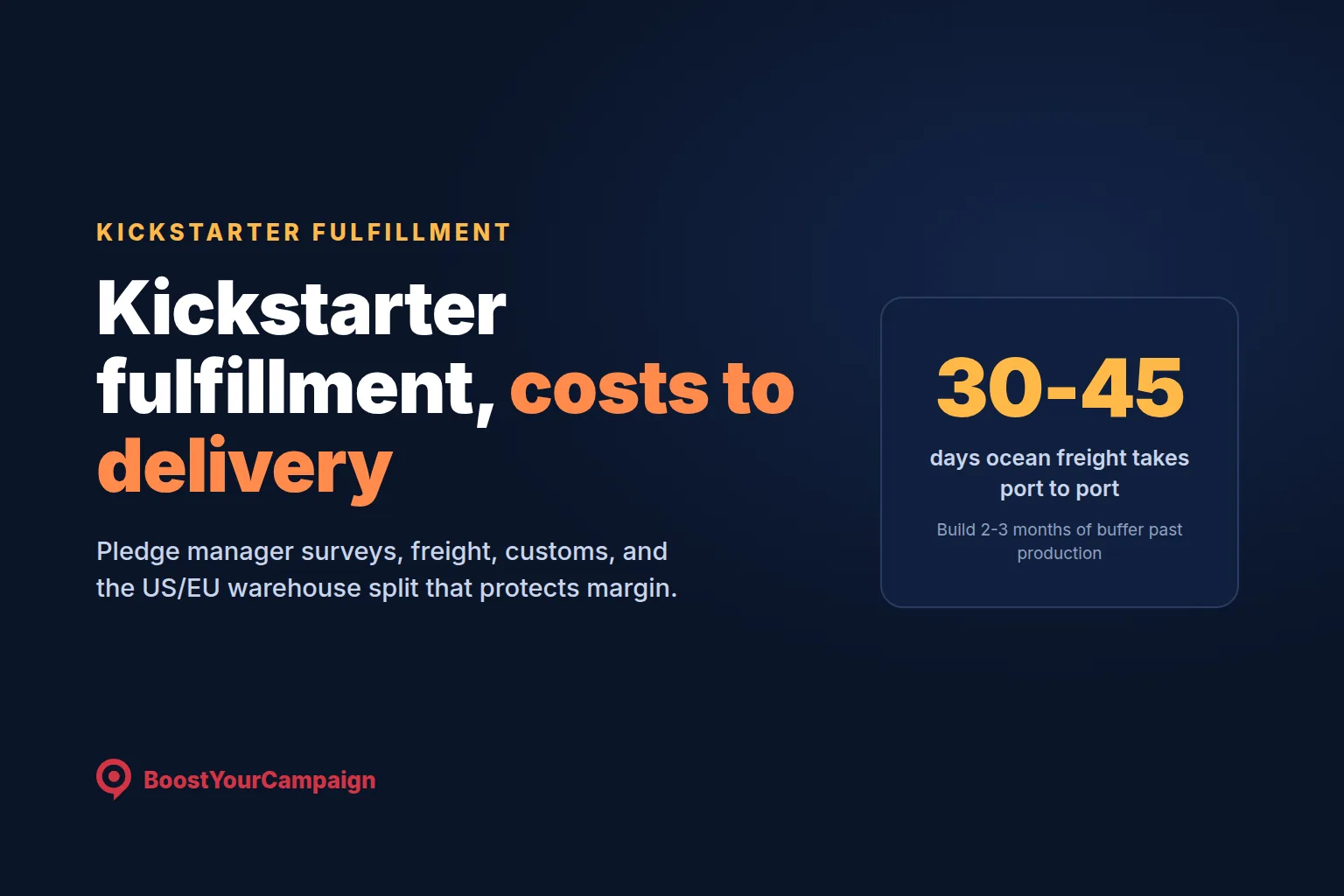
- Freight from the factory is its own leg - ocean freight typically runs 30-45 days port to port, and air freight is much faster but costs several times more.
- Where inventory sits changes the math - a single US warehouse turns every EU order into an expensive international shipment.
- DDP and DDU decide who pays duties - get this wrong and a backer opens tracking to a customs bill they didn't expect.
- The US de minimis exemption ended in 2025 - nearly every US-bound parcel now goes through a formal entry process, not a duty-free pass.
- Build in 2-3 months of buffer - production delays, freight transit, and customs holds are the rule, not the exception.
1) How Kickstarter fulfillment actually works, start to finish
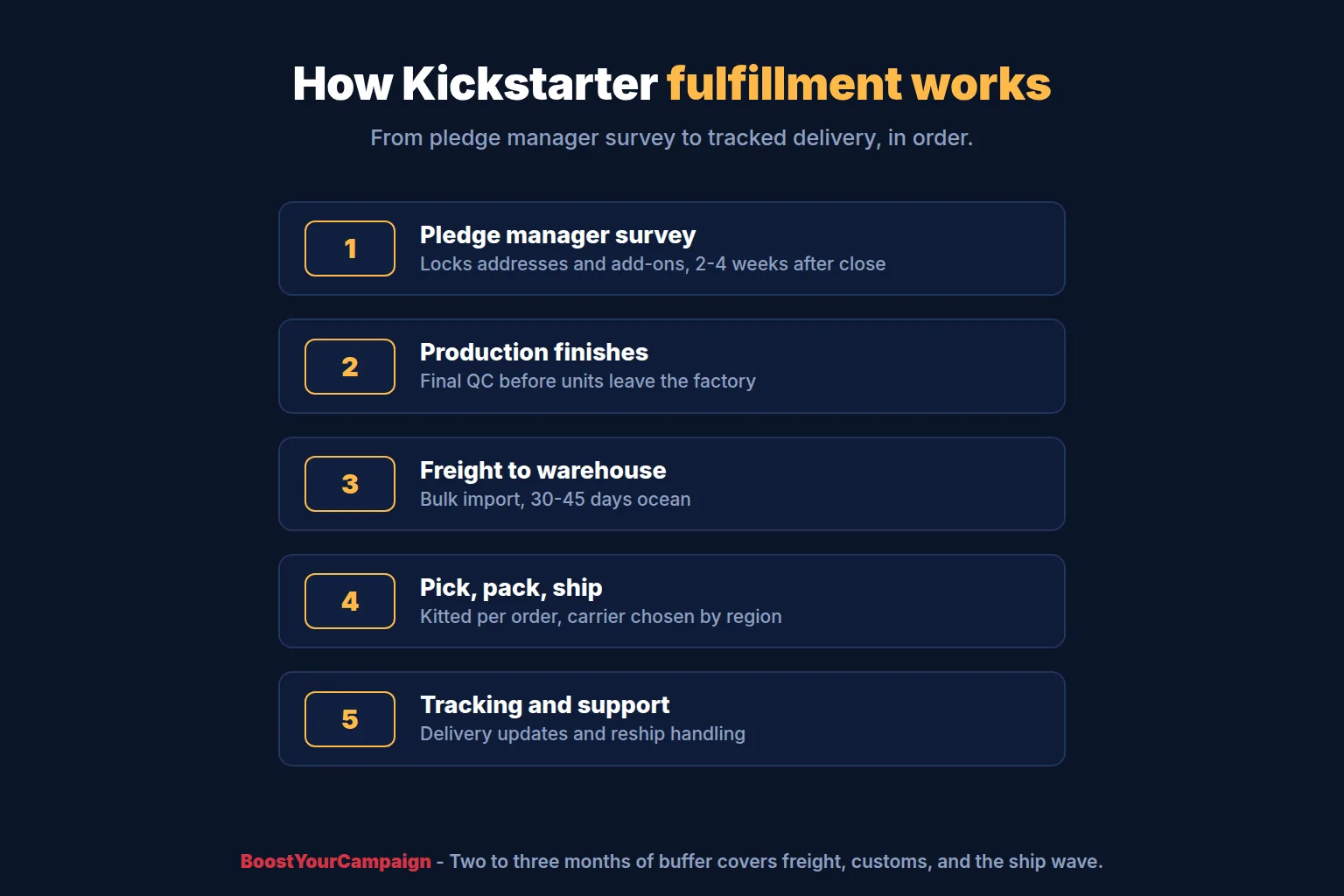
The process has a fixed order and skipping a step almost always costs more than doing it properly the first time. It starts with a pledge manager survey, typically opened 2-4 weeks after the campaign closes, using a tool like BackerKit or a similar platform. The survey confirms each backer's shipping address, locks reward tier and add-on selections, and calculates a shipping fee by region and weight class. This is the single most important data-quality step in the whole process - an address typo here becomes a lost or returned parcel four months later, once postage has already been spent.
While the survey window runs, production is finishing at the factory: final assembly, quality control, and packaging into the case packs that will travel by freight. Once units clear QC, they move to freight - a bulk shipment to one or more regional warehouses, cleared through customs as a single commercial import rather than thousands of individual backer parcels. That's a meaningfully simpler customs event than clearing every parcel separately, and it's one of the reasons warehouse-based fulfillment beats shipping straight from the factory for anything beyond a very small, geographically concentrated backer list.
At the warehouse, inventory is received and counted against SKU, then held until the fulfillment wave begins. Pick/pack is the physical labor of pulling the correct SKUs for each order, packing them together, and printing a shipping label. Carrier selection happens per order, based on region and weight - USPS, UPS, or FedEx for US domestic, Royal Mail, DPD, or DHL for most EU destinations - and each parcel gets a tracking number that's pushed back to the backer through the pledge manager or a direct email. Customer support then handles the tail end: delivery questions, address corrections that come in after the survey closed, and the inevitable handful of lost or delayed parcels that need a reship or a refund decision. Our guide to pledge managers and late pledges goes deeper on how the survey step and ongoing orders interact.
2) What fulfillment actually costs per unit
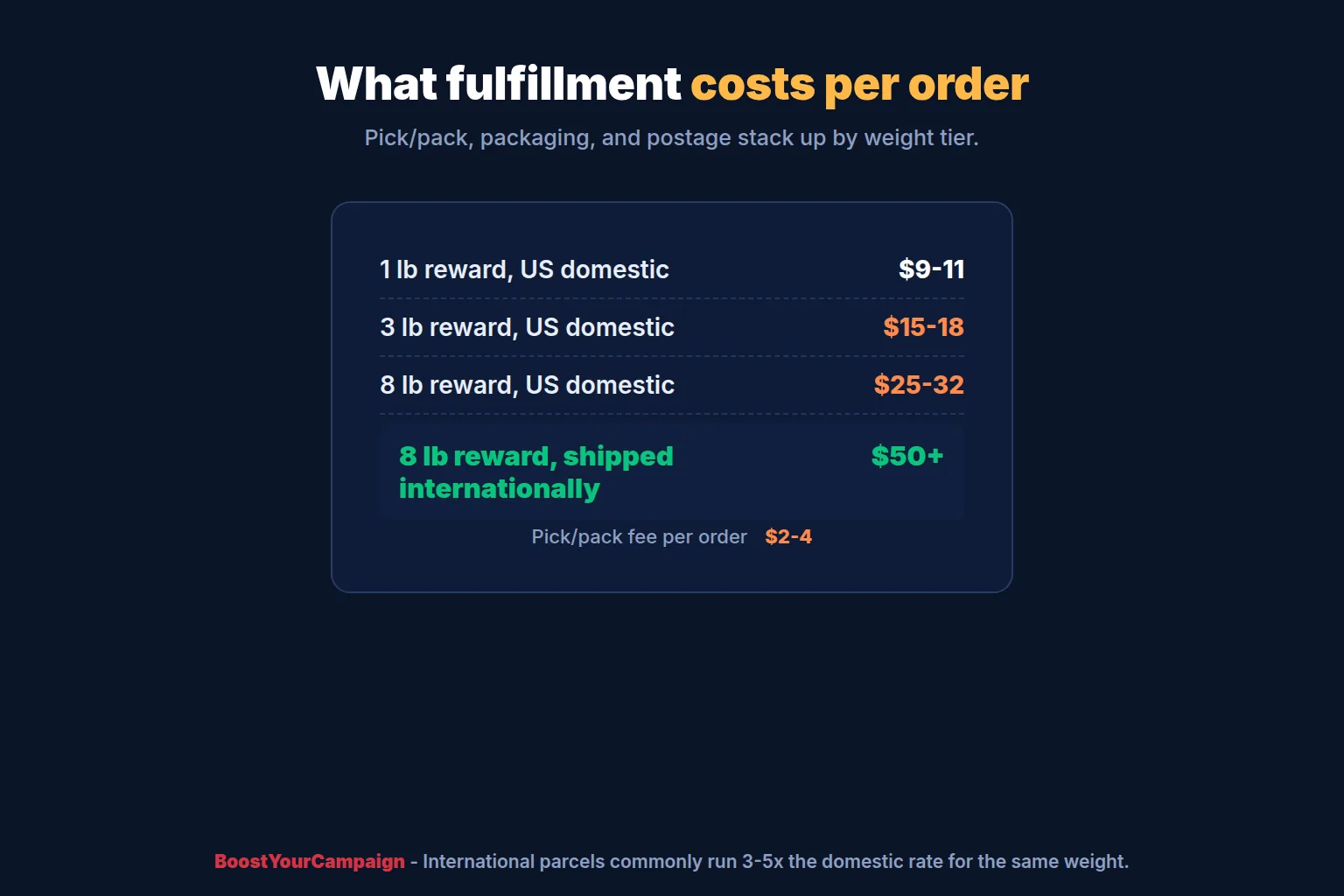
Fulfillment cost per order breaks into four line items: a pick/pack fee (typically $2-4 per order for a straightforward single-SKU pack, more for a multi-item kit), a per-item fee for extra SKUs bundled into one order, packaging materials, and postage, which is the line that scales the most with weight and destination. Here's roughly what that looks like at three weight tiers, US domestic versus EU:
A 1 lb reward - an apparel item or a small accessory - typically runs pick/pack around $2.50, packaging around $0.75, and US domestic postage around $6-8, landing at roughly $9-11 per order shipped from a US warehouse to a US backer. Ship that same parcel internationally, straight from a US warehouse to Europe, and postage alone often jumps to $20-25, since international parcels commonly run 3-5x the domestic rate for the same weight class.
A 3 lb reward - a small electronics gadget or a book-and-accessory bundle - typically runs pick/pack around $3, packaging around $1.50, and US domestic postage around $10-14, for a total near $15-18 domestic. Mailed internationally from a single US warehouse, that 3 lb parcel often lands around $35 to the UK once postage and handling are added, and can run $40 or more to Australia.
An 8 lb reward - a heavier gadget or a multi-item kit - typically runs pick/pack around $4 for the extra kitting labor, packaging around $2-3, and US domestic postage around $18-25, for a total near $25-32 domestic. Shipped internationally from one warehouse, an 8 lb parcel can run well past $50, especially to Asia-Pacific destinations, since that same 3-5x international multiplier applies at a heavier base rate.
Now compare that to fulfilling the EU side from an EU warehouse instead of the US: the 8 lb reward going to a German or French backer from a regional EU warehouse lands back near that $25-32 domestic band, because it's no longer crossing a border as an individual parcel - the border crossing already happened once, in bulk, as freight. That gap between "$50+ per parcel, shipped internationally one at a time" and "$25-32 per parcel, shipped domestically from regional stock" is the entire argument for splitting inventory, covered next. Our detailed shipping cost breakdown and fulfillment services guide both go deeper on pricing specific carriers and providers.
3) Direct-ship vs. splitting inventory between a US and EU warehouse
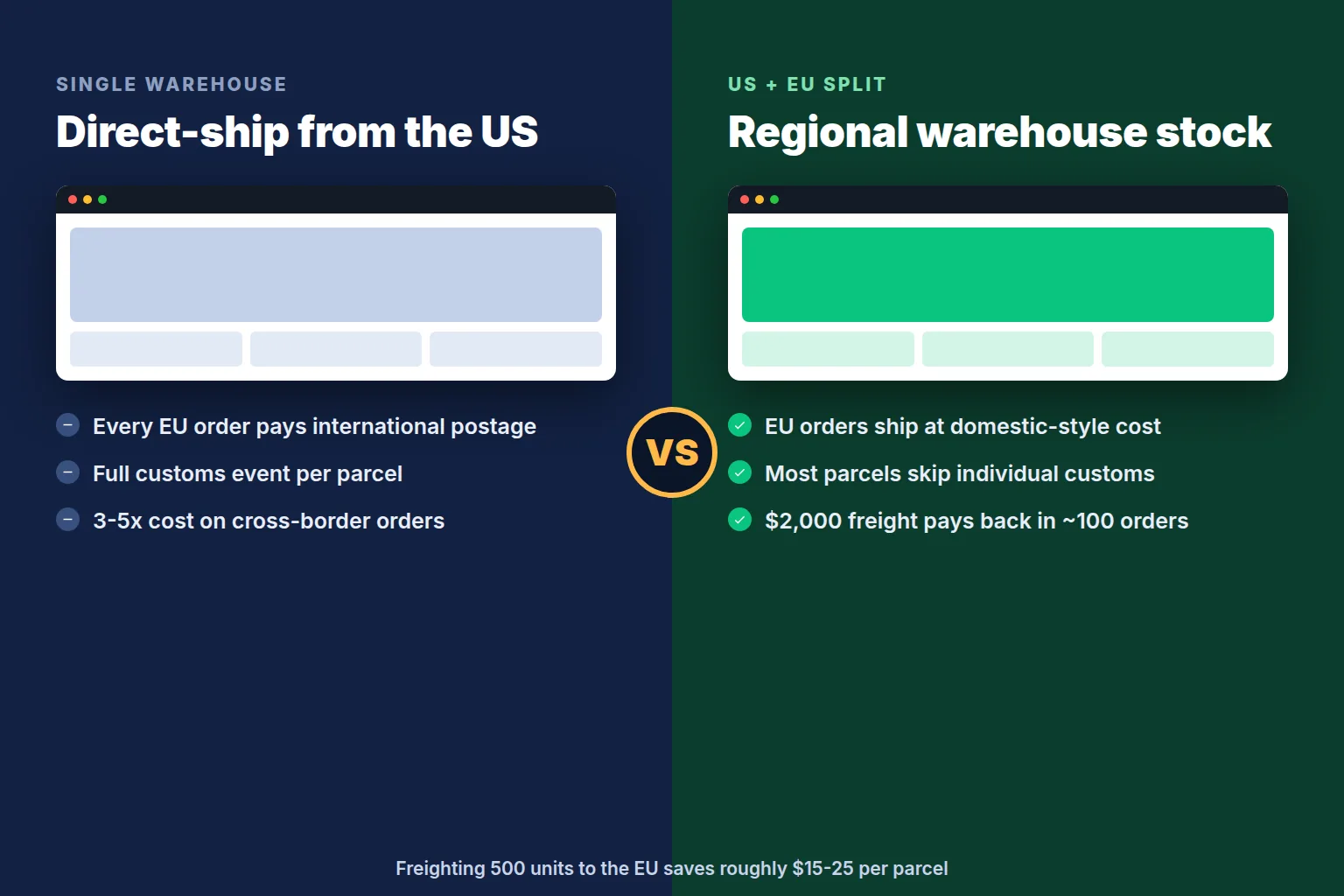
Direct-ship fulfillment means every backer order ships from one warehouse, wherever that happens to be. It's simple to set up and it's fine for a campaign with a small, geographically tight backer list. It stops making sense the moment a meaningful share of backers live outside that warehouse's home region, because every one of those orders pays the full international postage penalty described above, on top of a real customs clearance event for each individual parcel.
Splitting inventory means bringing part of the print run into a US warehouse and part into an EU warehouse, via one bulk freight shipment each, then fulfilling each region's backers from the warehouse closest to them. Bulk-freighting roughly 500 units to a UK or EU warehouse typically costs around $2,000, but it saves roughly $15-25 per parcel versus shipping each of those units internationally one at a time from a single US warehouse. Run the math and that freight cost pays for itself after somewhere between 80 and 130 EU orders - a threshold most well-marketed Kickstarter campaigns clear easily, since international backers commonly make up 15-30% of a campaign's total pledges.
The tradeoff is real: splitting one freight shipment into two adds a planning step, a second warehouse relationship to manage, and usually a small per-unit cost bump versus one larger container. For anything with real weight or international spread, the postage and customs savings on the EU side outweigh that added complexity - our board game fulfillment guide covers a category where this split matters even more, since box weight makes the direct-ship penalty especially steep. The same logic applies to a brand's post-campaign store, which is one reason we run ecommerce fulfillment out of the same US and EU warehouses once a campaign moves into ongoing Shopify sales.
4) DDP vs DDU: who pays the import duty
Delivered Duty Paid (DDP) means the shipper - the creator or the fulfillment partner acting on their behalf - prepays import duties and taxes before the parcel ever reaches the backer's country. The parcel clears customs without the backer doing anything, and it arrives with nothing more to pay at the door. Delivered Duty Unpaid (DDU, sometimes called DAP) means the opposite: duties and taxes are billed to the backer when the parcel arrives, often with a courier handling fee stacked on top.
DDU looks cheaper on the shipping line during checkout or in the pledge manager survey, because the duty cost isn't baked in. In practice it's the more expensive choice for the campaign's reputation - backers who already paid for a reward months earlier resent being billed again at the door, and a meaningful share of DDU parcels get refused or abandoned rather than paid for, which turns into a return, a support ticket, and a second postage cost. DDP costs more upfront because the duty gets built into what the creator pays, but it produces a clean, one-charge experience that reads as professional rather than as a surprise bill. Our EU VAT and customs guide covers how this interacts with the IOSS mechanism described in section 6 below.
5) Ocean freight vs. air freight: choosing the freight leg
Ocean freight is the default for a Kickstarter print run because it's cheap per unit, but it's slow: expect roughly 30-45 days port to port, plus local trucking and warehouse receiving on each end. That timeline has to be booked into the delivery estimate on the campaign page from day one, not discovered after the fact. Air freight cuts transit to days instead of weeks, but at a large multiple of the ocean rate - usually reserved for a stretch-goal component that missed the original freight booking, a small top-up order, or a campaign that's already running late and needs to recover time it can't get back any other way.
Container fill efficiency matters more than most creators expect going in. A freight quote priced against an assumed full container, when the actual shipment only fills three-quarters of one, means the real per-unit freight cost comes in higher than budgeted. Getting a quote against the actual unit count and box dimensions, rather than an early estimate, avoids that gap showing up as a margin surprise after reward pricing is already locked. Our crowdfunding fulfillment companies guide compares how different providers, including agencies with owned warehouses, handle this freight leg.
6) Customs basics every creator needs to plan for
A commercial invoice - declared value per unit, product description, and HS code - travels with every international shipment, both the bulk freight into a warehouse and, for direct-ship orders, the individual backer parcel. The HS code classifies the product for duty purposes, and getting it wrong doesn't just risk the wrong duty rate, it can hold a shipment at the border while customs sorts out the discrepancy. Getting the right code confirmed with a freight forwarder or customs broker before the first shipment moves is worth the extra step.
US formal entry matters more now than it used to. The $800 de minimis exemption, which used to let many low-value parcels clear US customs duty-free with minimal paperwork, effectively ended for a large share of shipments in 2025. That means parcels that would have breezed through a few years ago now often require a formal customs entry, with real paperwork and potential duty even on a modest-value reward. Creators shipping into the US, including US-based creators bringing inventory in from an overseas factory, need to plan for that formal entry process rather than assuming the old duty-free threshold still applies.
On the EU side, IOSS (the Import One-Stop Shop) covers parcels valued at 150 EUR or less: VAT gets collected at the point of pledge or checkout and remitted through one return, so the parcel clears EU customs without the courier collecting VAT again at the door. Above that threshold, the parcel goes through standard import procedures instead, which needs its own plan rather than an assumption that IOSS covers every reward tier. Any business importing goods into the EU, or exporting from it, also needs an EORI number - get that registered before freight arrives, not after it's sitting in a bonded warehouse waiting on paperwork. Our customs documentation guide walks through the paperwork for both sides in more detail.
7) Building a realistic fulfillment timeline
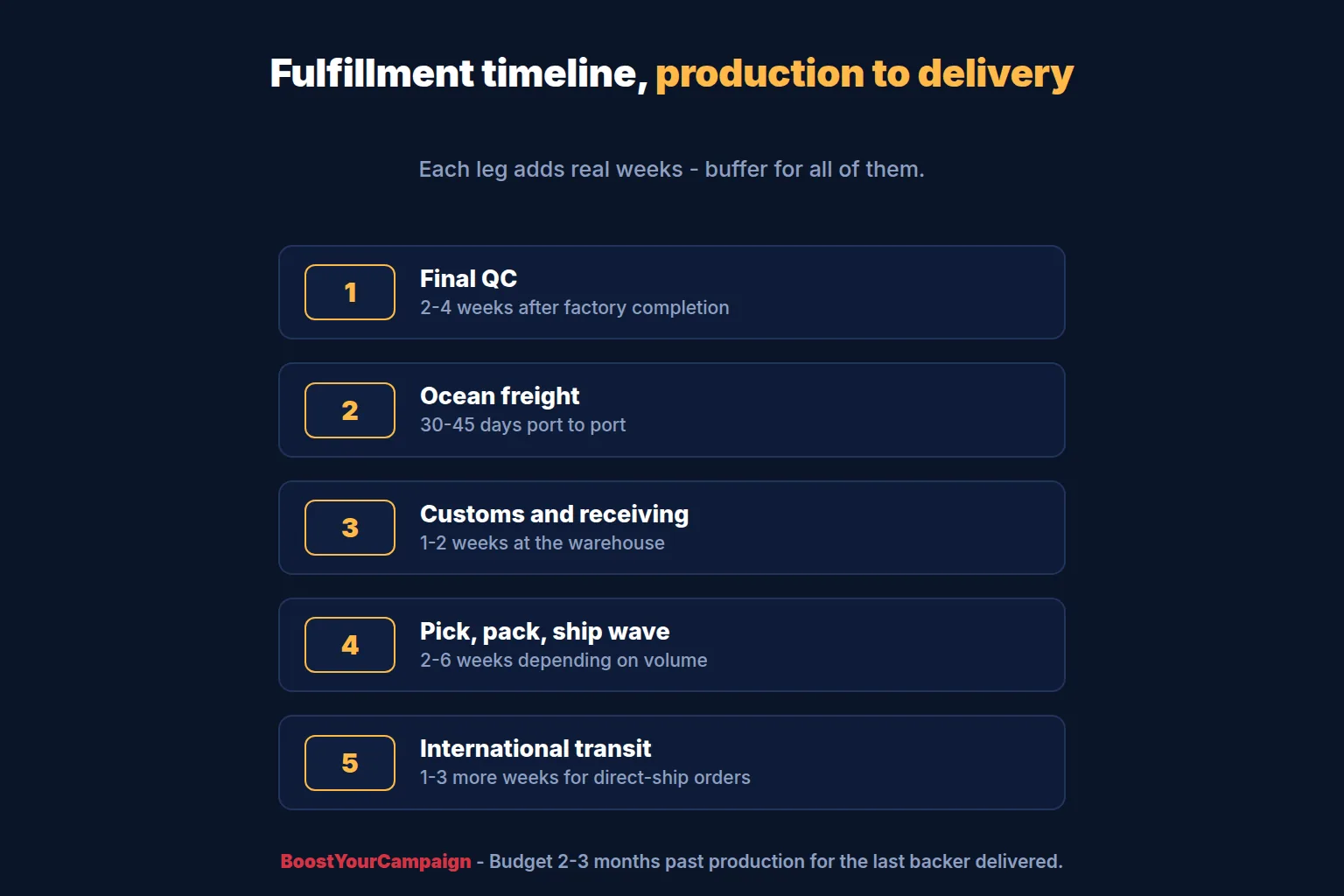
Work backward from "last backer delivered" and the timeline stacks up fast. Final production and QC typically takes 2-4 weeks after the factory says units are done. Ocean freight to a regional warehouse adds 30-45 days port to port. Customs clearance and warehouse receiving on the inbound freight adds another 1-2 weeks. The pick/pack/ship wave itself takes 2-6 weeks depending on order volume and how many SKUs each order contains, and any orders still shipping internationally rather than from regional stock add another 1-3 weeks of transit on top of that.
Add those legs together and 2-3 months of buffer between "production done" and "every backer has their reward" is the realistic number, not the optimistic one. Campaigns that promise a delivery date assuming every leg runs at its fastest case are the ones apologizing for delays a few months later - delays that were foreseeable from the freight and customs timelines alone. The same buffer logic applies if you're also running or planning an Indiegogo campaign alongside Kickstarter; our Indiegogo fulfillment guide covers how Late Pledge (formerly called InDemand) waves stack onto this same timeline on that platform.
8) Common failure modes that blow up a fulfillment plan
A few mistakes account for most of the fulfillment problems we see. Underestimating packed weight against the shipping estimate used to price reward tiers is the most common one - a reward that weighs 20-30% more than the number used at launch quietly erodes margin on every single order. Shipping everything from one warehouse to a global backer base is the second, since it turns a large share of orders into the expensive international case covered in section 2. Missing EORI or IOSS registration before freight or orders start moving is the third - it stalls parcels in customs right when backers are watching tracking most closely.
Treating pledge manager survey data as final without an address-verification pass is another one worth naming on its own: a bad address on a $30 international parcel is an expensive mistake to make at scale, and it's cheap to catch with a validation pass before the shipping wave starts. Promising a delivery date without freight and customs buffer built in causes most of the "why is my reward late" comment threads on a campaign's updates page. And choosing a carrier purely on price rather than regional reliability - a courier that's cheap but has a poor delivery record in a specific country - trades a small savings for a support-ticket problem that costs more in staff time than it saved in postage. Fee planning matters here too - platform fees, payment processing, and fulfillment cost all have to be modeled together rather than one at a time, which our Kickstarter and Indiegogo fees guide breaks down.
| Approach | Backer cost/experience | Customs risk | Best for |
|---|---|---|---|
| Direct-ship, single warehouse, DDU | Cheapest on paper, backer often billed at the door | High - every parcel is a separate customs event | Very small, geographically tight backer lists only |
| Direct-ship, single warehouse, DDP | Clean for the backer, expensive per international parcel | Medium - duty is prepaid but volume is still high | Small international share, low volume overall |
| US + EU warehouse split | Domestic-style cost and speed for most backers | Low - most orders never cross a border as parcels | Any campaign with a meaningful EU backer share |
| Agency with owned US/EU warehouses | Same as the split, bundled with campaign services | Low, handled by one team end to end | Creators who want fulfillment planned with marketing |
How BoostYourCampaign fits
BoostYourCampaign owns fulfillment warehouses in both the US and the EU, so the split described in section 3 isn't a separate vendor relationship a creator has to stitch together after the campaign funds - it's built into the same team that ran the ads. Reward pricing, shipping charges, and the US/EU split get modeled together before launch, and our in-house team handles the customs paperwork, pick/pack, and carrier selection described throughout this guide, including DDP setup and IOSS registration for EU-bound orders.
On the marketing side, BYC uses a skin-in-the-game ad model, investing its own money alongside the client's ad budget with fixed fees rather than a percentage-of-raise commission. The agency has been active since 2010 across 4,600+ campaigns with $734M+ raised and a 4.9/5 score across 300+ verified reviews. It's an Indiegogo Approved Agency, a Google Premier Partner, a Facebook Marketing Partner, an official Shopify Partner, and an Amazon Partner. Once a campaign delivers, the same warehouses carry straight into ongoing Shopify and ecommerce fulfillment, so a brand doesn't have to find a new logistics partner the moment the campaign updates page goes quiet. See our full services overview for how marketing, video, and fulfillment fit together under one roof.
Before you launch: a Kickstarter fulfillment checklist
| Question | Why it matters |
|---|---|
| Have you priced shipping against the actual packed weight of each reward tier? | Estimates based on an early prototype routinely miss the real weight, which eats margin on every order. |
| Is the plan a single warehouse or a US/EU split? | A split turns most international orders into domestic-style shipments and cuts postage sharply. |
| Will EU orders ship DDP with IOSS, or DDU? | DDU risks a surprise bill at the door and a higher parcel refusal rate. |
| Has an EORI number been registered for EU-bound freight? | Freight without one can sit in a bonded warehouse waiting on paperwork. |
| Is the delivery estimate built with 2-3 months of buffer past production? | Ocean freight alone is 30-45 days, before customs and the pick/pack wave. |
| Has the pledge manager survey data been through an address-verification pass? | A bad address on an international parcel is expensive to fix after the fact. |
Frequently Asked Questions
How much does Kickstarter fulfillment cost per unit?
It depends on weight and destination, but a light reward around 1 lb typically runs $9-11 per order shipped domestically, a mid-weight 3 lb reward runs roughly $15-18 domestic, and an 8 lb reward runs roughly $25-32 domestic. International shipping direct from a single warehouse commonly runs 3-5x those domestic numbers for the same weight.
What is a pledge manager and do I need one?
A pledge manager is a survey and order-management platform, like BackerKit, that collects final shipping addresses, locks add-on selections, and calculates shipping fees after a campaign closes. Almost every campaign with more than a small handful of backers needs one - it's the data source the fulfillment warehouse works from.
Should I ship from one warehouse or split between US and EU?
If EU backers make up a meaningful share of your total, usually somewhere above 15%, splitting inventory between a US and an EU warehouse typically pays for itself within 80-130 EU orders once you compare the added freight cost against the per-parcel savings on postage and customs.
What is DDP shipping and why does it matter for Kickstarter?
DDP (Delivered Duty Paid) means duties and taxes are prepaid before the parcel arrives, so the backer receives it without an extra bill at the door. DDU (Delivered Duty Unpaid) bills the backer on arrival, which increases refusal rates and support tickets.
Do I need to worry about US customs after the de minimis exemption ended?
Yes. The $800 de minimis exemption that used to let many low-value parcels clear duty-free largely ended in 2025, so most US-bound shipments now go through a formal entry process. Plan for that paperwork and potential duty even on modest-value rewards.
How long does Kickstarter fulfillment take from production to delivery?
Budget 2-3 months past "production done." Ocean freight alone typically takes 30-45 days port to port, and customs clearance, warehouse receiving, and the pick/pack/ship wave add several more weeks on top of that.
What's the difference between Kickstarter fulfillment and Indiegogo fulfillment?
The core logistics - pledge manager surveys, freight, warehousing, pick/pack, customs - are nearly identical. The main differences are platform-specific: Indiegogo has a larger international backer base and adds Late Pledge order waves after the main campaign. Our Indiegogo fulfillment guide covers those differences in full.
If you're planning a Kickstarter launch and want fulfillment priced correctly before you set reward tiers, reach out through /contact.
Want results like these for your campaign?
We've helped 4,600+ creators raise over $734M. Let's pressure-test your launch plan and find the highest-leverage fixes before you go live.
Talk to an expert →Get the free 87-step launch checklist
The exact pre-launch, live-campaign and fulfillment steps we use across 4,600+ launches. Free PDF, emailed instantly.
You're in - check your inbox. Open the checklist now ->