Weighing whether to take a Japanese product to Kickstarter or Indiegogo? Talk with BoostYourCampaign about your product, timeline, and target market.
Japanese brands are well positioned for crowdfunding success by reputation alone. Craftsmanship, materials, and design attention to detail are exactly what Kickstarter and Indiegogo backers respond to. What's missing for most Japanese creators is not product quality, it's a campaign built for Kickstarter or Indiegogo specifically, rather than a domestic Makuake or CAMPFIRE listing translated into English. The two audiences behave differently, expect different page structures, and respond to different marketing. Add US and EU fulfillment on top of that, and the practical gap most Japanese brands hit is marketing and logistics expertise for a foreign platform, not product readiness.
- Reputation is already an asset - Japanese design and manufacturing quality is a real trust signal with Western backers before they read a single word of copy.
- Translation is not localization - a page translated from a Makuake listing rarely matches how Kickstarter or Indiegogo backers expect a pitch to be structured.
- Domestic and international platforms reward different things - Makuake and CAMPFIRE audiences differ meaningfully from Kickstarter and Indiegogo audiences.
- Currency and payout logistics need planning - receiving USD or EUR pledges as a Japan-based entity has its own banking and tax considerations.
- Fulfillment from Japan is expensive per parcel - in-region US/EU warehousing usually beats direct shipping once volume is meaningful.
- Live campaign management needs coverage across time zones - a campaign launched for US backers needs attention during US hours, not just JST business hours.
1) Japanese brands start with a trust advantage most creators have to build from zero

Backers on Kickstarter and Indiegogo have specific, positive associations with Japanese manufacturing: precision, material quality, and design restraint. That's a real head start. Most first-time creators spend a meaningful part of their campaign copy trying to convince backers the product is well made. A Japanese brand can spend that same space on the actual pitch instead, because the country-of-origin signal is already doing some of that work.
That advantage only pays off if the campaign page is built to highlight it rather than bury it. Close, well-lit detail shots of materials and construction, a short explanation of the manufacturing process or workshop behind the product, and specific claims about tolerances or materials tend to outperform generic lifestyle photography, because they lean into exactly the association backers already hold.
It's worth being direct about this positioning rather than assuming backers will infer it. A campaign that mentions where and how the product is made, briefly and specifically, converts better than one that treats manufacturing origin as incidental information buried in the FAQ.
Design and manufacturing awards, a Good Design Award mention, a design institute credential, or recognition from a domestic industry body, translate surprisingly well as trust signals for a Western audience, even when the specific award is unfamiliar. Backers read award badges as third-party validation regardless of which institution issued them, so it's worth surfacing these credentials on the page rather than treating them as a detail only a domestic audience would recognize or care about.
2) A translated Makuake or CAMPFIRE page is not a Kickstarter page
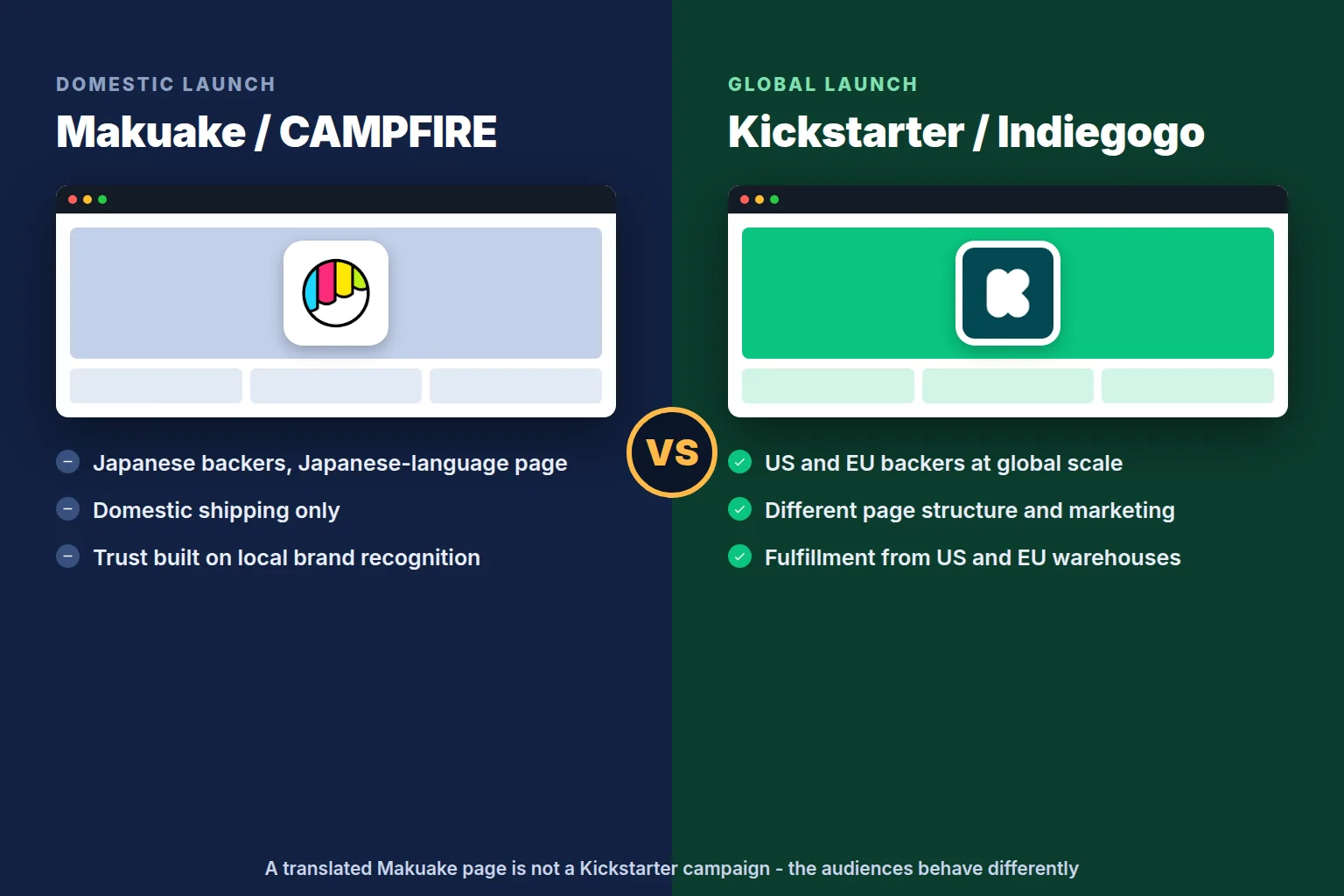
Makuake and CAMPFIRE, Japan's largest domestic crowdfunding platforms, have their own conventions: page layouts, backer expectations around reward structure, and a cultural tone that skews more formal and detail-dense than what typically converts on Kickstarter or Indiegogo. A direct translation of a successful domestic listing usually reads as flat or overly technical to a Western backer used to a punchier, more benefit-led opening.
Kickstarter backers decide whether to keep scrolling within seconds, based on a headline that states what the product does and for whom, in plain language, plus a hero image or video that shows the product itself. Indiegogo audiences respond similarly, with slightly more tolerance for a value-and-savings-forward pitch given the platform's Late Pledge continuation options. Neither audience wants a spec sheet as the opening section, even if the spec sheet is genuinely impressive.
Localization also means adjusting the campaign mechanics themselves, not just the words. Stretch goals, referral incentives, and update cadence are all expected features of a Kickstarter or Indiegogo campaign in a way they may not be on a domestic Japanese platform, and skipping them because the original Makuake campaign didn't use them leaves momentum on the table.
3) Currency, banking, and payout logistics need a plan before launch
Kickstarter and Indiegogo both process pledges in USD (or the creator's chosen currency on Indiegogo, more flexibly), which means a Japan-based entity needs a plan for receiving foreign-currency payouts, converting them, and accounting for the funds correctly under Japanese tax rules. This isn't complicated, but it needs to be set up before the campaign funds, not scrambled together during the payout window when creators are also managing fulfillment.
Some Japanese creators launch through a US or EU legal entity instead of their domestic one specifically to simplify this, particularly if they plan to keep selling in those markets after the campaign through Indiegogo's Late Pledge phase or a standalone ecommerce store. That decision affects tax treatment, so it's worth a conversation with an accountant familiar with cross-border crowdfunding income before deciding, not after the campaign is live.
4) Fulfillment from Japan works, but in-region warehousing usually wins on cost and speed
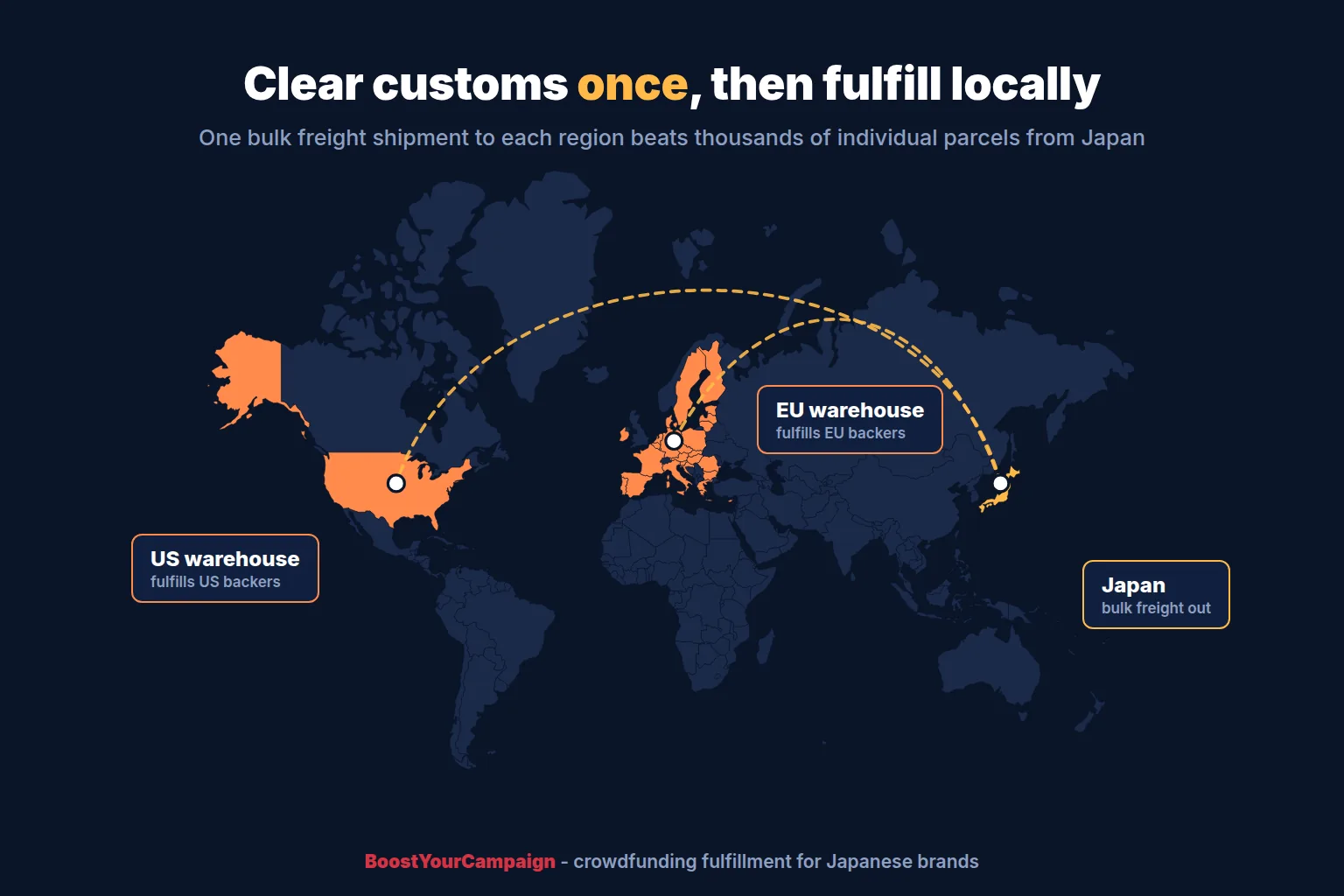
Shipping rewards individually from Japan to backers spread across the US and Europe is workable for a small campaign, using carriers like Japan Post's EMS or a courier like DHL or FedEx, but the per-parcel cost climbs fast, and delivery times of two to four weeks per package are common once customs clearance is added. For a campaign with more than a few hundred backers, that adds up in both cost and support tickets asking where a package is.
The alternative most established Japanese brands move to once volume justifies it is a single bulk freight shipment to a US warehouse and a separate one to an EU warehouse, clearing customs once as a commercial import rather than thousands of times as individual low-value parcels, then fulfilling backer orders from local stock. This is the same model covered in more detail in our crowdfunding fulfillment companies guide, and it typically cuts delivery time from weeks to days while lowering the shipping charge backers see at checkout.
EU-bound rewards carry the same VAT and IOSS considerations that apply to any non-EU manufacturer. Registering ahead of launch avoids backers getting an unexpected import bill or a package stuck in customs, which is a fixable problem that's much cheaper to solve before launch than during it. Tariff and duty schedules are also worth checking specifically for the product category before setting reward pricing; our crowdfunding tariffs guide walks through how that affects margin.
5) A live campaign needs attention outside JST business hours
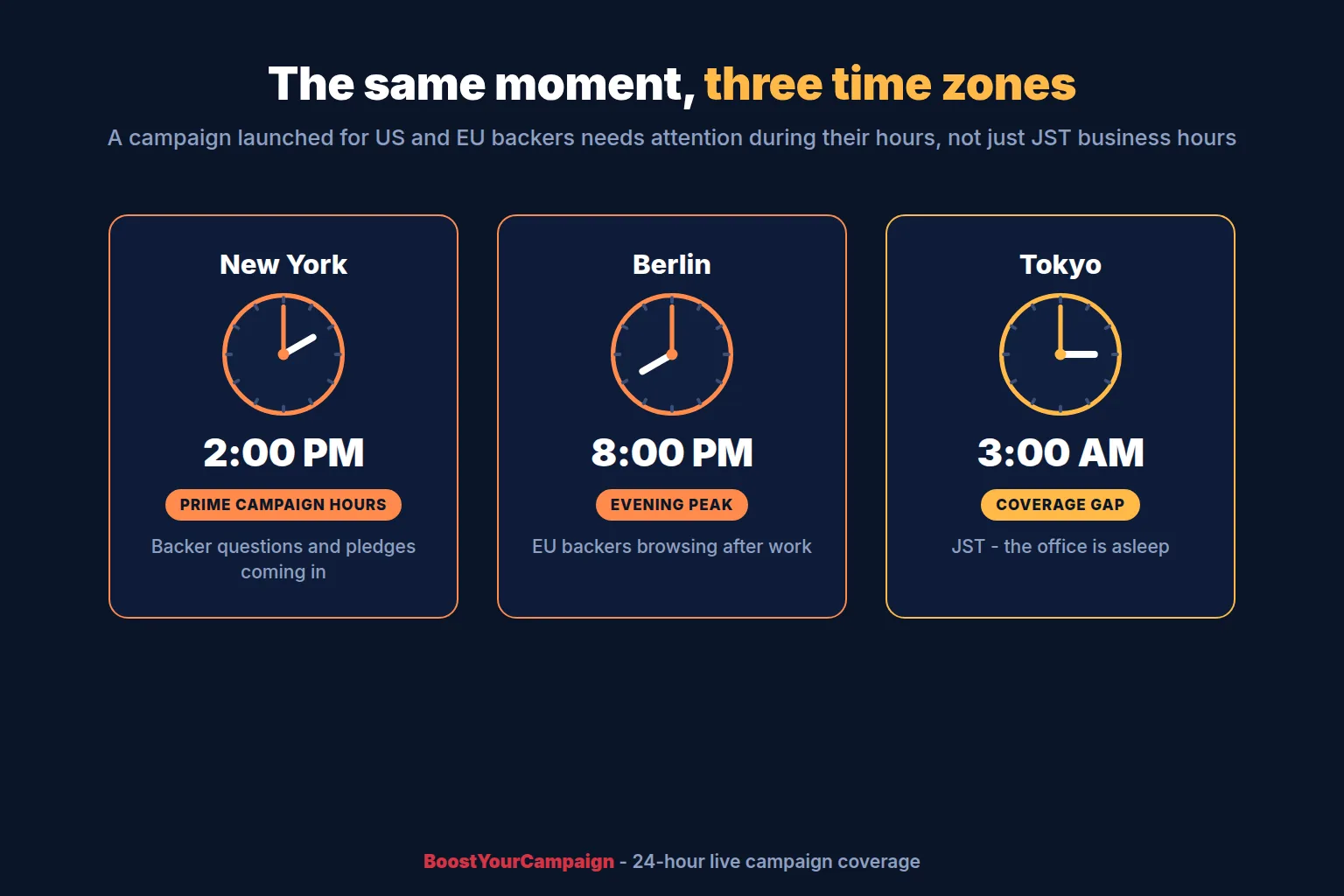
Once a campaign launches, the first 48 to 72 hours set the trajectory for the whole funding period, and most of the backer and ad-platform activity for a US/EU-targeted campaign happens during US and European daytime, which is late evening through early morning Japan Standard Time. A team that only monitors and adjusts ads during JST business hours will miss the highest-leverage window for optimization.
This is one of the more overlooked practical gaps for Japan-based teams running their own campaign: not a lack of skill, but a lack of coverage during the hours that matter most for a US/EU audience. Some brands solve this with a dedicated overnight team; others hand live-campaign ad management to a partner already staffed for US and EU hours.
Press outreach follows the same pattern. Journalists covering crowdfunding and hardware in the US and EU work on their own schedules and time zones, and a pitch that lands in their inbox at 3am their time, sent during a Japan-based team's normal workday, is easy to miss. Timing press outreach to land during recipients' working hours, rather than the sender's, meaningfully improves response rates.
6) Which categories carry the strongest "Japan advantage"
Precision tools, EDC gear, stationery and writing instruments, audio equipment, kitchenware, and compact home goods are where a Japanese brand's reputation does the most work on a Kickstarter or Indiegogo page. Backers in these categories are already primed to associate Japanese manufacturing with tight tolerances and material quality, so the campaign's job is mostly to surface that association clearly rather than build it from scratch.
Categories further from that association, like apparel or lifestyle products without an obvious precision or craftsmanship angle, still do well from Japanese brands, but the campaign needs a different hook, usually design philosophy or a specific material story, since "made in Japan" alone won't carry as much weight outside categories where backers already expect it to matter.
Video plays an outsized role in categories built on craftsmanship. A short behind-the-scenes segment showing the actual workshop, the hands doing the work, or a machine performing a precise operation tends to outperform polished lifestyle footage for this specific audience, because it makes the craftsmanship claim visible instead of asserted. This is one area where investing in dedicated video production, rather than relying on existing product photography, tends to pay for itself directly in conversion rate.
7) Pricing for a Western audience without eroding what makes the product special
Japanese manufacturing often runs on cost structures built around a domestic price-quality expectation that doesn't map directly onto what Western crowdfunding backers are used to paying. A product priced correctly for the Japanese market can look expensive on a Kickstarter page next to Western competitors, even when the material and construction quality genuinely justifies the difference.
The fix usually isn't lowering the price to match cheaper competitors, since that undercuts the exact craftsmanship positioning the campaign is built around. It's explaining the price with enough specificity, material sourcing, construction time, tolerances, that backers understand what they're paying for, paired with reward tiers structured around genuine value tiers rather than arbitrary discount steps.
8) Building a pre-launch audience when your existing following is in Japan
Many Japanese brands come to a Kickstarter or Indiegogo launch with a real following already: an Instagram audience, an existing customer base, maybe press coverage from a Makuake or CAMPFIRE campaign. Almost none of that following is positioned to see a US/EU-targeted campaign, since it lives on different platforms, follows different accounts, and often doesn't see English-language posts in its feed at all.
Pre-launch list building for a US/EU campaign essentially starts from zero on the audience side, even when the brand itself is well established at home. That means running a dedicated pre-launch phase, typically four to eight weeks, using paid social ads targeted specifically at US and EU audiences to build an email list of people who'll get notified the moment the campaign goes live. Campaigns that skip this step and rely on organic reach from a Japan-based following typically see a slow, weak opening day, which then makes it harder to catch the platform's discovery algorithm's attention during the window that matters most.
The pre-launch phase is also where campaign messaging gets tested cheaply before it matters. Running a handful of ad variations against a small budget reveals which framing, craftsmanship story or specific use case, actually resonates with a Western audience before committing the full campaign budget to one approach.
9) Warranty and support after the campaign, for a backer overseas
Precision products invite precision questions after delivery. If a backer in the US or EU has an issue with fit, function, or a defect, the natural question is where the replacement or repair comes from, and a plan that routes every claim back through Japan adds weeks to what should be a quick fix. Backers weighing whether to trust an unfamiliar overseas brand often check for exactly this before pledging, not just after something goes wrong.
Setting up a US or EU-based return and replacement point, rather than treating every warranty case as an international shipment, shortens resolution time and keeps support conversations from turning into public comments on the campaign page during what should be the highest-goodwill phase of the relationship. It also gives the brand a natural base for ongoing sales through Indiegogo's Late Pledge phase or a standalone store once the campaign itself wraps up.
How BoostYourCampaign fits
BoostYourCampaign runs a full-stack, done-for-you model built specifically around this kind of gap: campaign marketing, video production, and fulfillment under one roof, with owned video production studios and owned fulfillment warehouses in both the US and EU. That means live-campaign ad management happens on US/EU hours by default, and backer rewards can be pre-positioned close to backers instead of shipped individually from Japan.
BYC uses a skin-in-the-game ad model, investing its own money alongside the client's ad budget with fixed fees rather than a percentage-of-raise commission, which matters most during exactly the kind of cross-timezone live-optimization window described above. The agency is an Indiegogo Approved Agency, a Google Premier Partner, a Facebook Marketing Partner, an official Shopify Partner, and an Amazon Partner, active since 2010 across 4,600+ campaigns with $734M+ raised and a 4.9/5 score across 300+ verified reviews, documented on the reviews page.
For brands still finalizing a product ahead of launch, BYC also offers in-house MVP development support (/services/mvp-development), has worked with established ecommerce brands, and can help with retail introductions to major retailers including Best Buy when a product is ready. Client products have also moved from a BYC-run crowdfunding launch to Shark Tank coverage on the press page, and Kevin O'Leary has given a video testimonial about the agency, available on the reviews page. See this pricing guide for cost context while comparing options.
Before you launch from Japan: a quick checklist
| Question | Why it matters |
|---|---|
| Is the campaign page built for Kickstarter/Indiegogo, or translated from a Makuake listing? | Domestic and international backers respond to different page structure and pacing. |
| Who manages live-campaign ads during US/EU daytime hours? | Most backer and ad-platform activity happens outside JST business hours. |
| Is the payout entity and currency plan set before launch? | USD/EUR payouts to a Japan-based entity need a banking and tax plan in advance. |
| Is fulfillment direct-ship from Japan, or pre-positioned US/EU stock? | In-region warehousing usually cuts delivery time and per-unit shipping cost at meaningful volume. |
| Is VAT/IOSS registration handled for EU rewards? | Unregistered low-value shipments risk getting stuck in EU customs. |
| Does the page lean into manufacturing quality specifically, or leave it implied? | Backers respond to specific detail about materials and process, not just an assumption of quality. |
We publish the same kind of guide for other markets: Canada, the UK, and Germany and the DACH region.
The paperwork side of that route is covered in customs documentation for crowdfunding shipments, and the general process in the Kickstarter fulfillment guide.
Frequently Asked Questions
Can a Japan-based company launch directly on Kickstarter or Indiegogo?
Yes, subject to each platform's creator eligibility requirements, which typically involve a bank account and legal entity in an eligible country. Some Japanese creators launch through their domestic entity; others use a US or EU entity, particularly if they plan ongoing sales in those markets afterward.
Is Makuake or CAMPFIRE a better starting point than Kickstarter?
They serve different goals. Makuake and CAMPFIRE reach a Japanese domestic audience efficiently. Kickstarter and Indiegogo reach US and European backers directly, but reward a campaign built for that audience specifically rather than a translated domestic listing.
How does Indiegogo's Late Pledge phase work for continued sales?
Late Pledge, formerly called InDemand, is Indiegogo's continued pre-order period after the main campaign window closes. It gives manufacturers an ongoing sales channel, which can help justify a longer production run and often lowers per-unit cost.
Should fulfillment ship from Japan or from a US/EU warehouse?
Direct shipping from Japan is simpler for a small campaign but slower and more expensive per parcel at volume. Pre-positioning bulk stock in US and EU warehouses typically cuts delivery time and lowers per-unit shipping cost once backer counts justify a bulk freight shipment.
Does manufacturing quality alone guarantee a successful campaign?
No. Product quality is necessary but not sufficient. Campaigns still need a page built for the platform's audience, paid traffic managed during the hours that audience is active, and a fulfillment plan that doesn't create long delays or unexpected customs charges.
What's the biggest operational gap for Japan-based teams running their own campaign?
Time zone coverage during the live campaign. Most US/EU backer and ad-platform activity happens outside JST business hours, so campaigns without overnight coverage tend to miss the highest-leverage optimization window.
How should reward pricing account for the cost of true-to-quality materials?
Rather than discounting to match cheaper competitors, price transparently and explain the difference. Naming the specific material, tolerance, or construction detail that drives the cost gives backers a concrete reason to accept a higher price instead of assuming it's simply an overseas markup.
What happens if a backer has a warranty issue after the campaign ends?
Routing every claim back through Japan adds weeks to what should be a fast fix. A US or EU-based return and replacement point resolves issues much faster and protects the brand's reputation during the highest-goodwill window right after delivery.
If you want a direct read on whether your product and timeline are ready for a US/EU launch, reach out through /contact.
Want results like these for your campaign?
We've helped 4,600+ creators raise over $734M. Let's pressure-test your launch plan and find the highest-leverage fixes before you go live.
Book a free strategy call →Get the free 87-step launch checklist
The exact pre-launch, live-campaign and fulfillment steps we use across 4,600+ launches. Free PDF, emailed instantly.
You're in - check your inbox. Open the checklist now ->