A Kickstarter marketing funnel is the path a stranger takes from first seeing your product to backing it on launch day. Most campaigns that struggle have plenty of marketing activity and no funnel: ads point at a Kickstarter page that is not live yet, emails go out with no offer, and nobody knows on launch morning how many people are ready to pledge. This guide breaks the funnel into its stages, shows what each stage has to achieve, gives the conversion rates we plan around after 4,600+ campaigns since 2010, and walks through the math that tells you how big your list needs to be. If you want a team to build and run the whole funnel for you, talk to an expert.
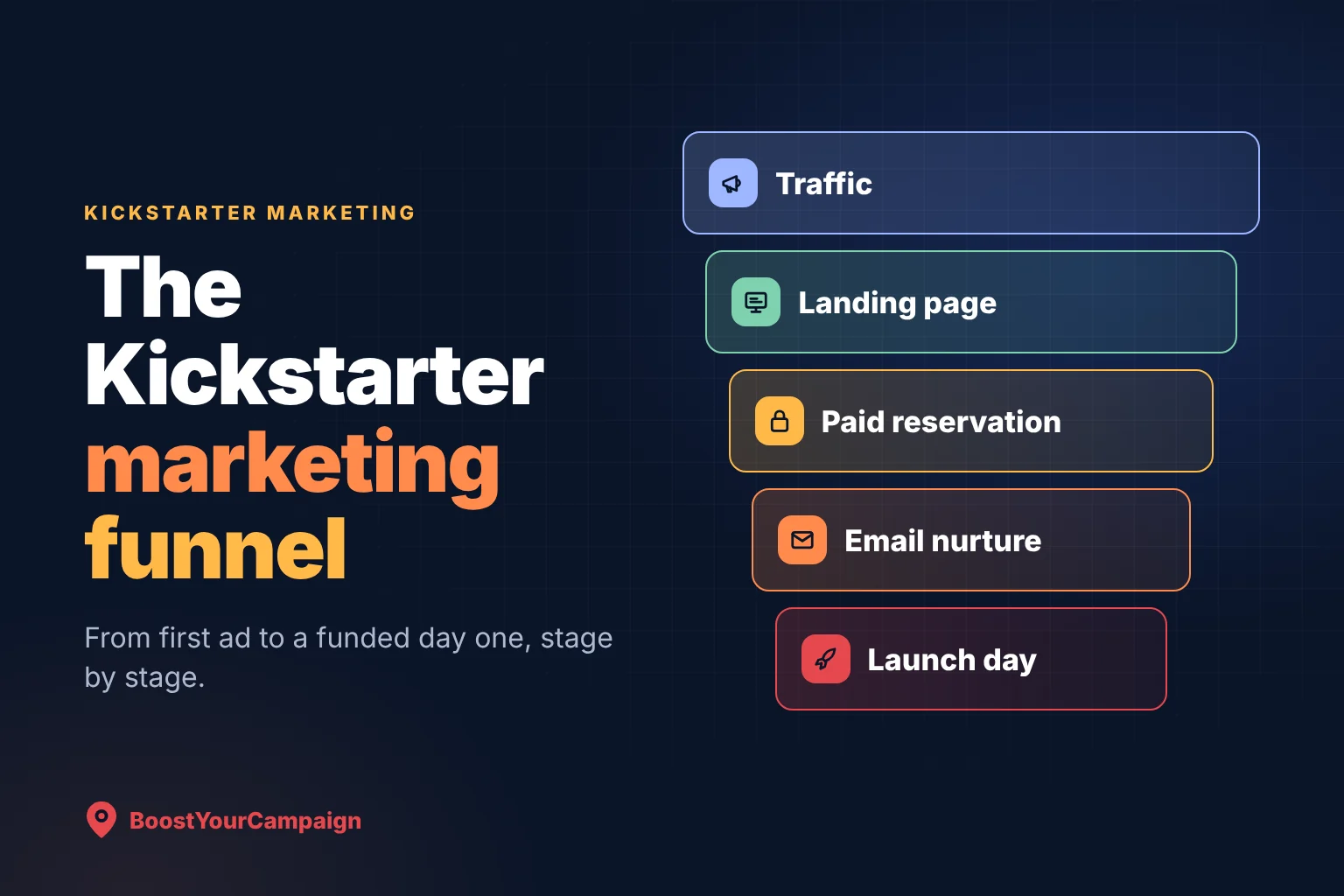
A Kickstarter marketing funnel moves people through five stages: traffic (ads, creators, press), a landing page that captures an email, a small paid reservation that proves intent, an email sequence that keeps them warm, and launch day, when the list backs first. Plan on 10 to 30% of leads placing a paid reservation, 30 to 50% of reservation holders backing, and 5 to 10% of the whole list backing. About 90% of the backers in the first 48 hours come from that list, and the campaigns we run usually reach 100% of their goal on day one.
- The funnel ends on launch day, not at the Kickstarter page. Everything before launch exists to fill the first 48 hours.
- Own the list. Kickstarter's "Notify me on launch" button is useful, but you cannot email those people yourself.
- A paid reservation is the best early signal. Under 10% of leads reserving means the offer needs work, not more ad spend.
- Work backwards from the goal to the number of backers, leads and reservations you need, then set the ad budget.
- Measure every stage weekly so you fix the weak step early instead of discovering it on launch morning.
What a Kickstarter marketing funnel is
A funnel is a sequence of steps where each step asks for a slightly bigger commitment than the last. Someone sees an ad, then gives you an email, then pays a small deposit, then opens your launch email and pledges. Fewer people make it through each step, which is why it is drawn as a funnel, and why the size of the top has to match the number you need at the bottom.
The reason this matters more on Kickstarter than in normal ecommerce is timing. A Shopify store can sell steadily for years. A Kickstarter campaign has a fixed window, and the platform's own discovery rewards projects that move fast at the start. A campaign that funds on day one gets the attention of Kickstarter's algorithm, gives press and creators a reason to cover it, and turns every later visitor into a backer who is joining a winner. A campaign that starts slowly has to fight for that attention for 30 days. The funnel is how you control the start.
It also changes how you judge marketing. Impressions and page views do not fund campaigns. The useful questions are concrete: how many emails did we collect this week, what did each one cost, and how many of those people paid to reserve?
The five stages of the funnel
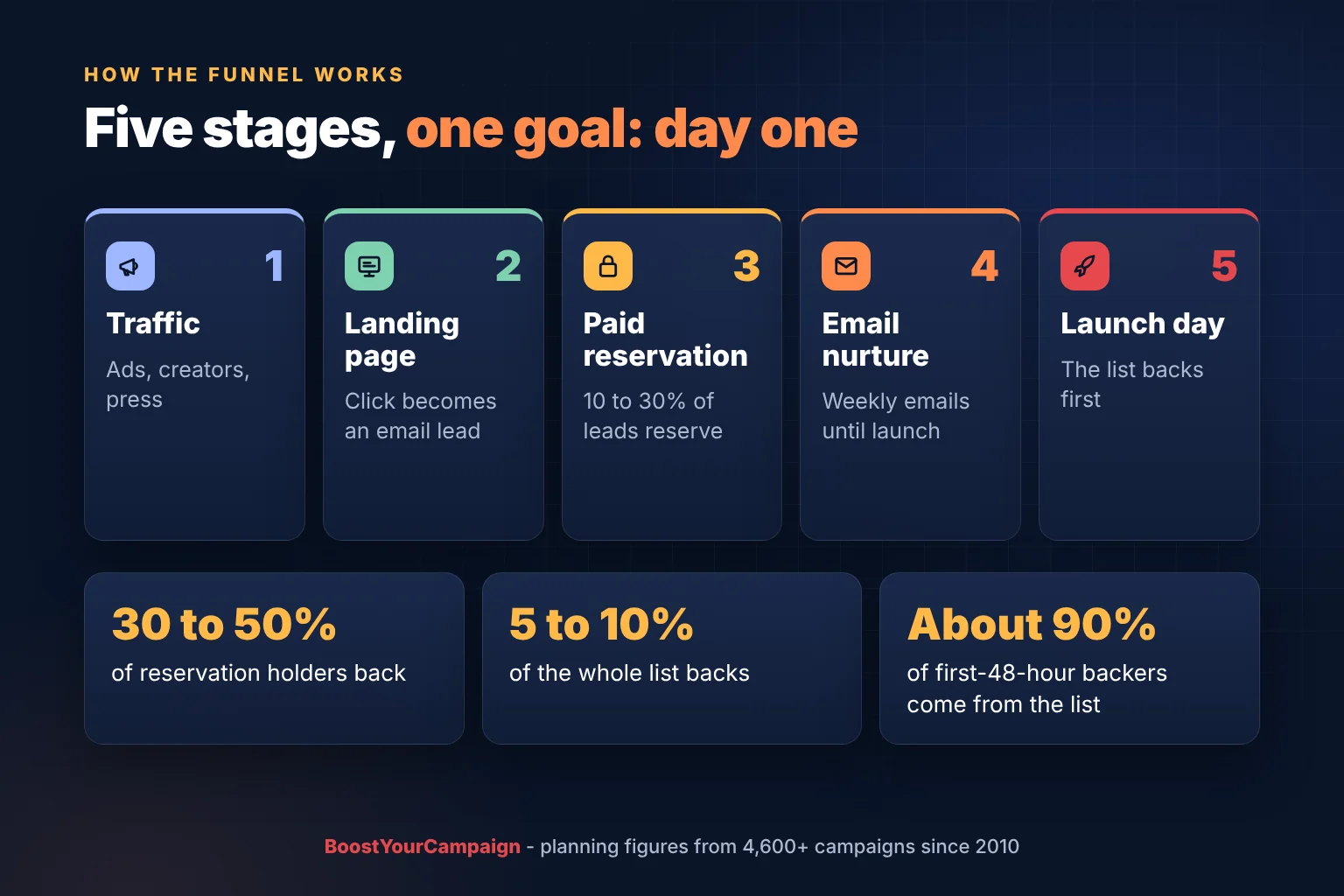
Every funnel we build for a launch has the same five stages. The channels and the creative change by product, but the order does not.
| Stage | Job | What to measure weekly | Planning figure |
|---|---|---|---|
| 1. Traffic | Put the product in front of the right people | Click-through rate, cost per click, creative winners | Set from the lead target below |
| 2. Landing page | Turn a click into an email lead | Landing page conversion rate, cost per lead | Test until the cost per lead fits the budget |
| 3. Paid reservation | Prove intent with a small deposit | Share of leads who reserve | 10 to 30% of leads; under 10% means fix the offer |
| 4. Email nurture | Keep leads warm until launch | Open and click rates, unsubscribes | Every lead hears from you weekly |
| 5. Launch day | Turn the list into first-day backers | Backers and funding in the first 24 and 48 hours | About 90% of first-48-hour backers come from the list; aim for 100% of goal on day one |
Stage 1: traffic that matches the backer
The top of the funnel is people who have never heard of you. Paid social is the main source for most product campaigns because it lets you test angles quickly and target by interest. Meta (Facebook and Instagram) still carries most of the volume for hardware, gadgets and design products, TikTok works well for products that show their value in a few seconds of footage, and Google search catches people already looking for a solution. Our guides to Kickstarter Meta ads and TikTok ads for Kickstarter cover the setup for each.
Free traffic belongs here too: creators and YouTubers in your niche, communities such as subreddits and Discord servers, trade shows and press. These sources rarely give you predictable volume, but they often bring the most committed backers, so send them to the same landing page so you can count them.
The test at this stage is simple. Run several creative angles at once, keep the ones that bring clicks at a cost the plan can afford, and cut the rest within days, not weeks. The product on screen and working in the first seconds of an ad usually beats a brand story.
Stage 2: a landing page that collects emails
Ads should point to a page you control, not to the Kickstarter pre-launch page. Kickstarter's pre-launch page has a "Notify me on launch" button, and Kickstarter will email those followers when the project goes live, but creators cannot contact those followers directly. You cannot send them an early bird reminder, a behind-the-scenes update or a launch countdown. An email address on your own list stays yours, for this campaign and the next.
A good pre-launch landing page has one job and one button. It shows the product working, states the main benefit in a headline, names the early bird saving, and asks for an email. Our breakdown of the anatomy of a pre-launch landing page that converts goes section by section. Use the Kickstarter pre-launch page as well, and link to it from your emails, but treat it as a second net, not the main one.
Stage 3: the paid reservation
An email address costs a person nothing. A small deposit, often $1, costs almost nothing too, but the act of entering card details separates the curious from the committed. That is why we put a paid reservation step straight after the email sign-up: the thank-you page offers a VIP reservation that locks in the best early bird price in exchange for a small refundable or credited deposit.
The reservation rate is the best early signal we know. If 10 to 30% of your leads reserve, the offer works and the funnel is healthy. If fewer than 10% reserve, more ad spend will not fix it. The product, the price, the early bird or the page needs work first, and it is far cheaper to learn that two months before launch than on launch day. For the full reasoning, see the three pre-launch numbers that predict crowdfunding revenue.
Reservation holders behave very differently from the rest of the list: 30 to 50% of them go on to back, compared with 5 to 10% of the list as a whole. They are the people who make day one happen.
Stage 4: the email nurture sequence
Leads collected eight weeks before launch will forget you by launch day unless you stay in touch. A nurture sequence keeps them warm with a steady rhythm of short emails: the story behind the product, how it is made, early feedback, answers to the questions people ask in ad comments, and a reminder of the early bird they are on the list for.
The week before launch the tone changes. You announce the launch date and time, explain how the early bird works and that it is limited, and send a final email the moment the campaign goes live, with one link straight to the Kickstarter page. Our library of Kickstarter email sequences and templates has the full calendar, from the first welcome email to the launch-day send.
A community space such as a Facebook group or Discord helps for some categories, especially games and tabletop, where backers enjoy talking to each other. For most consumer products, email does the heavy lifting.
Stage 5: launch day and the first 48 hours
Launch day is where the funnel pays out. About 90% of the backers in the first 48 hours come from the pre-launch list, which means the size and warmth of the list largely decides the opening. This is why the campaigns we run usually reach 100% of their goal on day one: the goal and the list are sized for each other before the launch date is set.
An early bird gives the list a reason to act in the first hours instead of whenever they get round to it. We set it at 20 to 40% off, limited either by quantity or to the first 24 to 48 hours, and make the limit visible on the page. Both limits work. What matters is that the limit is real.
One of our clients put it this way after launch: "We hit our goal in 17min and reached 400,000 euro with Finesse." That kind of opening is not luck. It is a list that was built, tested and warmed for weeks before the button was pressed.
After launch: the funnel keeps running
Once the campaign is live, the same ad accounts switch from collecting leads to sending traffic straight to the Kickstarter page. Retargeting people who joined the list but have not backed yet, and people who visited the campaign page, is usually the most efficient spend of the live phase. Press and creator coverage tend to land in the first two weeks, and a stretch goal or new add-on gives the list a reason to look again in the middle of the campaign.
When the campaign ends, the funnel continues into the pledge manager and late pledges, where people who missed the campaign can still order, and later into your own store. Our pledge manager and late pledges playbook covers that phase, and the Kickstarter Shopify app now moves those backer orders into Shopify for fulfillment.
Funnel math: how big does your list need to be?
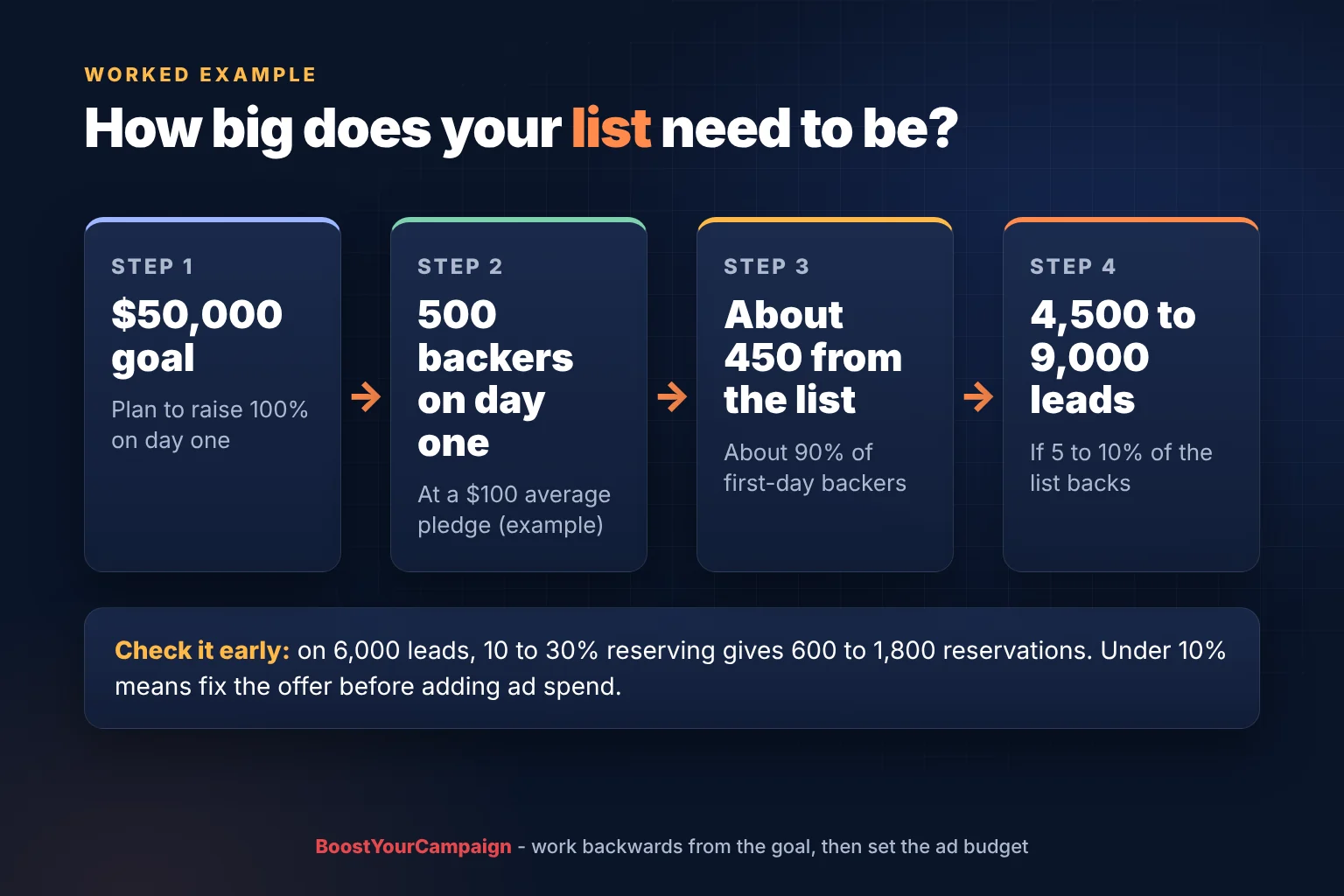
Work backwards from the goal, not forwards from the ad budget. Here is a worked example with round numbers. Use your own goal and average pledge.
- Day-one target. Goal $50,000. Plan to raise 100% of it on day one.
- Backers needed. With an average pledge of $100 in this example, that is 500 backers on day one.
- Backers from the list. About 90% of first-day backers come from the list, so about 450 of them.
- List size. If 5 to 10% of the list backs, 450 backers needs a list of roughly 4,500 to 9,000 leads.
- Reservations as a check. On a list of 6,000 leads, 10 to 30% reserving gives 600 to 1,800 reservations, and 30 to 50% of those backing gives 180 to 900 backers from reservations alone.
Two things follow from the math. First, the lead target and your cost per lead set the ad budget, so test the cost per lead early. Second, the reservation rate tells you within a few weeks whether you are on track. If reservations sit under 10% of leads, adding leads only makes a weak offer more expensive. Our free campaign grader runs a quick version of this check on your own numbers.
Common funnel mistakes
- Sending ads to the Kickstarter pre-launch page. You gather followers you cannot email, and you cannot measure cost per lead properly.
- Skipping the reservation step. Without it you have no early signal, and you find out on launch day whether the list was real.
- Starting too late. A list built in two weeks is usually too small and too cold. Most product launches need several weeks of lead generation, plus time to fix the offer if the numbers are weak.
- Going quiet between sign-up and launch. Leads who hear nothing for a month treat the launch email as spam.
- Setting the goal before sizing the list. A goal the list cannot fund on day one turns a strong product into a slow campaign.
- Judging the funnel by reach. Track leads, reservations and backers. Everything else is background.
The free 87-step launch checklist puts every one of these checks on a timeline, so you can see what should be finished in each week before launch.
Running the funnel yourself or with an agency
You can build every stage yourself with standard tools: an ads account, a landing page builder, a payment link for reservations and an email platform. Where creators usually get stuck is not the tools but the testing: finding winning ad angles fast, reading the reservation rate honestly, and fixing the offer before the budget runs out.
That is the work our team does every day. Since 2010 we have supported 4,600+ campaigns that raised over $734M, with in-house ad buyers, two in-house video studios, and a backer database of 8.5 million people. A crowdfunding marketing agency is worth it when the funnel numbers matter more than the hours: when a weak reservation rate needs fixing in days, or when the launch date is fixed and the list has to be ready. If that is where you are, talk to an expert about your launch.
Frequently asked questions
What is a Kickstarter marketing funnel?
It is the sequence that takes a stranger from first seeing your product to backing it: traffic from ads and other sources, a landing page that collects an email, a small paid reservation, an email sequence that keeps leads warm, and launch day, when the list backs first.
How many emails do I need for a Kickstarter launch?
Work backwards from your goal. Divide the goal by your expected average pledge to get day-one backers, take about 90% of them as coming from your list, then divide by 5 to 10%, the share of a pre-launch list that typically backs. A $50,000 goal at a $100 average pledge needs roughly 4,500 to 9,000 leads.
Should I send ads to my Kickstarter pre-launch page or my own landing page?
Your own landing page. Kickstarter's "Notify me on launch" followers get an automatic email at launch, but you cannot contact them yourself. An email list you own lets you warm people up, announce the early bird and send the launch email at the exact moment you go live.
What is a good reservation rate for a Kickstarter pre-launch?
10 to 30% of leads placing a paid reservation is healthy. Under 10% means the offer, the price or the page needs work before you add more ad spend.
How long should a Kickstarter pre-launch funnel run?
Long enough to reach your lead target and to fix the offer if the reservation rate is weak. For most product launches that means several weeks of lead generation. Our guide on pre-launch audience building covers the timeline in detail.
What share of first-day backers come from the email list?
About 90% of the backers in the first 48 hours come from the pre-launch list. That is why the list, not launch-day ad spend, decides how a campaign opens.
Want a funnel sized for your goal and run by people who have done it 4,600+ times? Talk to an expert, or check your plan first with the free campaign grader.
Want results like these for your campaign?
We've helped 4,600+ creators raise over $734M. Let's pressure-test your launch plan and find the highest-leverage fixes before you go live.
Talk to an expert →Get the free 87-step launch checklist
The exact pre-launch, live-campaign and fulfillment steps we use across 4,600+ launches. Free PDF, emailed instantly.
You're in - check your inbox. Open the checklist now ->