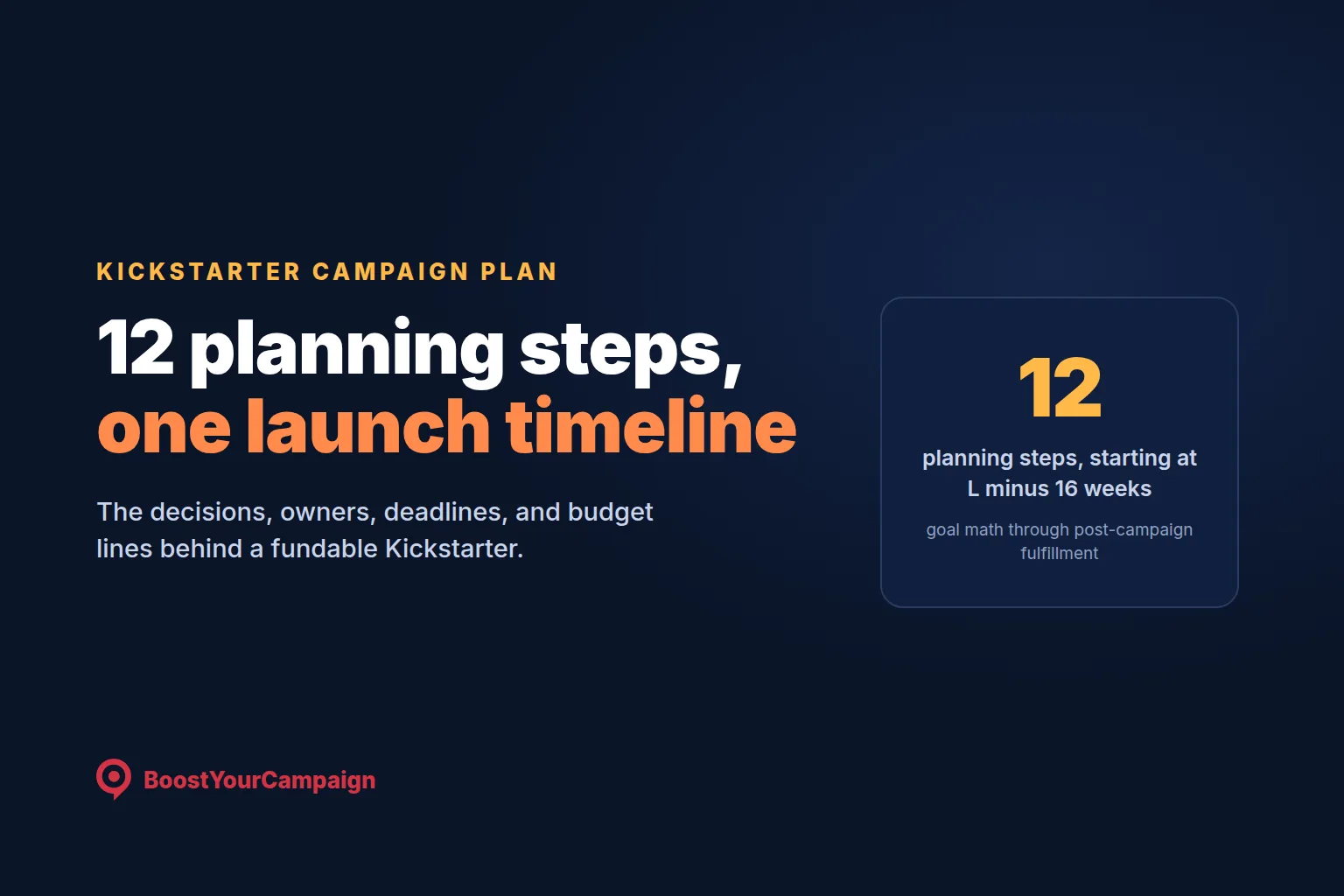
A Kickstarter campaign plan is a different document from a launch guide. The step-by-step guide to launching a Kickstarter covers how to build the page, film the video and run the ads. This article is the plan behind that work: the decisions to make, who owns each one, the deadline relative to launch, and what each step costs, laid out as a timeline you can copy into a sheet. If you want it built with you, talk with BoostYourCampaign.
A Kickstarter campaign plan is 12 planning steps that run from goal math and validation through fulfillment, starting roughly 16 weeks before launch. Three numbers decide whether the plan is fundable: platform and processing fees (roughly 8-10% of what you raise), a marketing budget (typically 15-25% of your goal), and a fulfillment reserve quoted from your packed cost of goods, weight and backer mix rather than taken as a share of the raise - stack those against your goal before you lock a launch date.
- The plan starts at L minus 16 weeks - goal math and validation come before a page or a video.
- Every step needs an owner and a deadline - a decision with no name attached rarely gets made.
- Three numbers decide fundability - fees (~8-10%), marketing (~15-25% of goal), fulfillment reserve (quote it from a packed sample).
- Validation is a gate, not a formality - a campaign that fails the go/fix/stop thresholds waits.
- The pre-launch list is the plan's engine - roughly 90% of first-48-hour backers come from it.
- Fulfillment gets planned before launch - pledge manager, shipping cost and warehouse choice belong in the plan.
1) Goal and funding target math
Decision: set the funding goal (the minimum to deliver rewards) separately from your real target (what you actually want to raise). Owner: founder or financial lead. Deadline: L minus 16 weeks. Budget line: none directly, but this step sets every number after it.
Kickstarter takes a platform fee of roughly 5% plus payment processing of roughly 3-5%, for a combined 8-10% off whatever you raise, and dropped or failed pledges typically erase another 3-8% of the pledged total. A $100,000 headline raise can net roughly $86,000 in real, collectible funds once both are counted, so budget against that net figure, not the number on the campaign page. Build the goal from real manufacturing, fulfillment, fee, and marketing costs. Our Kickstarter cost breakdown has the full line-item math.
2) Validation gate
Decision: go, fix, or stop, based on real numbers rather than instinct. Owner: founder, tested with a marketing lead. Deadline: L minus 16 to L minus 12 weeks, before deeper planning locks in. Budget line: a few hundred dollars to a low four figures.
A prototype and encouraging friends are not validation. Run a small landing page test behind paid traffic and read it against thresholds: visitor-to-lead conversion of 20-40% is a go, 10-20% means fix the headline and retest, under 10% is a stop. Lead-to-VIP conversion on a small reservation deposit of 10-30% is a go; under 10% means the offer needs work, so fix it and retest. Cost per lead of $1-3 and stable as spend scales is a go; climbing past $8 is a stop. Do not set a launch date until this gate passes. Our product validation guide covers the full test sequence.
3) Platform and category choice
Decision: Kickstarter, Indiegogo, or Gamefound, and the category the project launches under. Owner: founder. Deadline: L minus 14 weeks. Budget line: none, but the choice shapes fee math and audience downstream.
Kickstarter is all-or-nothing, which forces discipline on the goal and rewards a fast-funding page with organic visibility. Gamefound's 2025 acquisition of Indiegogo put both on a similar flat fee structure, so audience fit and category norms matter more than fees now. Tabletop projects weigh Gamefound's built-in pledge manager against Kickstarter's larger audience; hardware and design mostly default to Kickstarter. Decide early - rebuilding a page on a different platform close to launch is costly. Our Kickstarter versus Indiegogo comparison walks through the tradeoffs.
4) Budget plan
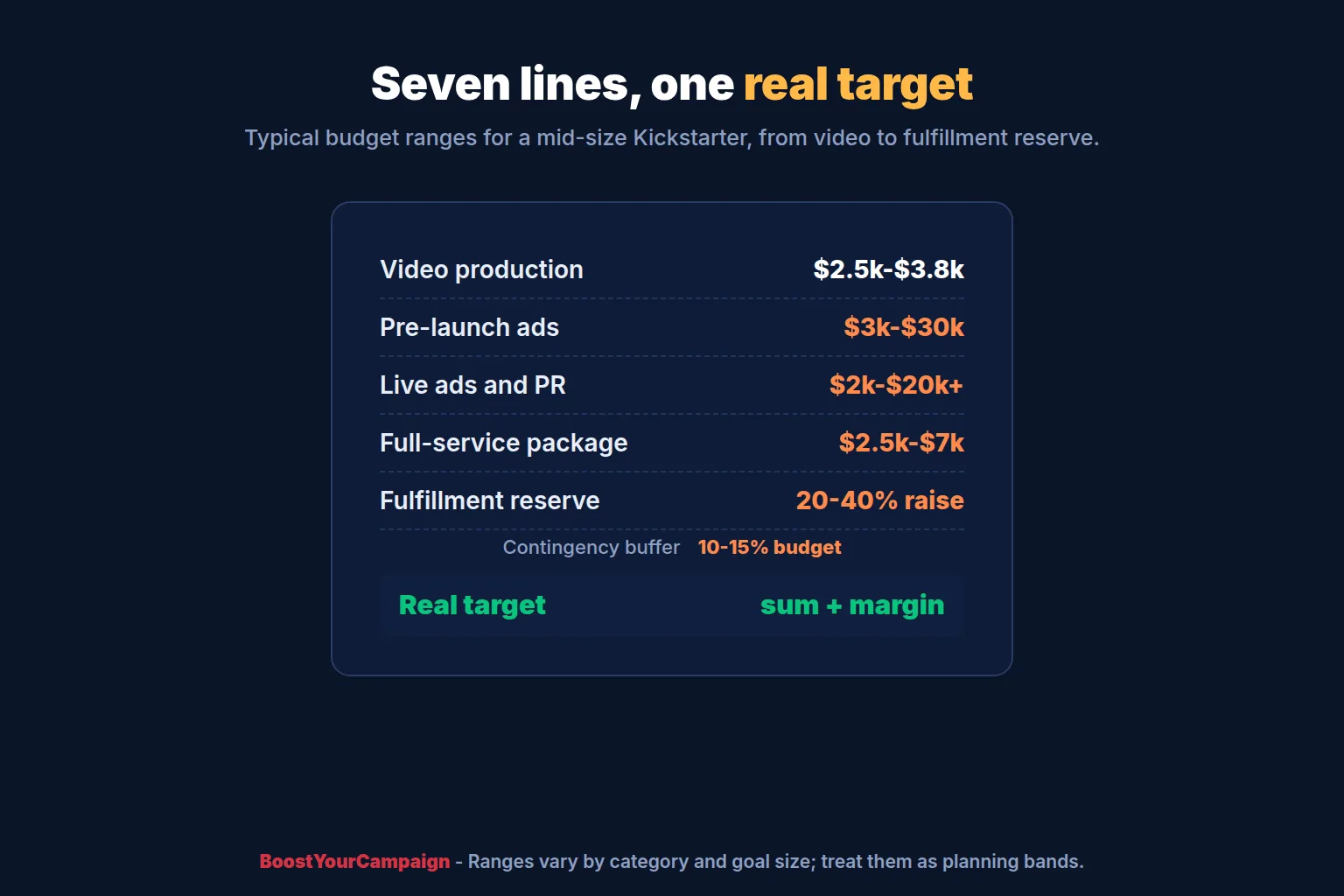
Decision: a line-item budget summing to your real target with margin. Owner: founder with agency or finance support. Deadline: L minus 14 to L minus 12 weeks. Budget line: the table below.
Build the plan from typical ranges rather than a single guess. The lines below are hedged, not guarantees - a bigger or more complex product moves toward the top of each range.
| Line | Typical range | Notes |
|---|---|---|
| Video production | $2,500-$3,799 | A clear, well-paced product demo beats a big-budget shoot |
| Page design and copy | Usually bundled into a full-service package | Photography is included in our video package; prototypes and samples are paid to your factory |
| Pre-launch ads (list building) | $3,000-$30,000 | Roughly $1-$3 per qualified lead, scales with goal size |
| Live-campaign ads and PR | $2,000-$20,000+ | Judged on return against true margin, not raw pledge volume |
| Fulfillment reserve | Quote from a packed sample | The most commonly underestimated line in the whole plan |
| Full-service or agency package | $2,499-$6,997 | Flat, done-for-you pricing that folds page, strategy and marketing together |
| Contingency buffer | 10-15% of budget | Timelines slip and quotes rise between planning and delivery |
5) Audience and list plan
Decision: a list size target, a landing page, and a reservation funnel. Owner: marketing lead. Deadline: L minus 12 through L minus 6 weeks, ongoing. Budget line: pre-launch ads, $3,000-$30,000.
Size your list target to your goal band: sub-$50K goals commonly aim for 2,000-5,000 qualified leads, $50K-$100K for 5,000-10,000, $100K-$500K for 10,000-25,000, and $500K+ for 25,000-50,000 or more. Raw count is a weak signal alone - a reservation funnel with a small deposit, often $1-$25, turns emails into a lead-to-VIP rate you can trust, and a healthy rate sits at 10-30%. Our Kickstarter benchmarks lay out the conversion ranges, and our Meta ads guide for Kickstarter covers the testing structure.
6) Reward structure
Decision: tier count, a hero tier, and early bird pricing. Owner: founder with marketing input. Deadline: L minus 10 to L minus 6 weeks. Budget line: none directly, but this decision sets the margin every other line depends on.
Plan 4-6 visible tiers built around one hero tier most backers are meant to choose, priced off retail with a campaign discount, fees, and product cost already subtracted. An early bird at a 20-40% discount, limited either by quantity or to the first 24 to 48 hours, creates real urgency. Keep most add-ons for the pledge manager rather than the live page. Our reward strategy guide has the full tier ladder and margin math.
7) Creative plan
Decision: video, page structure, images, and when the shoot happens. Owner: creative lead. Deadline: L minus 10 to L minus 6 weeks, with the shoot itself around L minus 9 to L minus 7. Budget line: video production, $2,500-$3,799.
Schedule the shoot early enough that a reshoot is still possible, and late enough that the product is close to final so the video does not promise a spec the build lacks. A focused video under two minutes, with the product on screen and working in the first 5 seconds, out-converts a longer film. Photography for the gallery runs alongside the shoot and is included in our video package rather than charged on top. Our video length and production cost guide covers shot lists and timing.
8) Pre-launch calendar
Decision: the week-by-week calendar from L minus 16 to launch day. Owner: marketing lead. Deadline: drafted by L minus 14, executed continuously. Budget line: spread across the ads and creative lines above.
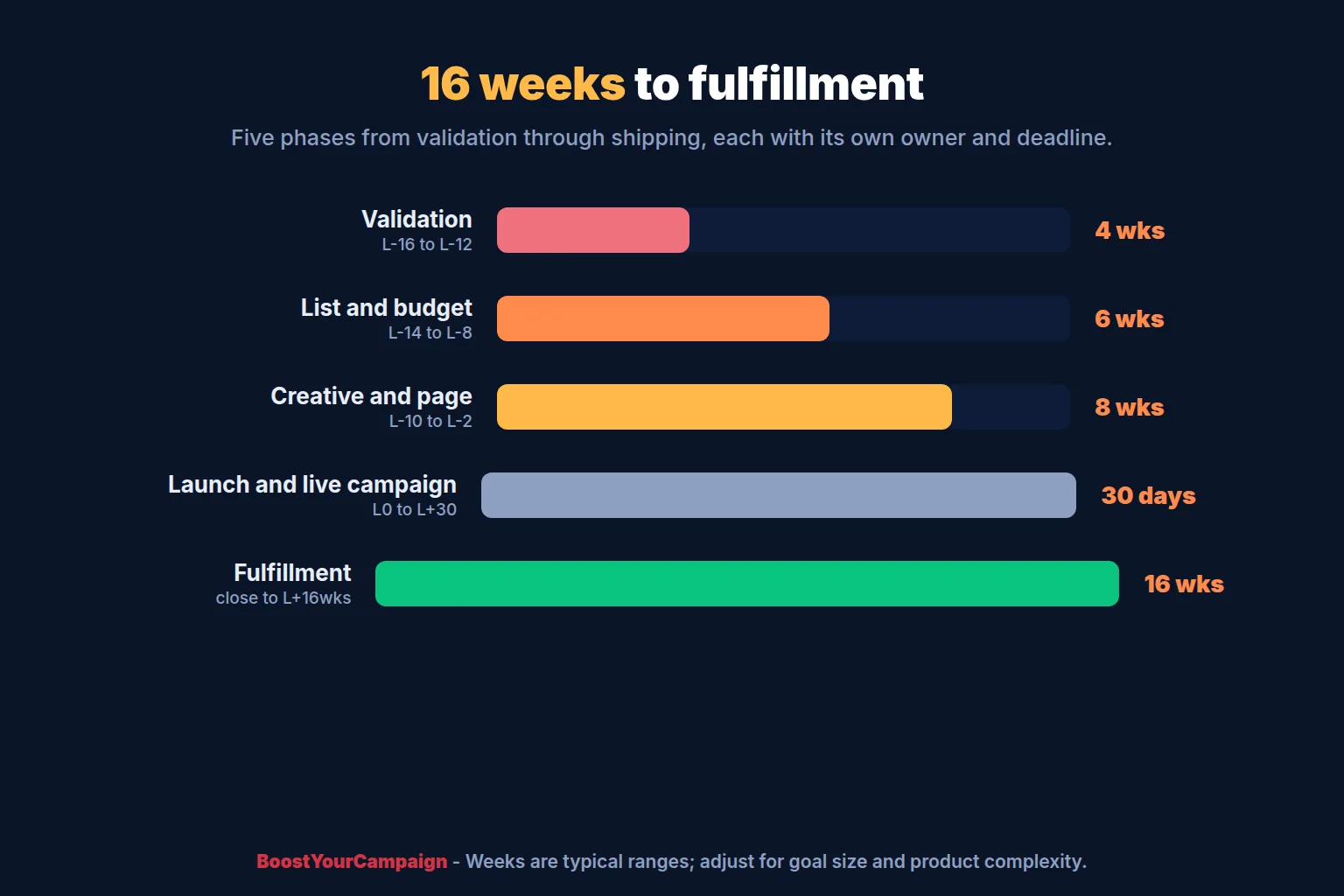
Split the calendar into three phases. L minus 16 to L minus 8: validation, platform choice, budget, and the start of list-building ads. L minus 8 to L minus 2: page and video finalized, reward tiers locked, page submitted for review, list-building scaled toward its target. Final 72 hours: the list is fully warm, ad creative is loaded, the VIP segment is tagged, and the launch-day plan is written down. Our pre-launch checklist and marketing timeline break each phase into tasks.
9) Launch-day plan
Decision: the hour-by-hour sequence for launch day and who runs each part. Owner: the whole team, with one launch-day lead named in advance. Deadline: written by L minus 72 hours, executed at L0. Budget line: none new, this step spends budget already built.
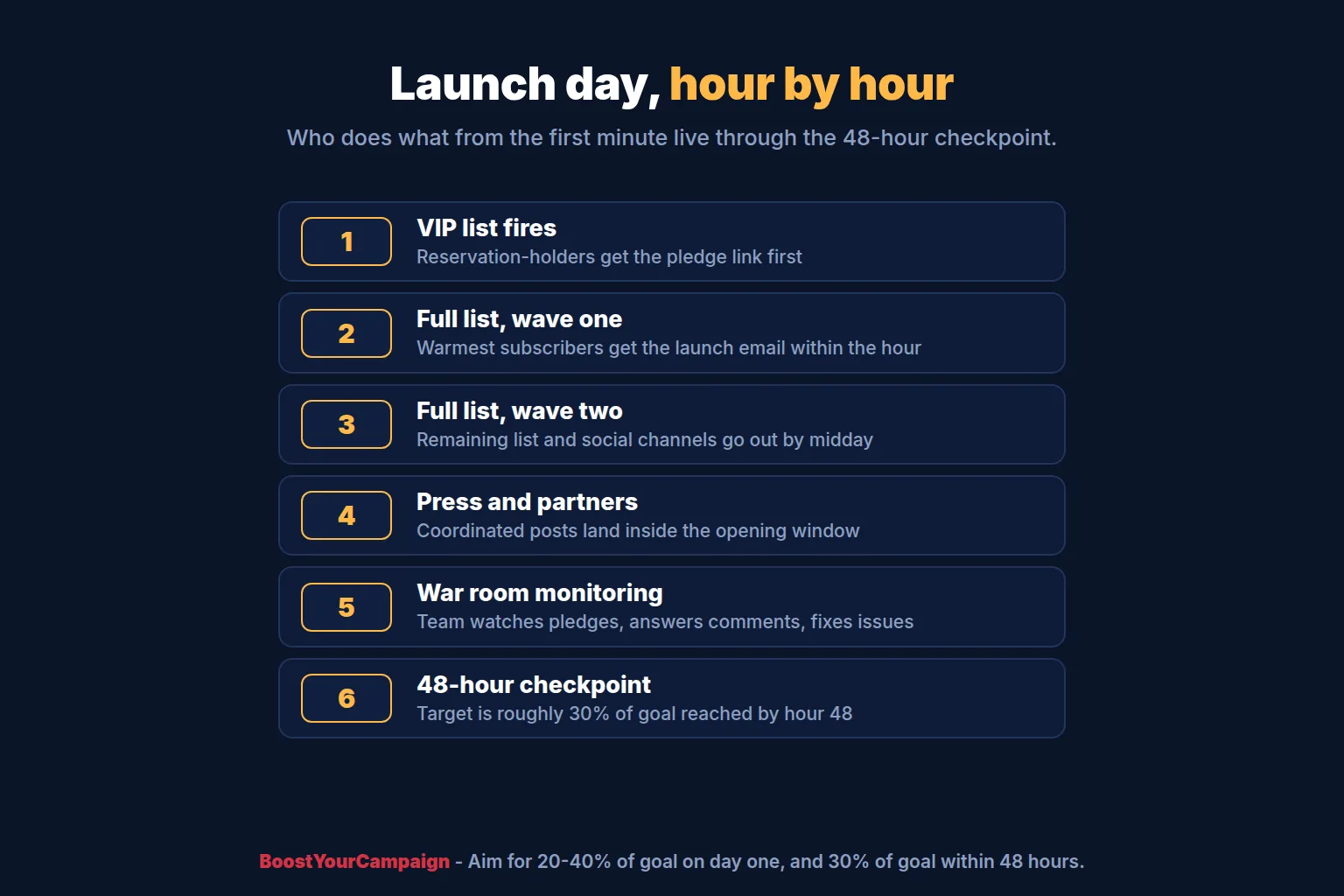
Fire the VIP segment the moment the campaign goes live, since they convert fastest and create the opening spike. Follow with the rest of the list in waves, and coordinate any press or partner posts to land in that window. Aim for 100% of your funding goal on day one, which is what the campaigns BoostYourCampaign runs usually reach. Which day and time you launch also matters; see our guide to the best day to launch a crowdfunding campaign.
10) Live campaign plan
Decision: updates cadence, retargeting, stretch goals, and the mid-campaign slump and final 72 hours. Owner: marketing lead. Deadline: L0 through roughly L plus 25 to 30. Budget line: live-campaign ads and PR, $2,000-$20,000+.
Every campaign follows a similar shape: a strong open, a quieter middle, and a closing surge. Plan for it rather than treating the middle as failure. Post updates on a fixed cadence, keep retargeting ads running against visitors who did not pledge, and roll out stretch goals as milestones pass. In the final 72 hours, re-activate the full list with a real reason to act now and turn ad spend back up, since a meaningful share of pledges land only in the closing hours. Our Meta ads guide covers scaling and retargeting during the live phase.
11) Fulfillment and post-campaign plan
Decision: pledge manager platform, shipping cost model, warehouse split, Late Pledge (formerly called InDemand), and whether a Shopify store follows. Owner: operations or fulfillment lead. Deadline: planned before launch, executed through roughly L plus 8 to 16 weeks. Budget line: fulfillment reserve, quoted from a packed sample rather than as a share of the raise.
Move backers into a pledge manager right after close to confirm addresses, collect shipping, and sell add-ons and late pledges, which often add a meaningful percentage on top of the original raise. International shipping commonly runs several times the domestic rate, and splitting inventory between a US and an EU warehouse turns most cross-border parcels into domestic-style ones, cutting cost, delivery time, and the VAT-at-the-door surprises that damage trust. Once shipped, Late Pledge (formerly called InDemand) or a Shopify store keeps capturing demand from latecomers. Our Kickstarter fulfillment guide covers pledge managers, warehousing, and shipping cost.
12) Risk register
Decision: name what can break and the fallback for each one, before it happens. Owner: founder, reviewed with the whole team at L minus 8 and L minus 2. Budget line: the contingency buffer from section 4, 10-15% of the total budget.
A plan without a risk register is a plan that only works if nothing goes wrong. Build the fallback into the plan itself, not into a panicked message to backers after the fact. If the goal-missed risk becomes real, our guide to what happens if a Kickstarter fails covers the mechanics and the relaunch path.
| Risk | What it looks like | Fallback |
|---|---|---|
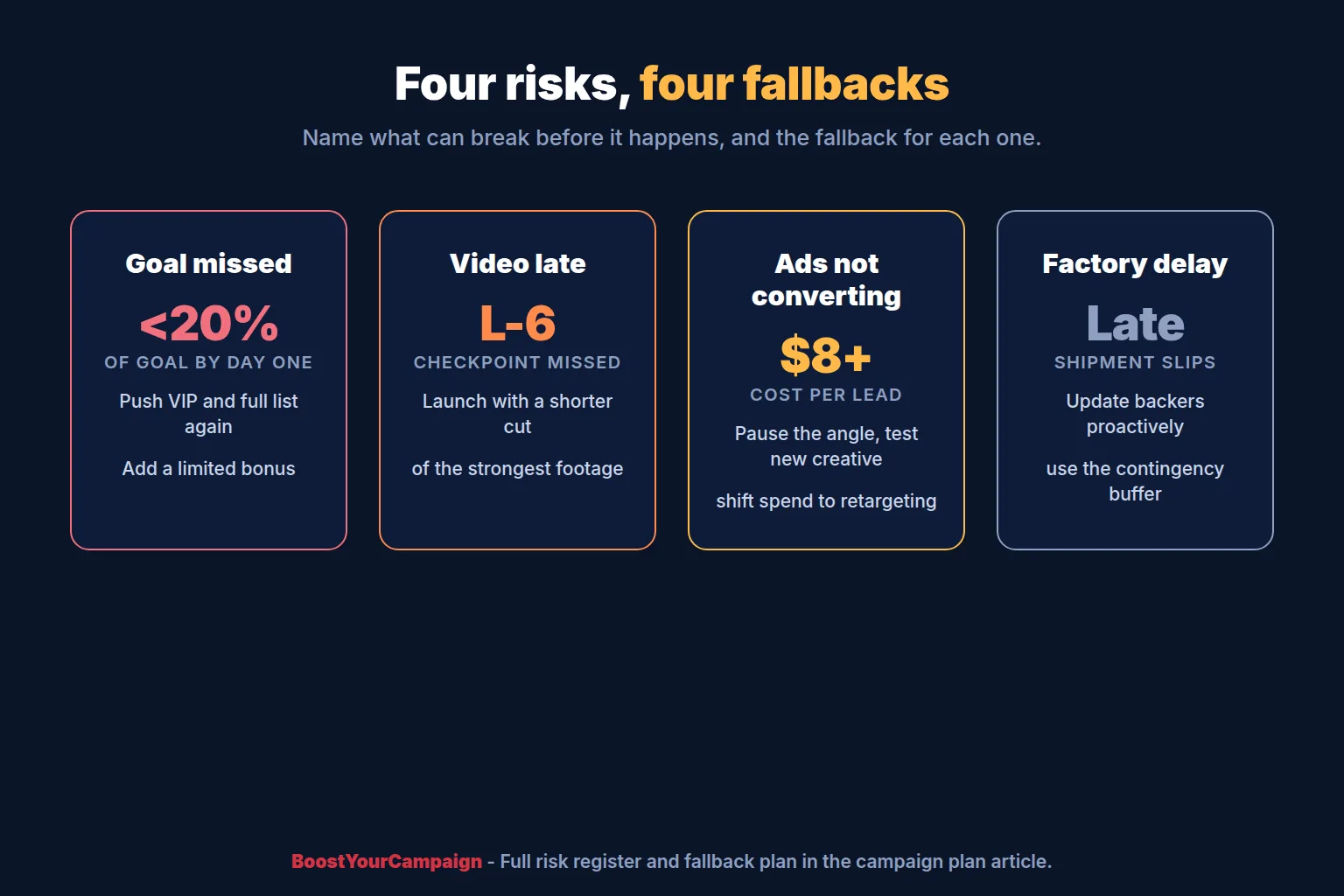
| Goal missed on day one | Under 100% of goal by end of launch day | Push the VIP and full list a second time, add a limited bonus, lean on retargeting |
| Video arrives late | Edit not finished by the L minus 6 checkpoint | Launch with a shorter cut of the strongest footage rather than delay launch day |
| Ads stop converting | Cost per lead or cost per pledge climbing past healthy ranges | Pause the losing angle, test new creative at small budget, shift spend to retargeting |
| Factory or freight delay | Production or shipping slips past the promised delivery date | Update backers proactively, hold the contingency buffer for expedited freight |
The master timeline
Copy this into a sheet and assign real names and dates. "L" is your launch date; every row is relative to it.
| Week | Milestone | Owner | Done when |
|---|---|---|---|
| L minus 16 | Goal math and validation test launched | Founder | Real target and floor goal both written down |
| L minus 14 | Validation gate reviewed, platform chosen | Founder | Thresholds passed, account set up on the platform |
| L minus 12 | Budget locked, list-building ads launched | Founder and marketing | Budget lines sum to the real target, buffer intact |
| L minus 10 | Reward tiers drafted, video shoot scheduled | Founder and creative lead | Hero tier priced against fees and product cost |
| L minus 8 | Video shoot happens, risk register reviewed | Creative lead | Footage in hand, every risk has a fallback |
| L minus 6 | Page draft complete, edit underway | Creative lead | Page reads clearly in a single scroll on mobile |
| L minus 4 | Reward tiers and pricing locked | Founder | Retail, discount, fees, and cost math signed off |
| L minus 2 | Page submitted for review, launch-day plan written | Marketing lead | Approval received, hour-by-hour plan has names attached |
| L minus 72 hours | List fully warmed, ad creative loaded | Marketing lead | VIP segment tagged, emails scheduled |
| L0 (launch day) | VIP fires first, then full list in waves | Whole team | 100% of goal reached by end of day one |
| L plus 2 to 25 | Live campaign, updates, retargeting, stretch goals | Marketing lead | Steady daily pledges, a stretch goal unlocked |
| Final 72 hours | Full list re-activated, ad spend scaled up | Marketing lead | Closing surge captured, no idle days near the deadline |
| Campaign close | Pledge manager opens | Fulfillment lead | Addresses, shipping, and add-ons collected |
| L plus 4 to 8 weeks | Manufacturing and freight underway | Fulfillment lead | Units confirmed in transit to US and EU warehouses |
| L plus 8 to 16 weeks | Fulfillment and Late Pledge live | Fulfillment lead | Backers receiving rewards, Late Pledge open for latecomers |
How BoostYourCampaign fits
We plan campaigns in this order because skipping a step almost always shows up later as a missed goal, a late video, or a fulfillment bill nobody budgeted for. Since 2010 we have run this process across more than 4,600 campaigns with $734M+ raised and a 4.9/5 score across 300+ verified reviews. We use a skin-in-the-game ad model, investing our own money alongside a client's ad budget with fixed fees rather than a percentage-of-raise commission, and we operate owned fulfillment warehouses in the US and EU, so the fulfillment reserve in section 11 gets executed, not guessed at after the campaign funds. See our services, or talk to an expert.
Campaign plan sign-off
- Funding goal and real target set, with fee, marketing, and fulfillment math behind them
- Validation gate passed on visitor-to-lead, lead-to-VIP, and cost-per-lead thresholds
- Platform and category locked, account verified
- Budget lines sum to the real target, contingency buffer intact
- List size target set for the goal band, reservation funnel live
- Reward tiers priced with fees, product cost, and shipping subtracted
- Video shoot scheduled, page structure drafted
- Pre-launch calendar written week by week through launch day
- Launch-day plan named hour by hour, with an owner for every task
- Live-campaign update, retargeting, and final-72-hours plan drafted
- Pledge manager, warehouse split, and shipping cost model chosen
- Risk register reviewed with a fallback for every listed risk
Frequently Asked Questions
How do I plan a Kickstarter campaign?
Work through the plan in order: set your funding goal and real target from real costs, validate the offer against go/fix/stop thresholds, choose a platform, build a full budget, set a list-size target, structure reward tiers, produce the video and page, build a pre-launch calendar, plan launch day hour by hour, plan the live campaign, plan fulfillment before you launch, and keep a risk register with a fallback for each risk. Each step needs an owner and a deadline relative to launch.
How long does it take to plan a Kickstarter campaign?
Most creators need roughly 8-16 weeks of focused planning before launch, with 12-16 weeks common for hardware or higher-goal projects. Validation alone is a 4-8 week sprint, and list-building typically runs 6-8 weeks. Compressing the plan into a few weeks usually means skipping validation or list-building, which raises the risk of stalling in the first days.
What should a Kickstarter campaign plan include?
A complete plan includes a funding goal and real target with fee math behind them, a validation gate, a platform decision, a full line-item budget, a list-size plan, a reward tier structure, a creative production plan, a pre-launch calendar, an hour-by-hour launch-day plan, a live-campaign plan, a fulfillment plan, and a risk register with fallbacks named in advance.
How much budget should I plan for a Kickstarter?
Budget for platform and processing fees (roughly 8-10% of what you raise), marketing of roughly 15-25% of your funding goal weighted toward pre-launch, and a fulfillment reserve quoted from your packed cost of goods, weight and backer mix, which does not scale with the size of your raise. Add a 10-15% contingency buffer on top, since timelines slip and quotes rise between planning and delivery.
When should I start planning a Kickstarter campaign?
Start roughly 16 weeks before your target launch date if you are starting from zero audience. Goal math and validation come first, list-building and creative work run through the middle weeks, and the final two weeks lock the page, the reward tiers, and the launch-day plan. A shorter runway is possible with an existing audience, but 16 weeks is the safer default.
What is a Kickstarter launch strategy?
A launch strategy is the plan for how momentum gets built and spent across three windows: a pre-launch phase that builds a warm list and a validated offer, a launch day that fires that list in waves to hit 100% of goal on day one, and a live-campaign phase that sustains momentum through updates and stretch goals before a final 72-hour push. The strategy is the sequence; this article is what makes it executable.
Is there a Kickstarter campaign plan template?
Yes - the sign-off checklist and the master timeline table on this page are the template. Copy both into a spreadsheet, add real names and dates for your project, and treat each row as a milestone with a done-when condition attached.
Who should be on a Kickstarter launch team?
At minimum: a founder who owns the goal, the budget, and final decisions; a marketing lead who owns list-building, ads, and the live-campaign plan; a creative lead who owns the video and page; and a fulfillment lead who owns the pledge manager, shipping, and warehousing. Small teams often combine these roles, but every function needs a named owner before launch day.
If you want this plan built around your product, goal, and timeline instead of adapted from a template, reach out through /contact and we will map it with you.
How ready is your campaign?
Score your page out of 100 in about 3 minutes, against the benchmarks in this post.
Want results like these for your campaign?
We've helped 4,600+ creators raise over $734M. Let's pressure-test your launch plan and find the highest-leverage fixes before you go live.
Talk to an expert →Get the free 87-step launch checklist
The exact pre-launch, live-campaign and fulfillment steps we use across 4,600+ launches. Free PDF, emailed instantly.
You're in - check your inbox. Open the checklist now ->