Planning a Kickstarter or Indiegogo launch from Australia? Talk with BoostYourCampaign about your product, target market, and timeline.
Australian creators start a Kickstarter or Indiegogo launch with an advantage most overseas brands don't have: English-language copy, cultural familiarity with the platforms, and no translation step. The real obstacle is geography. Almost all of your backers will be in the US and Europe, thousands of kilometers away, which means freight costs eat into margin, delivery times stretch to weeks unless you plan around it, and live campaign hours fall awkwardly outside a normal Australian workday. None of that is a marketing problem in the usual sense. It's a logistics and time zone problem that needs a plan before launch, not after backers start asking where their reward is.
- Language and platform familiarity are not the issue - Australian creators generally understand Kickstarter and Indiegogo conventions natively.
- Freight from Australia is expensive relative to the US and EU - distance and lower shipping volume to Australia mean higher per-unit freight cost in both directions.
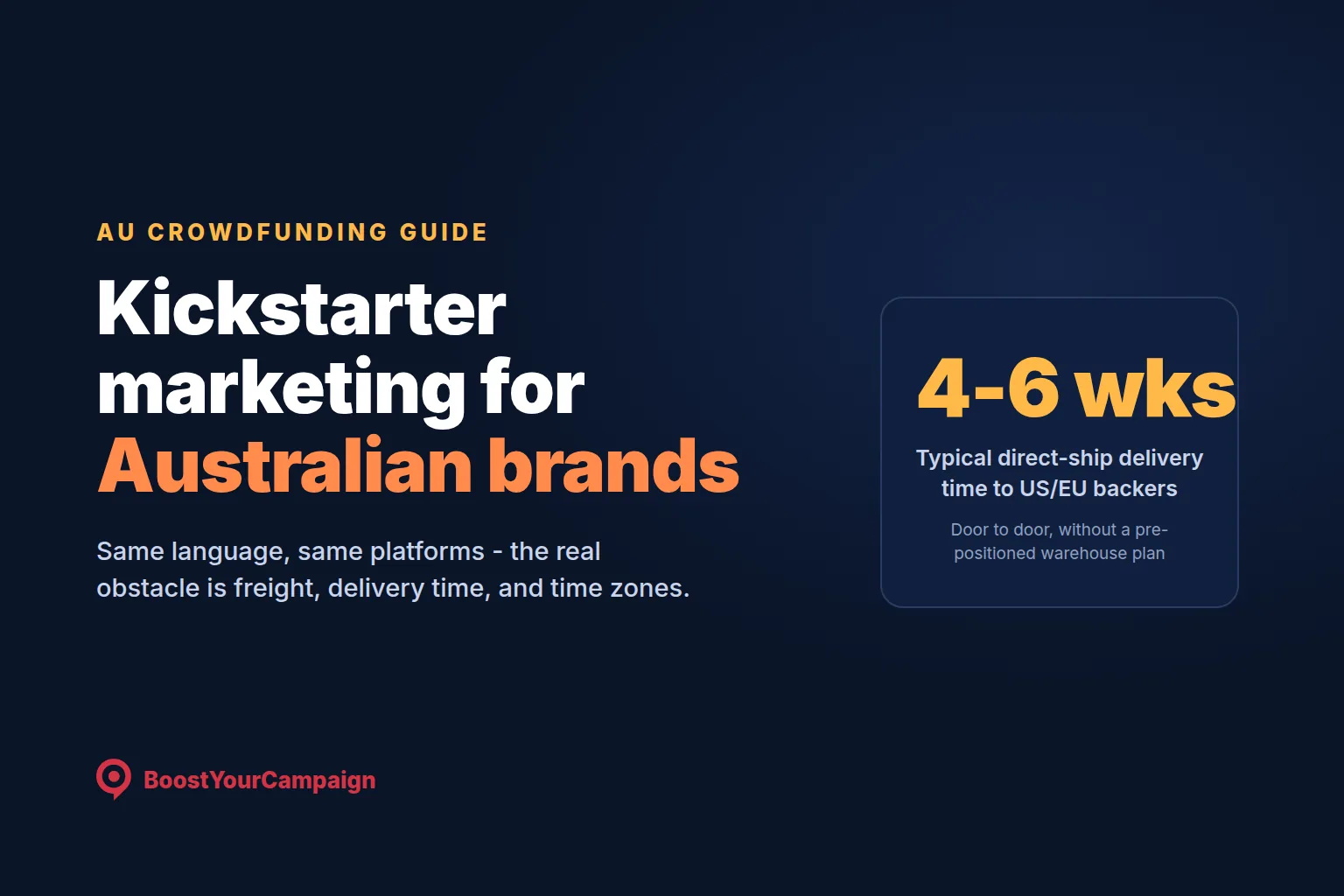
- Direct-ship delivery times frustrate overseas backers - four to six weeks door to door is common without a fulfillment plan built around it.
- Live campaign hours fall outside AEST business hours - most US/EU backer and ad activity happens overnight Australian time.
- Many Australian brands already manufacture in Asia - which changes the practical fulfillment question to where stock should sit, not where it's made.
- In-region US/EU warehousing is usually the fix - pre-positioning stock near backers solves both the cost and delivery-time problem at once.
1) The advantage Australian creators already have
Compared to a brand navigating a language and cultural gap, Australian creators start ahead. Campaign copy doesn't need translation or localization, backers don't discount the pitch for stilted phrasing, and the general expectations around reward tiers, stretch goals, and update cadence are already familiar territory because Australian creators consume the same platforms and follow the same successful campaigns as their US and UK counterparts.
That familiarity means the campaign page itself is rarely the weak point for Australian launches. Where campaigns actually lose ground is almost always downstream of the pitch: in the shipping estimate backers see at checkout, in the delivery date they're promised, and in how responsive the ad account is during the hours their target market is actually online.
Australian brands also carry a specific, positive reputation in outdoor, adventure, and sustainability-minded categories that's worth leaning into deliberately rather than treating as background. Backers in these categories already associate Australia with a genuine relationship to the outdoors rather than a marketing narrative invented for the campaign, which is a real head start most overseas brands don't get to claim.
2) Freight cost is the real tax on an Australia-based campaign
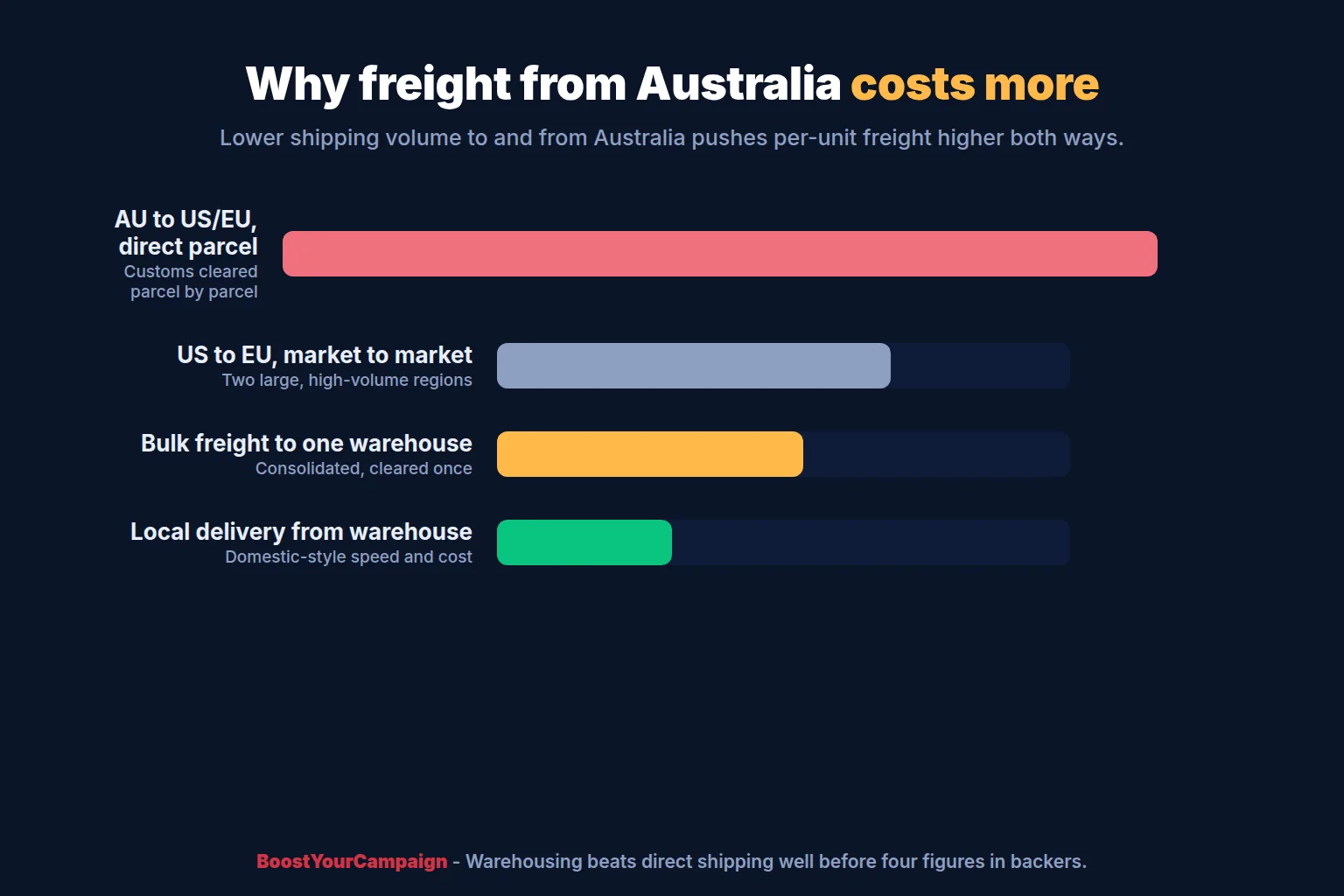
Australia's population and shipping volume relative to the US and Europe mean freight rates in both directions run higher than routes between two large, high-volume markets. A parcel shipped individually from Australia to a backer in Ohio or Berlin costs meaningfully more than the same parcel would cost moving between two US or two EU addresses, and that gap shows up directly in either your shipping charge to backers or your margin if you decide to absorb it.
The instinct for a lot of first-time Australian campaigns is to ship individually, direct from home base, because it's the simplest thing to set up before launch. It's also usually the most expensive option per unit once a campaign has more than a couple hundred backers, and it means every single parcel clears customs individually in the destination country, which adds delay and inconsistency on top of the base freight cost.
It's worth running the actual numbers before committing to a fulfillment approach rather than assuming direct shipping is "good enough" because it's simplest. Getting a quote for bulk freight to a single US or EU warehouse, then comparing the landed cost per unit against individual parcel shipping at your expected backer volume, usually makes the case for in-region warehousing obvious well before a campaign reaches four figures in backers.
3) Delivery time is a trust problem as much as a logistics one
Backers funding a campaign from Australia are often not thinking about the distance involved until their tracking number shows a multi-week transit time. Four to six weeks door to door is common for individually shipped parcels once customs processing is factored in, and that gap between "funded" and "in hand" is exactly the window where support tickets, public comments asking where the reward is, and refund requests tend to spike.
None of that reflects badly on the product. It reflects a fulfillment plan that wasn't built around the actual distance to the audience. Campaigns that get ahead of this, either by setting realistic delivery expectations upfront or by restructuring fulfillment to cut the distance, avoid most of that friction entirely.
Setting the right expectation on the page itself matters more than most creators assume. A clearly stated, realistic delivery window, even if it's longer than backers might prefer, generates far less frustration than an optimistic date that slips, because backers plan around whatever number they're given at pledge time.
4) Live campaign hours don't line up with a normal Australian workday
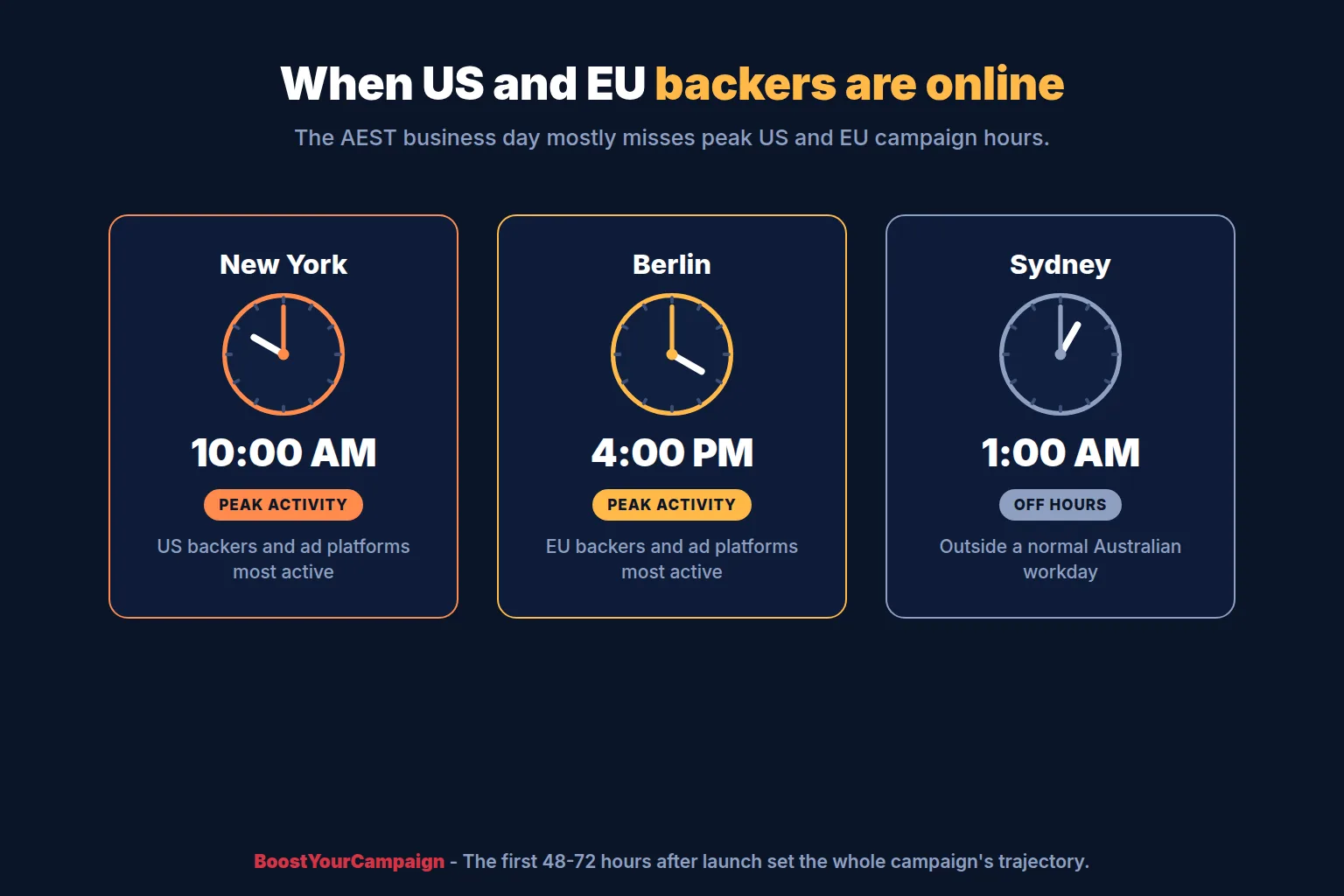
The highest-leverage window for ad optimization, backer questions, and press outreach on a US/EU-targeted campaign happens during US and European daytime, which is late evening through early morning AEST. A campaign monitored only during a standard Australian 9-to-5 will miss most of that window, particularly the first 48 to 72 hours after launch, which typically set the trajectory for the entire funding period.
This is a solvable staffing problem, not a fundamental limitation. Some Australian creators run their own overnight shifts during the critical launch window; others hand live-campaign ad management to a team already covering US and EU hours by default, which avoids the burnout of running a campaign on inverted sleep for a month.
5) A lot of "Australian" products are already manufactured in Asia
Many Australian consumer brands, particularly in hardware, apparel, and outdoor gear, already manufacture through factories in China, Vietnam, or elsewhere in Asia and manage the brand, design, and go-to-market from Australia. That changes the practical fulfillment question from "where is this made" to "where should finished stock sit before it ships to backers," and the answer is rarely Australia once the target audience is almost entirely in the US and Europe.
For brands in this position, it's often more efficient to route finished goods from the Asian factory directly into a US or EU warehouse rather than shipping to Australia first and then back out to backers on the other side of the world. That single routing decision can cut weeks off the fulfillment timeline without changing where the product is actually made.
6) In-region warehousing is the fix, not a workaround
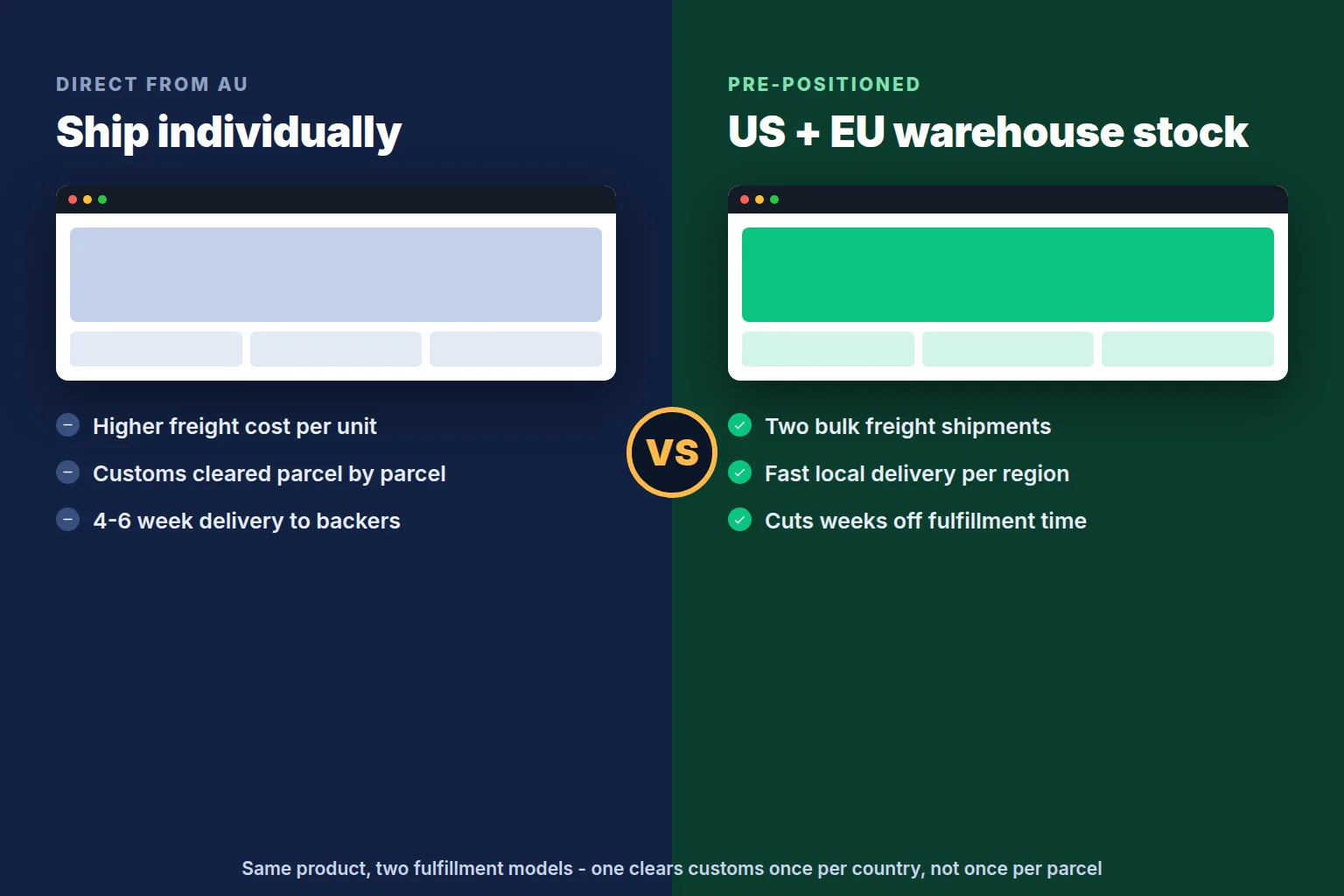
The pattern that solves both the cost and delivery-time problem at once is pre-positioning stock in a US warehouse and, separately, an EU warehouse ahead of or during the campaign, then fulfilling individual backer orders from whichever is closest. This turns thousands of expensive, slow individual international parcels into two predictable bulk freight shipments plus fast local delivery, the same model covered in more depth in our crowdfunding fulfillment companies guide.
EU-bound rewards still need VAT and IOSS registration handled ahead of time regardless of where the brand is based, and it's worth checking current tariff schedules for your product category before finalizing reward pricing, since duties can shift what looked like healthy margin into a thin one. Our crowdfunding tariffs guide covers how to price around that instead of discovering it after launch.
7) Which categories Australian brands already do well in
Outdoor and adventure gear, sustainable and eco-conscious products, apparel, and surf and lifestyle products are categories where Australian brands regularly perform well on Kickstarter and Indiegogo, partly because the country's own outdoor culture gives these products genuine credibility rather than a marketing angle bolted on afterward. Backers respond to that authenticity, and it's worth leading with it rather than treating "Australian-made" or "Australian-designed" as an afterthought in the copy.
Categories with less inherent connection to Australian identity still launch successfully, but they need to lead with the product itself rather than leaning on origin as a selling point, since "from Australia" carries less automatic weight with US and EU backers than it does in outdoor or sustainability-focused categories specifically.
Sustainability claims specifically carry more weight when they're specific rather than asserted: a stated material source, a real end-of-life plan for the product, or a verifiable supply chain detail converts better than a general "eco-friendly" label, which US and EU backers have grown skeptical of after years of loosely substantiated sustainability marketing across many categories, not just crowdfunding.
8) Domestic platforms versus going straight to Kickstarter or Indiegogo
Australia doesn't have a dominant domestic crowdfunding platform the way Japan has Makuake or CAMPFIRE, so most Australian creators go straight to Kickstarter or Indiegogo rather than running a domestic campaign first. That's generally the right call given the audience size difference, but it does mean Australian creators don't get the "practice run" that a domestic-first strategy provides in markets where one exists.
The practical substitute is a genuine pre-launch phase: building an email list, testing messaging with a small paid ad budget before the campaign goes live, and getting page copy reviewed by someone with direct Kickstarter or Indiegogo experience rather than treating the platform's general audience as forgiving of a first draft.
9) Building a pre-launch audience in a market you're not part of yet
An Australian brand with a solid local following, an engaged Instagram audience, a loyal domestic customer base, is starting from close to zero on the US/EU side, since that following largely doesn't overlap with the audience a Kickstarter or Indiegogo campaign needs on day one. English-language content removes the localization step, but it doesn't remove the need to actually reach a new audience before launch.
A genuine pre-launch phase, typically four to eight weeks of paid social ads targeted specifically at US and EU audiences, builds the email list of people who get notified the moment the campaign goes live. Campaigns that skip this and rely on a domestic following to carry a US/EU launch usually see a slow opening day, which then makes it harder to catch the platform's discovery algorithm during the window that matters most for long-term momentum.
This phase also doubles as cheap message testing. A handful of ad variations against a modest budget shows which angle, the product story, a specific use case, or the Australian outdoor and sustainability credibility covered above, actually converts a Western audience before the full campaign budget is committed to one direction.
10) Handling warranty, returns, and support from the other side of the world
A defective unit or a wrong-size exchange is a minor annoyance when the replacement ships from a warehouse down the road. It's a much bigger one when the only option is shipping it back to Australia and waiting weeks for a resolution, and backers weighing whether to trust a new brand often think about this before they pledge, not just after something goes wrong.
A US or EU-based return and replacement point solves this the same way it solves the initial fulfillment problem: it puts support physically close to the backer instead of on the other side of the planet. It also gives the brand a natural base for continued sales after the campaign, whether through Indiegogo's Late Pledge phase or a standalone store, without having to solve the distance problem twice.
How BoostYourCampaign fits
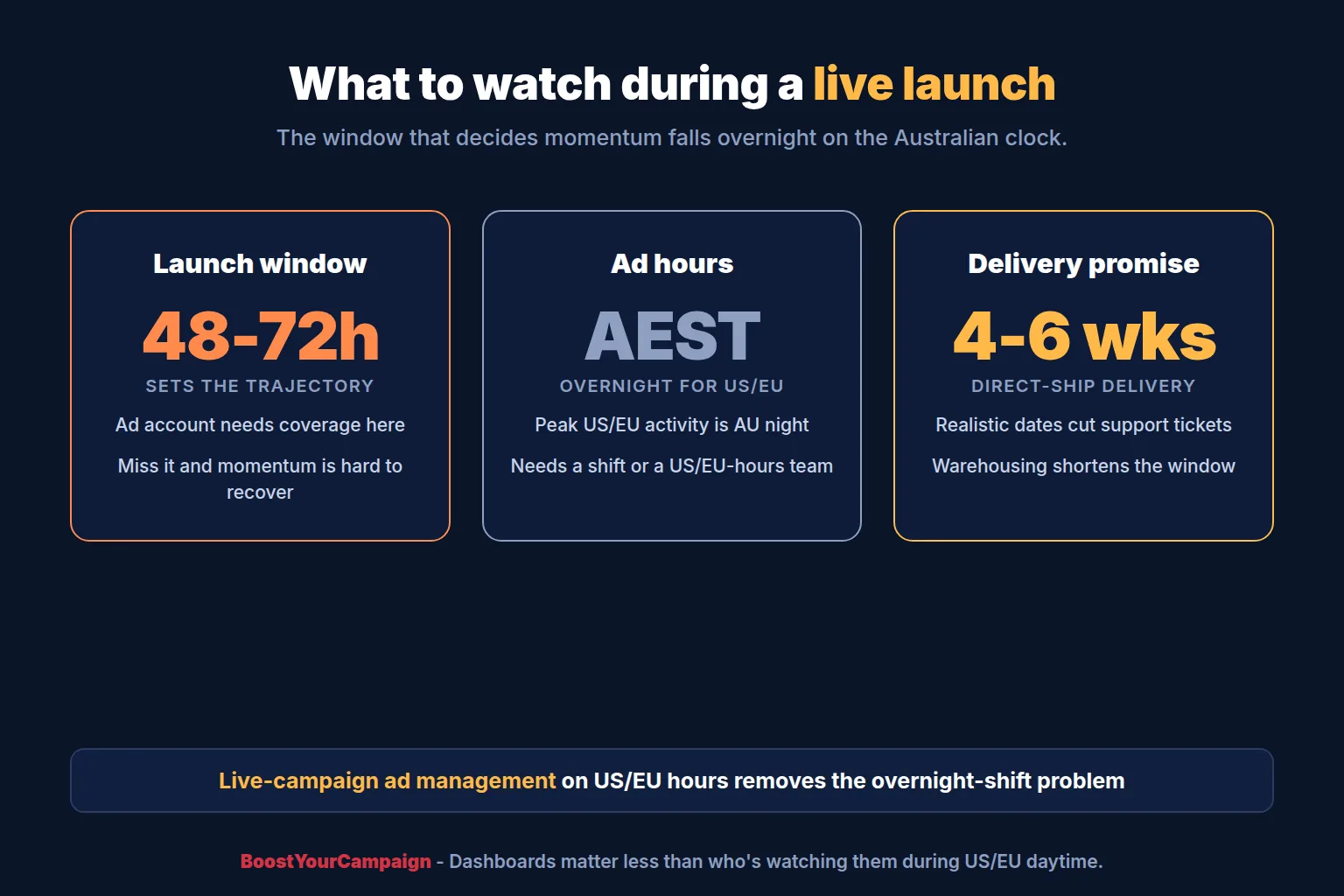
BoostYourCampaign runs a full-stack, done-for-you model built around exactly this kind of geography problem: campaign marketing, video production, and fulfillment under one roof, with owned video production studios and owned fulfillment warehouses in both the US and EU. Live-campaign ad management happens on US/EU hours by default, which removes the overnight-shift problem entirely for Australian creators, and rewards can be pre-positioned close to backers instead of shipped individually across the Pacific and beyond.
BYC uses a skin-in-the-game ad model, investing its own money alongside the client's ad budget with fixed fees rather than a percentage-of-raise commission, which keeps incentives aligned during the live-optimization window that matters most. The agency is an Indiegogo Approved Agency, a Google Premier Partner, a Facebook Marketing Partner, an official Shopify Partner, and an Amazon Partner, active since 2010 across 4,600+ campaigns with $734M+ raised and a 4.9/5 score across 300+ verified reviews, documented on the reviews page.
For brands still finalizing a product ahead of launch, BYC also offers in-house MVP development support (/services/mvp-development), has worked with established ecommerce brands, and can help with retail introductions to major retailers including Best Buy when a product is ready. Client products have also moved from a BYC-run crowdfunding launch to Shark Tank coverage on the press page, and Kevin O'Leary has given a video testimonial about the agency, available on the reviews page. See this pricing guide for cost context while comparing options.
Before you launch from Australia: a quick checklist
| Question | Why it matters |
|---|---|
| Is fulfillment planned as direct-ship or pre-positioned US/EU stock? | Direct-ship from Australia is usually the slowest and most expensive option per unit at volume. |
| Who covers live-campaign ad management outside AEST business hours? | Most US/EU backer and ad-platform activity happens overnight Australian time. |
| If manufacturing happens in Asia, does stock route through Australia first? | Routing finished goods directly into a US/EU warehouse can cut weeks off delivery time. |
| Is VAT/IOSS registration handled for EU rewards? | Unregistered low-value shipments risk getting stuck in EU customs regardless of origin country. |
| Have current tariff and duty schedules been checked for this product category? | Duties can shift what looked like healthy margin at the reward-pricing stage. |
| What delivery estimate is actually realistic, and is it stated on the page? | Setting an honest timeline upfront avoids most delivery-related support volume later. |
We publish the same kind of guide for other markets: Canada, the UK, and Germany and the DACH region.
For the parcel-level numbers behind the freight decision, see Kickstarter shipping costs with real US and EU examples and the customs documentation guide.
Frequently Asked Questions
Do Australian creators face any platform restrictions on Kickstarter or Indiegogo?
No. Australia is an eligible country on both platforms for creator payouts, so there's no structural barrier the way there can be for creators in some other countries. The challenges are logistical, not platform-based.
Is it cheaper to ship directly from Australia or use a US/EU warehouse?
Direct shipping is simpler to set up for a small campaign, but per-unit freight and customs cost usually make pre-positioned US/EU warehousing cheaper once backer counts justify a bulk freight shipment, in addition to being significantly faster.
How much should we budget for shipping from Australia to US/EU backers?
It varies by product weight, dimensions, and category, but freight rates on Australia-to-US/EU routes typically run higher than routes between two high-volume markets like the US and EU. Pricing this accurately before setting reward tiers avoids underpricing shipping and eating the difference out of margin.
Do we need someone awake during US hours for the campaign to succeed?
Not literally awake at all hours, but the first 48 to 72 hours and any major ad-account issue during the campaign benefit from coverage during US/EU daytime, since that's when most backer and ad-platform activity happens.
What if our product is manufactured in Asia rather than Australia?
That's common. It usually makes more sense to route finished stock directly from the Asian factory into a US or EU warehouse rather than shipping it to Australia first and back out again, which adds unnecessary time and cost.
Does Indiegogo's Late Pledge phase help with the shipping cost problem?
Late Pledge, formerly called InDemand, extends the sales window after the main campaign closes, which can help justify a longer production run and a bulk freight shipment to a US or EU warehouse rather than continuing to ship individually from Australia.
Should we run a domestic crowdfunding campaign before launching internationally?
Australia doesn't have a dominant domestic platform the way some markets do, so most Australian creators go straight to Kickstarter or Indiegogo. A genuine pre-launch phase, building an email list and testing messaging with a small ad budget, serves as the substitute for the "practice run" a domestic-first strategy would otherwise provide.
What happens if a backer needs a warranty replacement after delivery?
Routing every claim back to Australia adds weeks to what should be a quick fix. A US or EU-based return and replacement point resolves issues much faster and keeps support conversations from becoming public comments on the campaign page.
If you want a direct read on whether your product and timeline are ready for a US/EU launch, reach out through /contact.
Want results like these for your campaign?
We've helped 4,600+ creators raise over $734M. Let's pressure-test your launch plan and find the highest-leverage fixes before you go live.
Book a free strategy call →Get the free 87-step launch checklist
The exact pre-launch, live-campaign and fulfillment steps we use across 4,600+ launches. Free PDF, emailed instantly.
You're in - check your inbox. Open the checklist now ->