BackerKit started as the pledge manager sitting behind thousands of Kickstarter campaigns, and it now also runs its own crowdfunding platform for creators who want to launch without leaving the BackerKit ecosystem. If you're weighing a BackerKit launch against a Kickstarter one, or trying to plan the pledge manager phase after either, talk with BoostYourCampaign about your audience size and product.
BackerKit Crowdfunding is a launch platform built by the company that already runs pledge management for a large share of Kickstarter campaigns, so tiers, add-ons, surveys, and late pledges live in one system instead of two. It fits creators who bring their own audience - repeat creators, tabletop publishers, and design brands with an existing email list - better than it fits a first-time creator counting on platform discovery, since BackerKit does not have anything like Kickstarter's browse traffic. Most creators still use Kickstarter (or Indiegogo) for the initial discovery-driven raise and then run BackerKit as the pledge manager and pre-order layer afterward, though a growing number of repeat creators now launch directly on BackerKit Crowdfunding itself.
- BackerKit is two things now - the pledge manager almost every Kickstarter creator already uses, and a standalone crowdfunding platform for launching.
- Tiers, add-ons, and the pledge manager are one system - no export/import gap between funding and fulfillment data.
- It rewards creators who bring their own traffic - repeat creators, tabletop publishers, and design brands with a list convert well; cold discovery is thin.
- Fees run in the same range as other rewards platforms - roughly a platform percentage plus payment processing, confirm the current number before you launch.
- It doubles as the post-campaign layer - even Kickstarter-first creators often run BackerKit afterward for late pledges and pre-orders.
- Marketing has to do more of the work - your list, ads, and email carry the launch instead of platform browse traffic.
1) What BackerKit Crowdfunding actually is
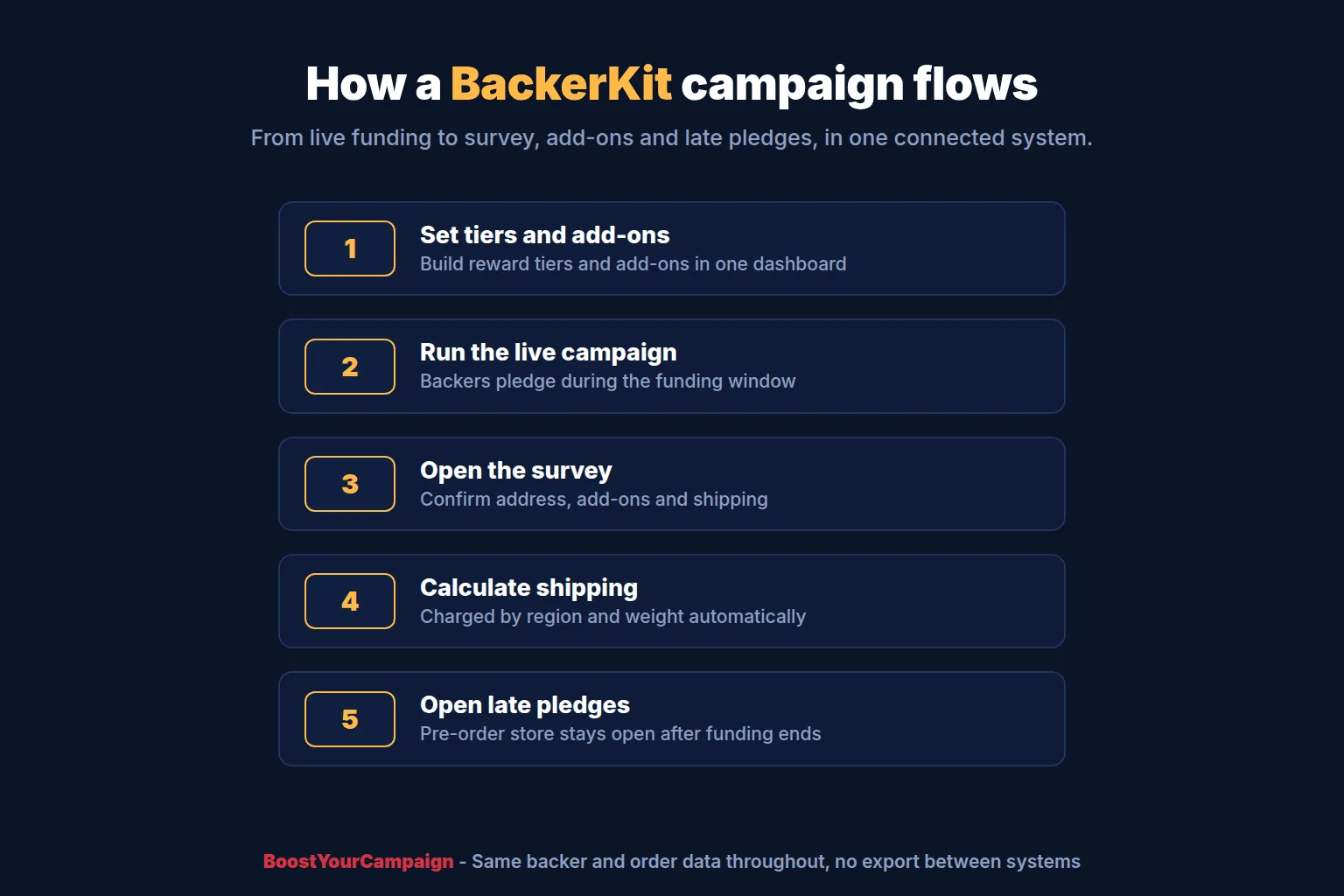
BackerKit built its reputation as a pledge manager, not a launch platform. For years, the standard pattern was: run the campaign on Kickstarter, then move backers into BackerKit's survey and add-on tool once funding closed, to collect shipping addresses, sell upgrades, and calculate freight. That tool is still one of the most widely used pledge managers in tabletop and design crowdfunding, and it's the reason a lot of creators already have a BackerKit account before they ever consider launching a campaign there.
BackerKit Crowdfunding is the company's own launch platform, built on top of that same infrastructure. A campaign can now run entirely inside BackerKit - funding, tiers, add-ons, and the survey - without ever touching Kickstarter or Indiegogo. The pitch is continuity: instead of a campaign living on one platform and its pledge manager on another, with a data handoff in between that occasionally breaks or requires manual cleanup, the whole lifecycle - pledge, survey, add-on sale, late pledge - stays inside one system with one login for you and, often, one account for a backer who's supported you before.
For a repeat creator, that continuity is a real advantage. A backer who supported a previous project on BackerKit already has an account, a saved address, and payment details on file, which lowers friction for exactly the audience most likely to convert quickly. For a first-time creator with no existing BackerKit relationship among their backers, that advantage mostly disappears, since there's no returning-customer effect to draw on yet.
2) How pledge tiers, add-ons, surveys, and late pledges work together
The core mechanic is the same shape as Kickstarter or Indiegogo: a campaign page with reward tiers, a funding goal, and a live window where people pledge. What's different is what happens immediately after. Because the pledge manager isn't a separate product, add-ons, upgrades, and the confirmation survey are available in the same dashboard a creator already used to build the campaign, rather than requiring a second setup pass in a different tool once the campaign funds.
That matters most for shipping and SKU accuracy. On a platform where the campaign and the pledge manager are different products, address collection, add-on sales, and shipping calculation happen in a second wave of setup, often under time pressure right after a campaign ends. Inside BackerKit Crowdfunding, the survey and add-on store are already built around the same tier and product data used during funding, which cuts down on the mismatched-SKU problem that shows up when campaign data has to be re-entered or re-mapped into a separate system.
Late pledges and a pre-order store work the same way once the main campaign closes: BackerKit keeps a storefront open so people who missed the live window can still buy in, at the same or adjusted pricing, and that revenue flows through the same backer and order database as the original campaign. Some campaigns also offer Pledge Over Time or a similar installment option for higher-priced tiers - the exact terms and availability shift, so confirm what's currently offered before you build a tier structure that assumes it.
3) Who fits a BackerKit launch, and who should stick with Kickstarter
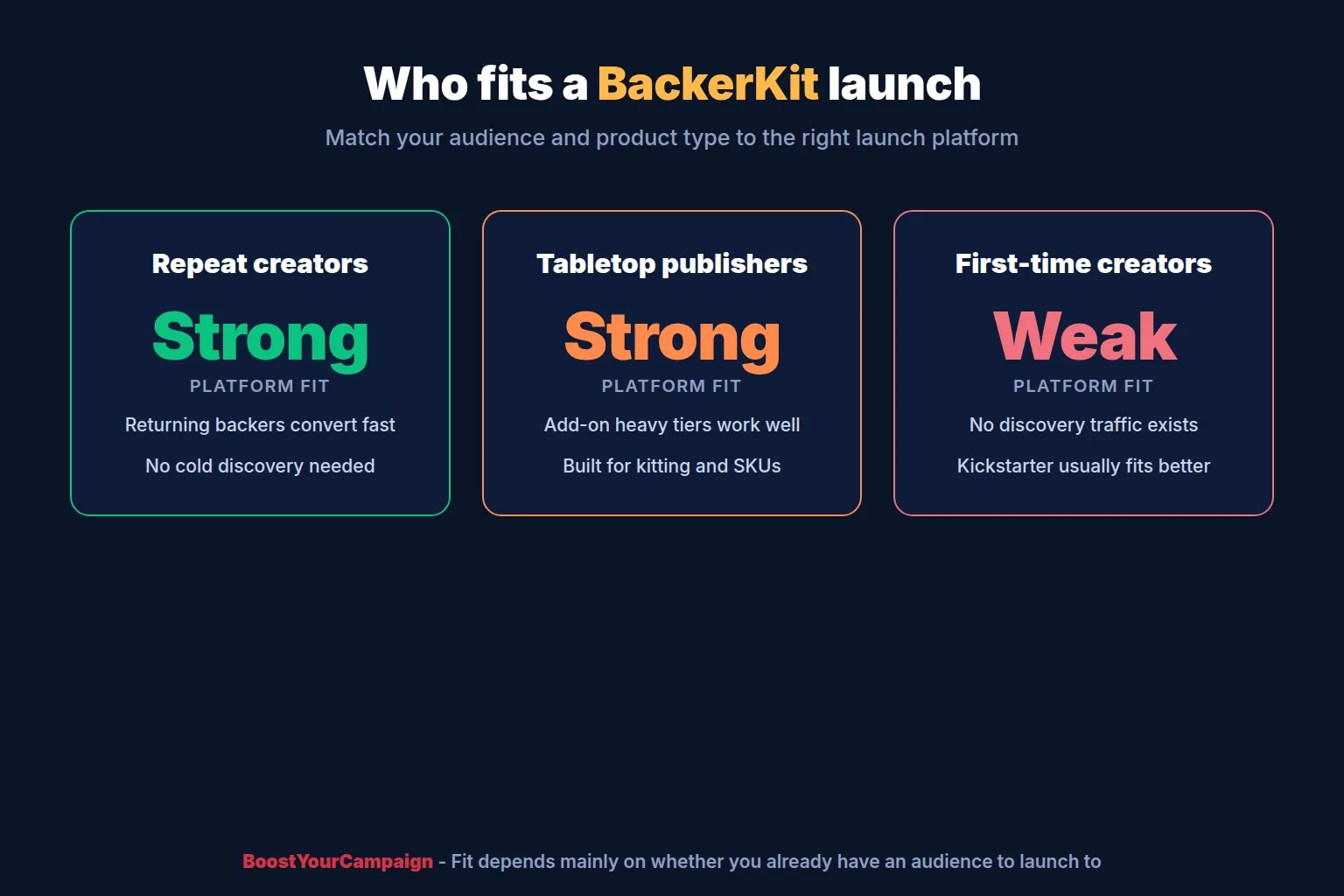
BackerKit Crowdfunding fits a specific profile well: creators who already have an audience that will show up on day one without platform discovery doing any of the work. That's most often a repeat creator with backers from a previous project, a tabletop publisher with an established following, or a design brand with an email list and social following built up before the campaign page goes live. For these creators, the appeal of one continuous system for funding and fulfillment outweighs the loss of Kickstarter's organic browse traffic, because that traffic was never going to be a large share of their raise anyway.
It fits less well for a first-time creator whose plan depends on Kickstarter's "Projects We Love" placement, category browsing, or the platform's own recommendation algorithm to find backers who've never heard of the product. That kind of cold discovery is the thing BackerKit Crowdfunding does not have at anything like Kickstarter's scale, and a campaign that's counting on it to fill a funding goal is better served launching where that discovery traffic actually exists.
A useful way to frame it: if you could name, right now, roughly how many people from your own list or following would pledge in the first 48 hours, BackerKit is a reasonable launch platform. If the honest answer is "I'm hoping the platform finds people for me," Kickstarter or Indiegogo is still the better starting point, with BackerKit picking up the pledge manager and late-pledge work once that campaign funds.
4) BackerKit vs Kickstarter: audience, tools, and fees
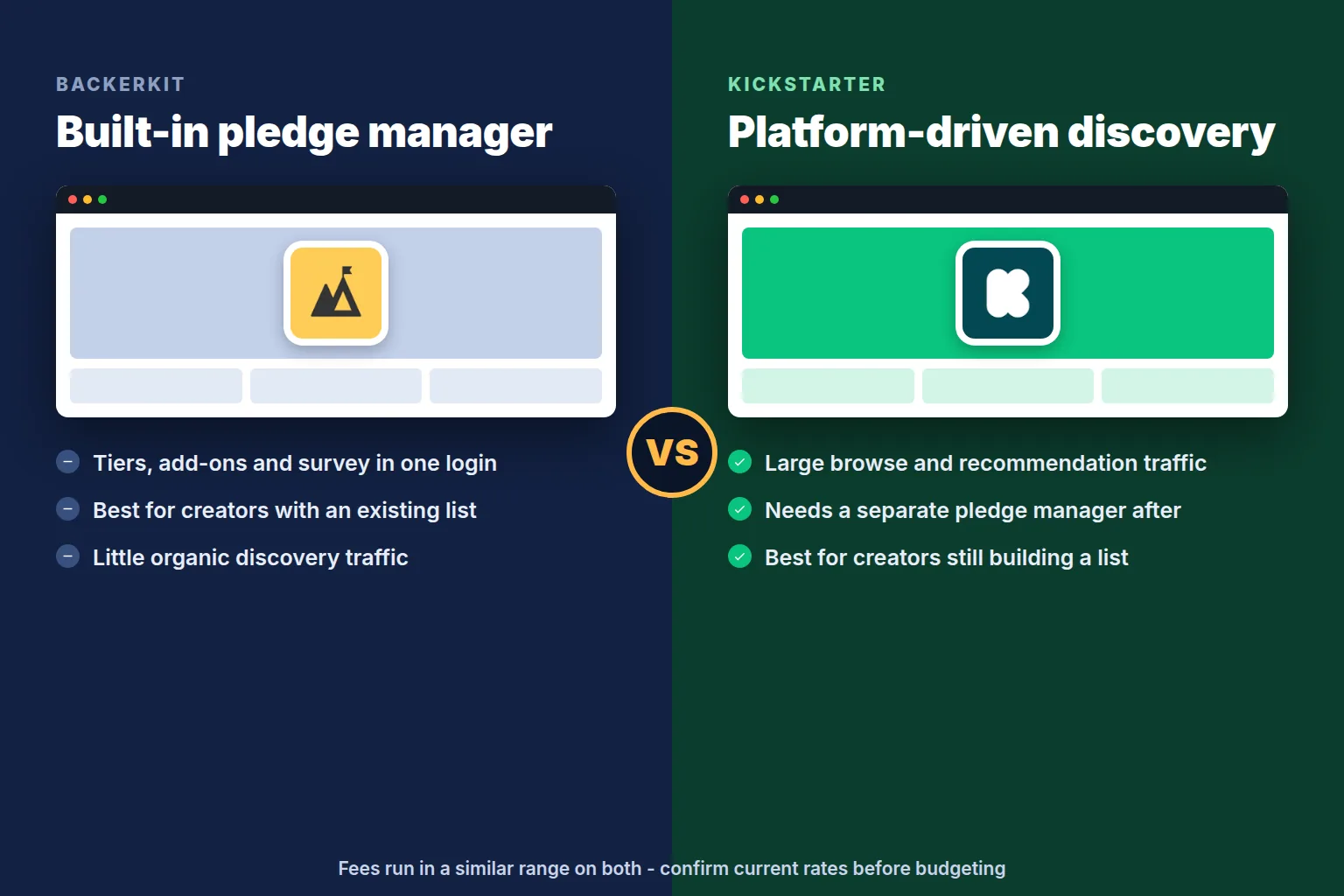
The audience difference is the single biggest factor in this decision. Kickstarter has a large browsing and discovery audience that finds new projects through the platform itself, independent of a creator's own marketing. BackerKit Crowdfunding's audience is mostly backers who already follow specific creators or came from that creator's own marketing; the platform itself isn't a meaningful discovery channel yet. That's not a knock on BackerKit, it's just a different product built for a different job.
On tooling, BackerKit's advantage is the unified pledge manager. A Kickstarter campaign has excellent discovery but needs a second platform (often BackerKit itself) bolted on after funding to run the survey, add-ons, and late pledges. A BackerKit Crowdfunding campaign has that tooling built in from day one, which removes a data-handoff step but also means you're inside one company's ecosystem for the entire lifecycle rather than mixing platforms.
On fees, both platforms charge roughly the same shape of cost: a platform percentage plus separate payment processing fees, in the same general range as most rewards crowdfunding platforms. Confirm the current published rate on each platform directly before finalizing a budget, since these numbers get revised and a stale figure in a spreadsheet is an easy way to misprice a campaign's net proceeds. Our Kickstarter and Indiegogo fees guide breaks down that fee stack in detail for the two bigger platforms, and the same categories - platform fee, payment processing, pledge manager fee where it's a separate cost - apply when budgeting a BackerKit launch.
5) Fees: what actually comes out of a BackerKit raise
BackerKit's published fee structure for its crowdfunding platform runs in the same general range as Kickstarter and Indiegogo - roughly a 5% platform fee plus payment processing, which itself typically runs in the 3-5% range depending on card mix and region. That combined range is consistent with what most rewards crowdfunding platforms charge, so a BackerKit launch shouldn't be budgeted as meaningfully cheaper or more expensive than a Kickstarter one on the platform-fee line alone. Confirm the exact current numbers directly on BackerKit's site before finalizing a budget, since fee structures do get revised.
The other cost line to plan for is the pledge manager itself. On Kickstarter, using BackerKit as a separate pledge manager after the campaign closes typically adds its own fee on top of what Kickstarter already charged. On BackerKit Crowdfunding, that pledge manager function is part of the same platform, so it's worth checking whether the published crowdfunding fee already covers the survey and add-on tooling or whether there's a separate charge for it - the answer affects how you compare total cost between the two paths.
Payment processing, refunds, and chargebacks work about the same way across all these platforms: a small percentage of backers will dispute a charge or request a refund after the fact, and the platform fee on that transaction typically isn't returned even when the backer's payment is. None of these numbers are large enough individually to change a go/no-go decision, but stacked together they're worth modeling against your actual reward pricing before launch rather than after.
6) Running BackerKit as the late-pledge and pre-order layer after a Kickstarter
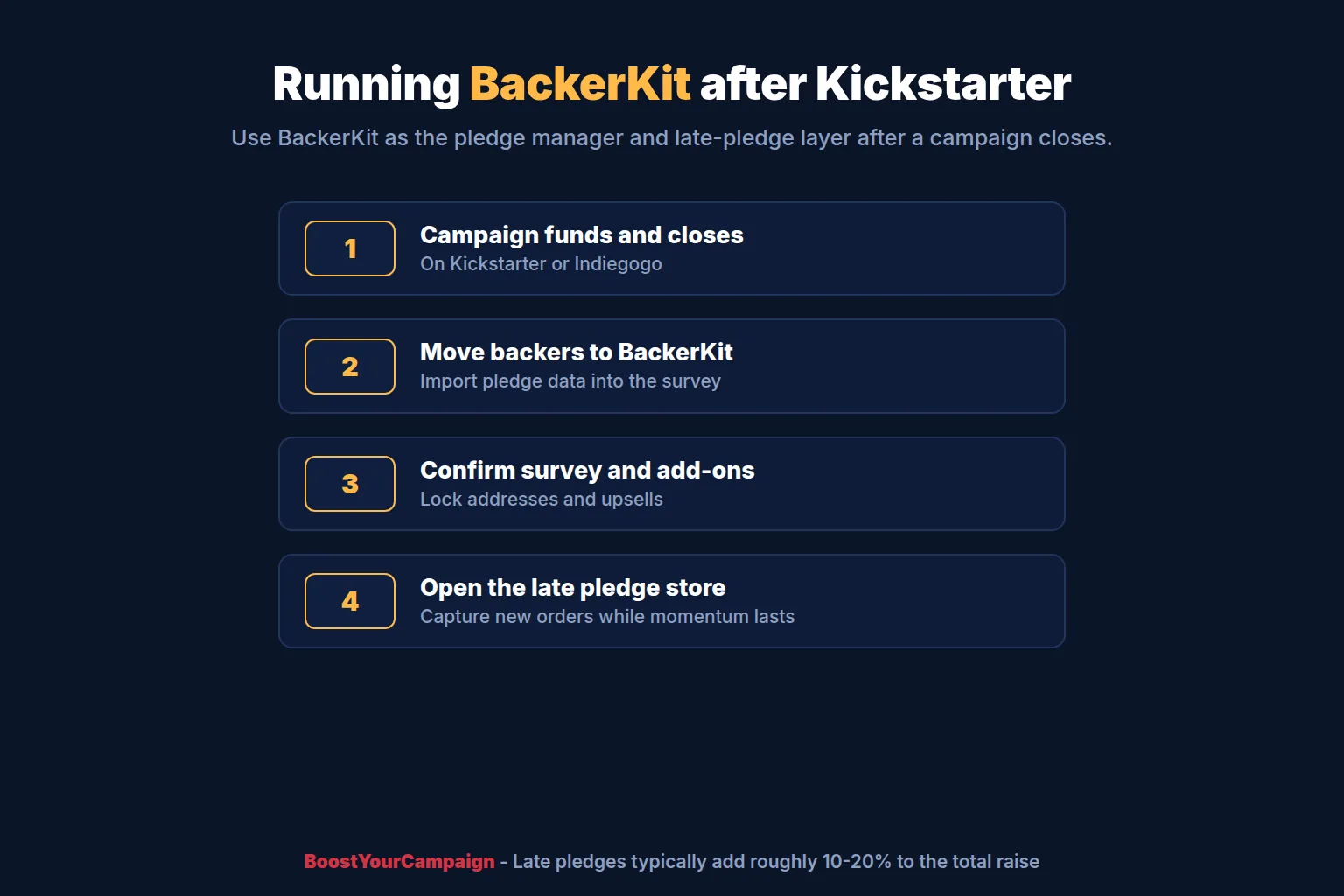
Even for creators who launch on Kickstarter specifically for its discovery traffic, BackerKit is still frequently the tool of choice for what happens next. Once a campaign funds and closes, moving backers into a BackerKit survey to confirm addresses, sell add-ons, and calculate shipping is one of the most common and best-tested workflows in crowdfunding, and it's a separate decision from where the campaign itself was launched.
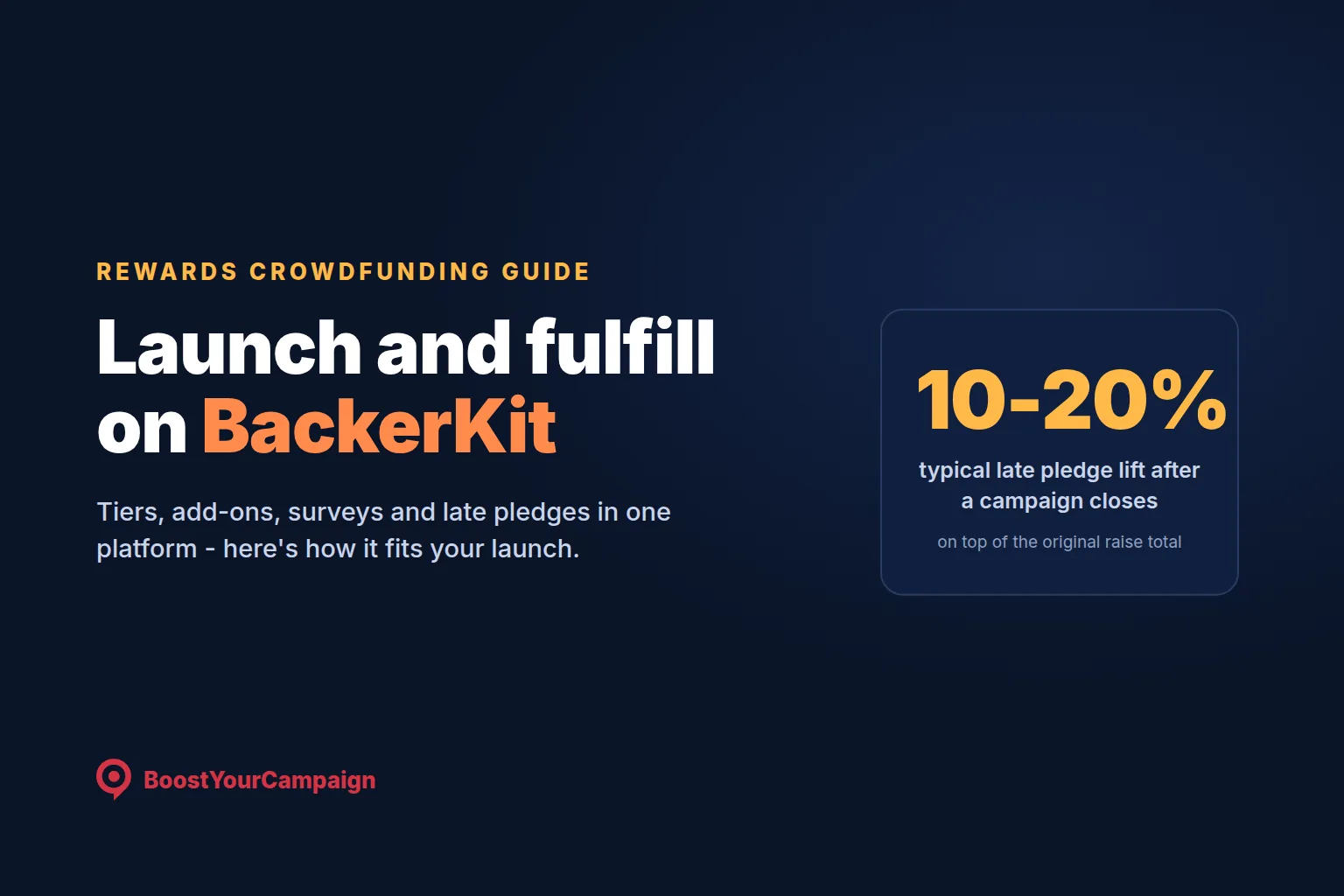
Late pledges typically add roughly 10-20% to a campaign's total raise when opened promptly, while the campaign page still has traffic and backers are still watching for updates. Running that late-pledge window through BackerKit's pre-order store, rather than letting momentum die between "campaign closed" and "pledge manager opens," is one of the more reliable ways to capture that additional revenue. Our guide to selling after a campaign closes and our pledge manager and late pledges guide both go deeper on sequencing that window correctly.
For creators comparing pledge manager options rather than just BackerKit in isolation, our Kickstarter vs Gamefound vs BackerKit comparison and Gamefound guide cover the tabletop-specific alternative that's grown alongside BackerKit in recent years, particularly for board game campaigns with heavy shipping and kitting requirements.
7) Marketing implications: your list carries the launch
The single biggest planning shift for a BackerKit launch versus a Kickstarter one is that organic discovery essentially isn't part of the plan. A Kickstarter campaign can, at least in theory, pick up meaningful traffic from platform browsing, category pages, or an editorial feature, on top of whatever a creator drives themselves. A BackerKit Crowdfunding campaign has to assume that traffic doesn't exist and plan the entire funding curve around owned and paid channels: email list, social following, paid ads, and press outreach a creator generates directly.
That changes pre-launch planning in a concrete way. The email list and paid ad testing that would normally be "extra" insurance on top of Kickstarter's discovery traffic become the entire plan on BackerKit, which means the pre-launch window - building the list, testing ad creative, lining up press - needs more lead time and a larger share of the overall budget relative to a Kickstarter launch. A creator who normally spends 60% of their marketing effort before launch and 40% during it on Kickstarter should expect that ratio to shift further toward pre-launch on BackerKit, since there's no discovery traffic during the live window to lean on.
The upside is that a well-warmed list tends to convert at a higher rate on BackerKit than the same list would see arriving at a Kickstarter page, partly because returning BackerKit backers already have an account and saved payment details, and partly because everyone arriving at the campaign came there on purpose rather than through platform browsing. It's a smaller top of funnel with a tighter conversion rate, rather than a larger top of funnel with more variance.
8) Fulfillment exports and getting from pledge to package
Because BackerKit already functions as a pledge manager, the export path from campaign data to a fulfillment warehouse is generally more direct than a two-platform setup. Address data, tier selections, and add-on purchases live in one place, which reduces (though doesn't eliminate) the SKU-mismatch and address-error problems that show up when data gets moved between a launch platform and a separate pledge manager tool. That said, the export still needs to match whatever format your fulfillment partner's warehouse system expects, and getting a sample export reviewed by the warehouse before the real shipping run starts is worth the extra day it takes.
The underlying fulfillment problems - weight-based shipping cost, a US/EU warehouse split to avoid cross-border customs on every EU parcel, VAT and IOSS registration for EU backers, and packaging that survives a parcel network - don't change based on which pledge manager collected the order. Our Kickstarter fulfillment guide covers those mechanics in full, and they apply the same way whether the order came from a Kickstarter-to-BackerKit handoff or a BackerKit-native campaign.
How BoostYourCampaign fits
BoostYourCampaign runs full-stack crowdfunding marketing and fulfillment for both platform-native and BackerKit launches, which matters here because a BackerKit launch lives or dies on pre-launch list building and paid traffic rather than platform discovery, and that's exactly the phase BYC invests in earliest with clients. The agency runs a skin-in-the-game ad model, putting its own money into ad spend alongside the client's budget with fixed fees rather than a percentage-of-raise commission, so the incentive to build a strong pre-launch list and warm audience is shared rather than one-sided.
On the fulfillment side, BYC operates owned warehouses in the US and EU, so whether a campaign runs natively on BackerKit or lands there as the post-Kickstarter pledge manager and late-pledge layer, the export from BackerKit's order data into an actual shipping plan is handled by the same team that priced the reward tiers in the first place. The agency has run since 2010 across 4,600+ campaigns with $734M+ raised and a 4.9/5 score across 300+ verified reviews, and is an Indiegogo Approved Agency, a Google Premier Partner, a Facebook Marketing Partner, an official Shopify Partner, and an Amazon Partner. For creators weighing BackerKit against other options, our crowdfunding platforms for startups guide covers the broader set of platform options a BackerKit launch sits alongside.
Planning a BackerKit launch: quick checklist
| Question | Why it matters |
|---|---|
| Do you have an existing list or following that can drive day-one pledges? | BackerKit has little to none of Kickstarter's organic discovery traffic. |
| Have you confirmed BackerKit's current platform and processing fees? | Rates shift, and a stale number in your budget model misprices your net proceeds. |
| Is your pre-launch window long enough to build and warm a list? | Owned and paid traffic has to cover the work Kickstarter's discovery traffic would otherwise do. |
| Have you planned a late-pledge and pre-order window after the main campaign? | Late pledges typically add roughly 10-20% to total raise when opened promptly. |
| Does your fulfillment partner support a direct export from BackerKit's order data? | A clean export cuts SKU mismatches and address errors before shipping starts. |
| If you're a first-time creator, would Kickstarter's discovery traffic serve you better? | BackerKit rewards creators who already have an audience more than it helps creators trying to build one from zero. |
For a wider comparison of pledge manager and launch platform options in tabletop specifically, see our Kickstarter vs Gamefound vs BackerKit guide. You can see the full range of what BYC runs on our services page, and for equity-based fundraising as a different capital route entirely once a raise like this has built traction, see our equity crowdfunding marketing service and our Wefunder vs StartEngine vs Republic comparison.
Frequently Asked Questions
Is BackerKit Crowdfunding the same as the BackerKit pledge manager?
They're built on the same underlying platform but serve different jobs. The pledge manager is the survey, add-on, and shipping tool that's been widely used after Kickstarter campaigns for years. BackerKit Crowdfunding is a full launch platform where a campaign can run funding, tiers, and the pledge manager in one system from the start.
Should I launch on BackerKit or Kickstarter?
If your funding plan depends on Kickstarter's platform discovery - browse traffic, category placement, editorial features - Kickstarter is still the better starting point. If you already have a strong list or following from previous projects and don't need platform discovery to find backers, BackerKit Crowdfunding's unified funding-to-fulfillment system is a reasonable direct launch option.
What does BackerKit charge in fees?
BackerKit's crowdfunding platform fee runs in roughly the same range as other rewards platforms, around a 5% platform fee plus separate payment processing typically in the 3-5% range. Confirm the current published rate directly on BackerKit's site before finalizing a campaign budget, since these numbers can change.
Can I use BackerKit after a Kickstarter campaign even if I didn't launch there?
Yes, this is one of the most common uses of BackerKit. Many Kickstarter and Indiegogo creators move backers into a BackerKit survey once the campaign closes, to confirm addresses, sell add-ons, and calculate shipping, entirely separate from where the original campaign launched.
Does BackerKit support installment payments like Pledge Over Time?
Some higher-priced tiers on some campaigns offer an installment-style payment option, but availability and terms shift, so confirm what's currently offered before building a tier structure that assumes it's available for your campaign.
How much do late pledges typically add to a campaign's total?
Late pledges opened promptly after a campaign closes, while the page still has traffic, typically add roughly 10-20% to the total raise. Waiting too long to open that window lets momentum fade and reduces how much of that additional revenue actually shows up.
Does BackerKit work well for board games and tabletop specifically?
Yes, tabletop is one of BackerKit's strongest categories, alongside Gamefound, because both platforms are built around the add-on-heavy, multi-SKU tier structure common in board game campaigns. Our Gamefound guide covers the tabletop-specific alternative in more depth if you're weighing the two.
Does a BackerKit launch need the same marketing effort as a Kickstarter launch?
It typically needs more pre-launch marketing effort, not less, because BackerKit doesn't have Kickstarter's organic discovery traffic to lean on during the live window. A larger share of the total campaign result on BackerKit comes from list building, email, and paid ads done before launch day.
If you're weighing a BackerKit launch or planning the pledge manager phase after a Kickstarter or Indiegogo campaign, reach out through /contact and we'll map out the platform and fulfillment plan together.
Want results like these for your campaign?
We've helped 4,600+ creators raise over $734M. Let's pressure-test your launch plan and find the highest-leverage fixes before you go live.
Talk to an expert →Get the free 87-step launch checklist
The exact pre-launch, live-campaign and fulfillment steps we use across 4,600+ launches. Free PDF, emailed instantly.
You're in - check your inbox. Open the checklist now ->