To hit your Kickstarter goal, work eight marketing tips before launch: analyze whether your product suits crowdfunding, target innovators and early adopters, build your network and community early, run influencer outreach, create your assets and video, host a launch event, drive traffic with a landing page and paid ads, then bring in expert help.
Article Quick Facts
Entrepreneurs Crowdfunding Success Expert TipsReady to maximize your Kickstarter campaign?
Discover proven strategies and expert tips to reach your funding goals.
Campaign Success Metrics
66% Average failure rate Without proper strategy 85% Success with strategy With professional guidance 3.2x Higher ROI Return on marketing investment- Product analysis: study funded campaigns in your category and confirm your idea fits crowdfunding
- Target innovators and early adopters who love backing new products first
- Build your network and community early, while you are still developing the prototype
- Run influencer outreach to bloggers, press, and dedicated niche communities
- Create your marketing assets: social profiles, website, and campaign video
- Host a launch event (local or virtual) with a special offer for early pledges
- Drive traffic with a landing page plus paid and retargeting ads
- Bring in expert help to build and execute the full marketing strategy
20 Kickstarter marketing tips to reach your funding goal
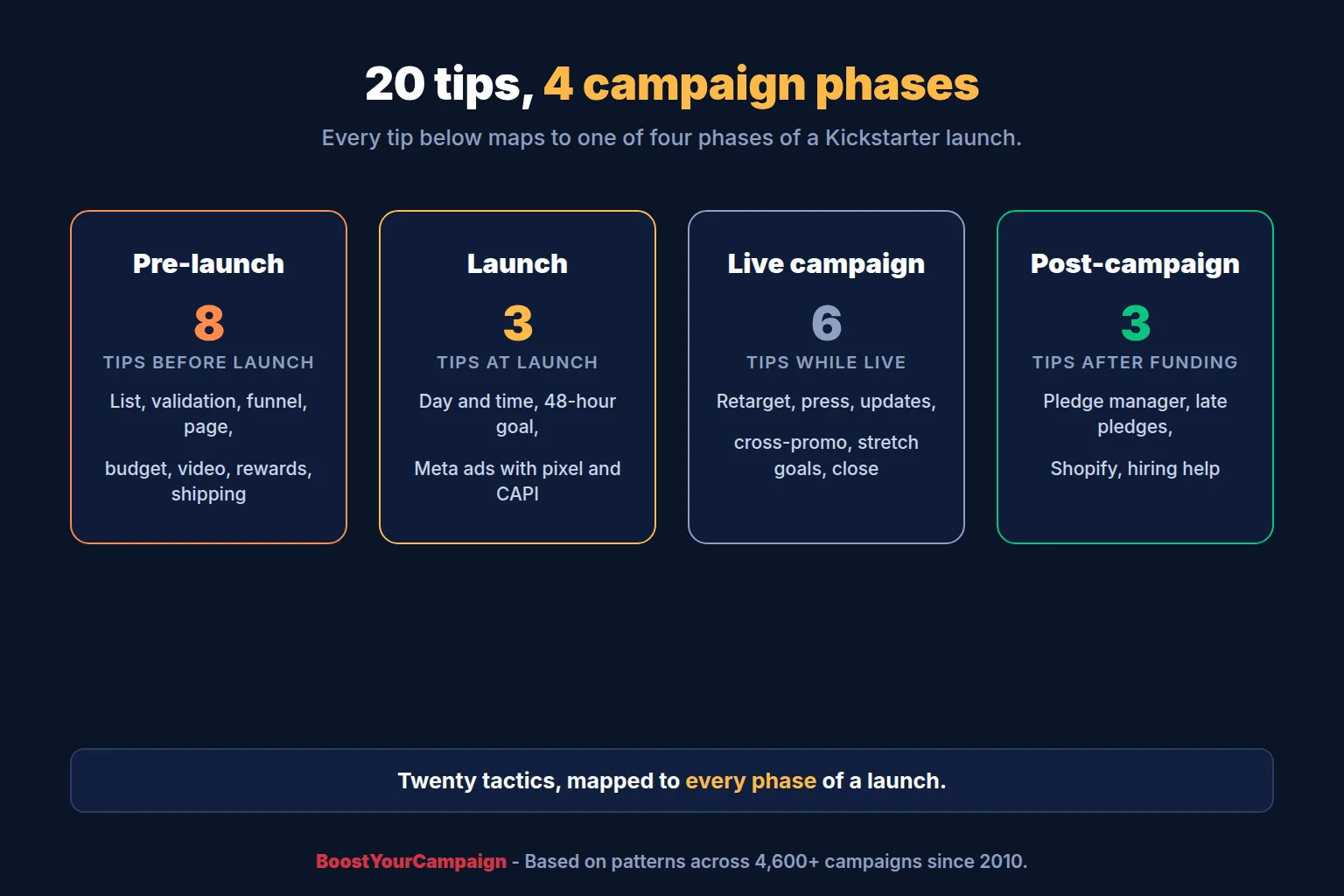
Crowdfunding is a powerful way to start a business, providing market research while increasing capital. But success needs more than a great idea - it needs a marketing plan that runs from the weeks before launch through the months after it closes. These 20 tactics cover every phase, drawn from patterns across more than 4,600 campaigns and $734M+ raised since 2010.
Tips by phase
Every tip below belongs to one of four phases. Use this table to jump to the stage you are planning for right now.
| Phase | Tips covered | Primary focus |
|---|---|---|
| Pre-launch | Tips 1-8: pre-launch list, validation test, $1 reservation funnel, landing page, budget, video, reward tiers, shipping quote | Prove demand and build the list before spending on ads |
| Launch | Tips 9-11: launch day and time, the 48-hour benchmark, Meta ads setup | Convert the warm list into first-week momentum |
| Live campaign | Tips 12-17: retargeting, press and newsletters, update cadence, cross-promotion, stretch goals, final 72 hours | Sustain momentum through the middle and close strong |
| Post-campaign | Tips 18-20: pledge manager and late pledges, moving to Shopify, knowing when to hire help | Turn a funded campaign into a lasting business |
Tip #1: Build the pre-launch list first
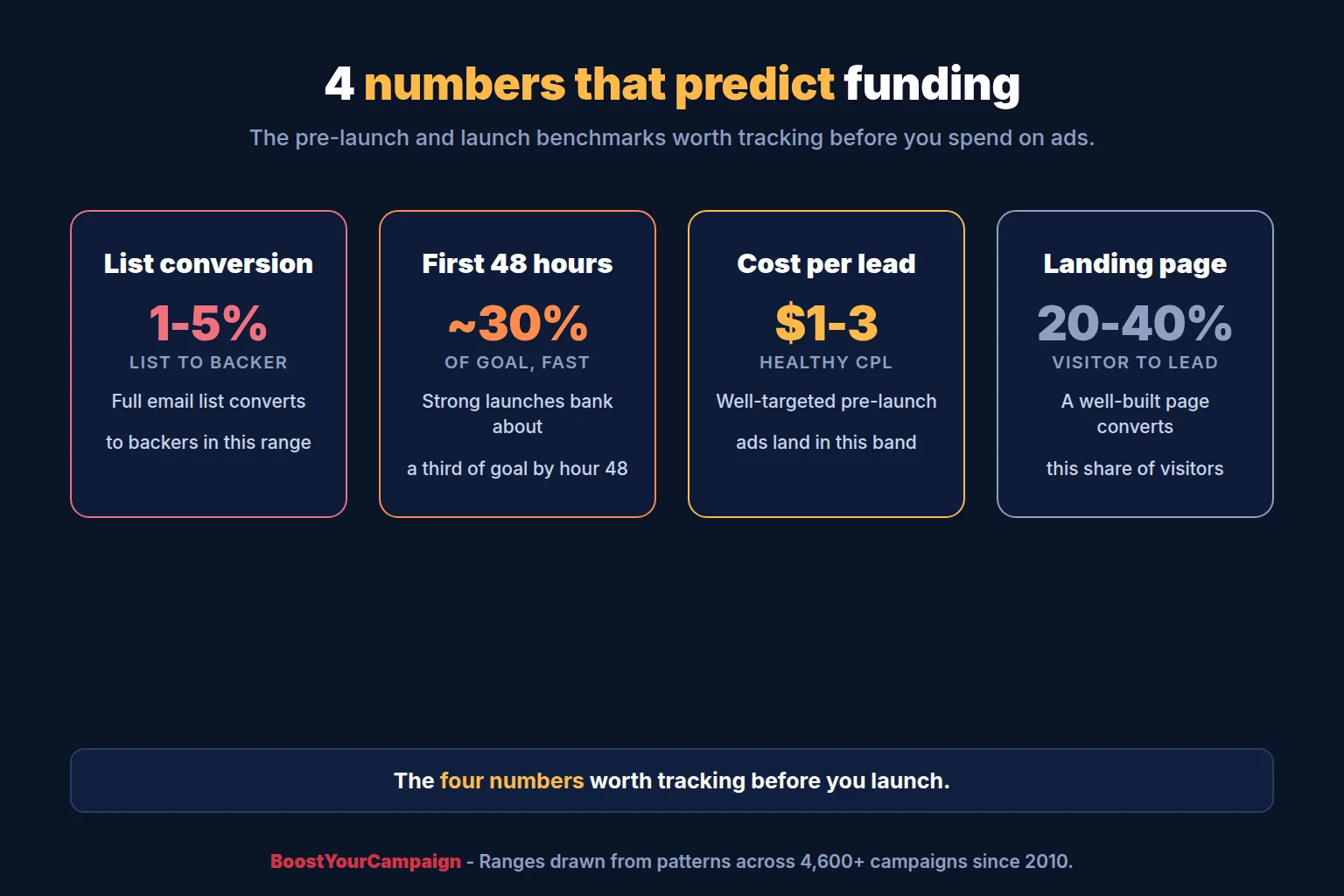
Your pre-launch email list is the single biggest lever on this whole list. In the campaigns we have run since 2010, roughly 90% of the backers who pledge in the first 48 hours come from people who joined the list before launch, not from anyone finding the page cold. Start with your own network: family, friends, and the online communities where people who actually buy products like yours already gather, and treat every conversation as a chance to earn an email address rather than settle for encouragement alone. Aim for at least 2,000 to 5,000 qualified leads for a sub-$50,000 goal, more for a larger one. See our Kickstarter benchmarks for list-size targets by goal band.
Tip #2: Run a validation test
Not every product is ready for crowdfunding, and a prototype plus encouraging friends is not proof that it is. Before locking a launch date, run a small landing page test behind a modest ad budget and read the numbers against real thresholds: a landing page converting visitors to leads at 20% or better is a good sign, and a cost per lead holding steady in the $1 to $3 range as you scale spend means the offer is landing. A rate that never clears single digits, or a cost per lead that keeps climbing, means the offer or price needs work before you spend more. Our guide to how to validate a product before Kickstarter covers the full test sequence.
Tip #3: Use a $1 reservation funnel
A plain email opt-in tells you who is curious. A small refundable deposit, usually $1 to $25, tells you who will actually pay, and that difference is the most useful thing you can measure before launch. VIP reservers who put down a deposit convert to a full pledge at roughly 5 to 10 times the rate of a plain subscriber, and a healthy lead-to-VIP rate sits in the 5% to 15% band. If fewer than 2% of your leads upgrade to a reservation, that is a signal about the offer or price, not about your traffic. Our reservation funnel guide covers how to set the deposit and the follow-up sequence that gets leads to commit.
Tip #4: Build a landing page that converts 20-40%
Before anyone can join your list, they need a page built to collect the email, and a well-built one converts 20% to 40% of visitors into leads. That number lives or dies on the top of the page: a clear headline, a hero image or short clip that shows the product doing what it does, and nothing distracting above the fold. Pair the landing page with matching social profiles so a curious visitor who clicks through finds a consistent story, not a dead end. A page converting in the single digits almost always has a structural problem, not a cosmetic one. Our pre-launch landing page guide breaks down what belongs above the fold.
Tip #5: Plan the budget
A funding goal is not a wish list, it is the output of a budget built from real costs. Platform and processing fees run roughly 8% to 10% of what you raise, marketing typically takes 15% to 25% of your goal, and a fulfillment reserve commonly needs 20% to 40% of the total raise once shipping and overruns are counted. Skipping this step is how creators end up with a funded campaign and no margin left to actually ship the product. Build the goal from manufacturing, fulfillment, fee, and marketing costs added together, not a number that feels achievable. Our Kickstarter campaign plan lays out all 12 planning steps with owners and deadlines.
Tip #6: Keep the video at 2-3 minutes
Videos in the 2 to 3 minute range convert best, and a 2:15 runtime is a workable default for most hardware or consumer products. The first 30 seconds decide whether anyone keeps watching, so open with the product doing what it does, not a logo or a slow introduction, and put the strongest claim before the one-minute mark since retention drops sharply after that. Cost splits into honest tiers: a DIY phone shoot with a tight script runs a few hundred dollars, a freelancer runs roughly $3,000 to $10,000, and full production runs $10,000 to $25,000 or more. Our video length and cost guide covers what drives the price within each tier.
Tip #7: Structure rewards with 4-6 tiers
Most campaigns do best with 4 to 6 visible reward tiers built around one hero tier most backers are meant to choose, not 10 or 12 options that force a comparison instead of a decision. Price the core tier off a real retail price with a 20% to 35% campaign discount, then subtract roughly 8% to 10% in combined platform and processing fees plus your actual product cost to see what margin survives. A limited-quantity early bird, the first 100 or 150 units at a deeper discount, creates real urgency; a countdown clock alone tends to train backers to wait for the next sale. Our reward strategy guide has a full worked margin example.
Tip #8: Quote shipping before pricing
Get real shipping quotes for your actual weight, dimensions, and target regions before you finalize reward prices, not after. A shipping estimate baked into the tier price eight or nine months before a product ships is a guess that freight rates and fuel surcharges will likely move past by delivery time, and a wrong guess either overcharges nearby backers or quietly eats the margin you built into the core tier. Most campaigns now collect shipping separately once addresses and weights are confirmed, and say so plainly on the reward page so nobody is surprised later. EU-bound rewards add a VAT layer worth registering for ahead of time. Our shipping cost guide walks through real dollar ranges by weight and region.
Tip #9: Launch on a Tuesday morning
When you launch matters almost as much as what you launch. Tuesday through Thursday mornings, roughly 8am to 10am in your primary backer time zone, are the most commonly recommended launch windows, since they build a full week of momentum before the weekend slowdown. Pair the moment with a small launch-day event, in person or on social media, so your earliest supporters show up together instead of trickling in over days. Coordinate the exact launch time with your team, your VIP email, and any partner posts so they land in the same narrow window. Our guide to the best day to launch covers the full reasoning.
Tip #10: Aim for 30% of goal in 48 hours
A strong launch typically banks around 30% of its total goal in the first 48 hours, and that share comes overwhelmingly from the pre-launch list rather than organic Kickstarter discovery, which barely contributes before day two or three. Treat that 30% figure as your trajectory checkpoint: if your list size and lead-to-VIP rate cannot plausibly reach anywhere close to it, the honest move is to delay the launch, rebuild the list, or resize the goal, not launch anyway and hope organic traffic fills the gap. Kickstarter's algorithm rewards fast-funding projects with more visibility on Popular and category pages, so early momentum compounds. Our Kickstarter benchmarks page has the full worked example.
Tip #11: Set up Meta ads with pixel and CAPI on the landing page
Kickstarter will not let you install a Meta Pixel or any tracking script on your project page, so cold traffic sent straight there is close to unmeasurable and cannot be retargeted. Install the Pixel and Conversions API on your landing page instead, before you spend a dollar, since CAPI keeps your reported cost per lead honest as browser tracking gets blocked more often. Test new ad sets at $20 a day for 3 to 4 days before deciding to kill or scale, and expect a cost per lead in the $1 to $3 range for a well-targeted campaign with strong creative. Our Meta ads guide covers the full three-phase setup.
Tip #12: Retarget leads who did not pledge
Once the campaign is live, the highest-value audience to retarget is not a cold lookalike, it is people who already raised their hand: landing page visitors who never signed up, leads who have not pledged, and anyone who watched most of a video ad without clicking through. Each group needs a different message, not the same ad repeated. Non-pledging leads respond to a direct "we're live" message with the reward and price attached, while bounced visitors need a reason they did not act the first time. Cap frequency at roughly 3 to 4 views per person over a few days and refresh the creative weekly so it does not fatigue.
Tip #13: Use press and newsletters measured by pledges
Press and influencer coverage feel exciting, but the only number that matters is pledges, not mentions. A feature in a big outlet that drives a handful of visits is worth less than a smaller, dedicated newsletter in your exact category, so research the blogs, forums, and creators your backers already read rather than chasing the biggest name first. Reach out with a clear pitch, a working prototype or demo, and a specific ask, and track every placement with its own link so you can see which ones converted. Treat a quiet week from a big outlet as normal, not a failing campaign. Our guide to getting press for your Kickstarter covers outreach templates and timing.
Tip #14: Post updates on a cadence
Updates influence both existing backers deciding whether to add to their pledge and undecided visitors reading the comments before they commit. Post on a fixed cadence, roughly once a week during the quiet middle stretch and more often around a stretch goal or a milestone, and use each one to show real progress: a manufacturing photo, a shipped sample, an answer to a question that keeps coming up in the comments. Skipping updates for two or three weeks during the middle of a campaign reads as silence, and silence makes anyone still on the fence assume the project stalled. A steady cadence keeps the community you built pre-launch engaged through the slower weeks.
Tip #15: Cross-promote with live campaigns
Other creators running live campaigns in an adjacent category are one of the most overlooked traffic sources on Kickstarter. Reach out to a handful of projects with a similar backer profile, not a direct competitor, and propose a simple trade: a mention in each other's updates, a shoutout in a newsletter, or a shared giveaway. Backers who already trust one crowdfunding creator are more open to backing a second one than a stranger cold from an ad, since the introduction carries some of that trust with it. This costs nothing but outreach time and a few honest conversations, and it works best when you start early enough in your live campaign to actually benefit from the traffic it sends.
Tip #16: Plan stretch goals that protect margin
A stretch goal is a free upgrade for every backer once the campaign clears a funding threshold, and every one you announce is a new cost against the margin your reward pricing already built in. Model the cost, complexity, and shipping impact of a stretch goal before you announce it, not after backers already expect it, and favor unlocks with close to zero marginal cost, like digital content or a name in the credits, over physical add-ons that look exciting mid-campaign and turn into a fulfillment problem later. Space stretch goals out with clear thresholds rather than unlocking several in one burst, which strains both your production plan and your believability. Our stretch goals guide covers sequencing and threshold math.
Tip #17: Push the final 72 hours
A meaningful share of pledges land only in the campaign's closing hours, and treating the final 72 hours as an afterthought leaves real money on the table. Re-activate your full list with a direct, honest reason to act now, not a generic reminder, and turn ad spend back up across every retargeting audience at once, since urgency converts warm traffic at its best rate of the whole campaign. If you have a limited add-on or a last-chance bundle, this is the window to feature it prominently rather than saving it for later. Write the hour-by-hour plan for this window in advance, with one person named to run it, so nothing gets missed while pledges are coming in.
Tip #18: Prepare the pledge manager and late pledges
The campaign closing is not the finish line, it is the handoff into a pledge manager that confirms addresses, collects shipping, and sells add-ons backers did not buy the first time. Move backers into the pledge manager quickly after close, since a fast handoff keeps momentum from the campaign's closing surge instead of losing it to a gap of silence. Late pledges, backers who missed the live campaign but still want in, typically add somewhere in the range of 10% to 20% on top of the original raise for a campaign that keeps marketing after it funds. Our pledge manager and late pledges guide covers which platform fits your project.
Tip #19: Move to Shopify after
A funded Kickstarter is often the start of the real business, not the end of it. The email list, ad audiences, and creative you built for the campaign form the foundation of a direct store once fulfillment winds down, and moving to a platform like Shopify lets you keep selling to backers who found you late and to new customers your ads already proved you can reach. Set this up before the campaign fully closes rather than scrambling for it afterward, so there is no awkward gap between the last reward shipping and the first regular sale. Our guide to moving to Shopify after crowdfunding covers the transition step by step.
Tip #20: Know when to hire help
Every tip on this page is doable alone with enough time and marketing experience, but most first-time creators are learning tracking, ad structure, video, and pledge manager logistics all at once, under a deadline they cannot move. A specialist partner earns its fee by having already made the setup mistakes on someone else's budget: reading a flat lead-to-VIP rate, knowing which stretch goal will not strain production, or catching a shipping quote that would have eaten margin. Since 2010 we have worked on more than 4,600 campaigns and helped raise over $734M, with a 4.9/5 score across 300+ verified reviews. See our Kickstarter marketing services, or compare options in our PR and advertising agencies guide.
| Tip | Main goal | Best timing |
|---|---|---|
| Network and community | Warm backers ready on day one | Months before launch |
| Influencer and press outreach | Awareness inside your niche | Pre-launch and live |
| Marketing assets and video | Credibility and conversion | Before launch |
| Launch event with early offer | Day-one momentum spike | Launch week |
| Landing page and paid ads | Scale reach by interest and demographics | Pre-launch and live |
Frequently asked questions
What is the most important Kickstarter marketing tip?
Build your pre-launch list before you touch ad creative or reward tiers. Roughly 90% of the pledges that land in the first 48 hours come from people who joined an email list or a small paid reservation before launch day. A landing page, several weeks of list-building ads, and a validation test that confirms people will pay come before anything else. Every other tip on this page works better once that list exists, and most barely work without it.
How do I market a Kickstarter with no budget?
A zero ad budget campaign leans hardest on your personal network, an existing email list, relevant online communities, and press. Post the campaign to friends, family, and the niche forums or groups where your actual buyers spend time, and pitch smaller category newsletters directly rather than chasing big outlets first. Ask early testers to share the page on launch day so the first hours show real activity. It caps how far you can scale, but list building, updates, and outreach cost time, not money, and still move pledges.
How early should I start marketing a Kickstarter?
Start 8 to 12 weeks before launch for most physical products, and closer to 16 weeks if the goal is large or the product needs several rounds of validation. That window covers a validation test, list-building ads, landing page iteration, video production, and reward tier pricing, all of which need to finish before launch day rather than get rushed in the final week. Complex hardware or large tabletop projects often benefit from starting even earlier, since prototype rounds and manufacturing quotes take longer than expected.
Do Kickstarter ads work?
Yes, for most categories with a workable price point and margin, but only once tracking and a landing page are in place first. Kickstarter will not accept a Meta pixel on the project page, so ads sent straight there are close to unmeasurable. Ads that send cold traffic to a landing page, build a list, and then retarget people who signed up but have not pledged routinely outperform ads pointed at the campaign page alone. A cost per lead in the $1 to $3 range is a healthy sign the ads are working.
Ready to Launch Your Campaign?
Our team of crowdfunding experts can help you develop and execute a winning marketing strategy.
Frequently Asked Questions
What are the key Kickstarter marketing strategies to reach your funding goal?
This guide covers eight tips: product analysis, targeting innovative backers, using your network and crowdfunding communities, influencer marketing, creating your marketing assets, hosting an event, using a landing page with paid ads, and launching with expert help. Together they turn a great idea into a funded campaign.
How important is your personal network for a Kickstarter campaign?
Your network is one of your strongest early assets. Start talking to family, friends, and neighbors and sharing on social media as you build your prototype, because the earlier you spread the word, the more contacts you will have in place when you launch. People you know often back you even when they do not need the product.
Should you use paid ads for a Kickstarter campaign?
Paid ads are one of the best ways to expand reach and drive traffic based on demographics and interests, and retargeting works as a timely reminder for people who already visited your content. They can get complicated and expensive if you are not experienced, so it often pays to work with a professional crowdfunding marketing company.
How does influencer marketing work for Kickstarter and Indiegogo?
Influencer marketing means actively reaching out to the influencers, bloggers, and press in your product's niche rather than waiting for them to find you. Smaller, dedicated communities often deliver better results than big names, and channels like Twitter and guest blog pitches are great ways to make those connections.
Why does product analysis come first in Kickstarter marketing?
Not every product is suited to crowdfunding, so you start by studying successful campaigns in your category on Kickstarter to see what works. Evaluate your innovation level and unique features, market demand and problem-solution fit, and story potential and emotional connection before you invest in promotion.
Want results like these for your campaign?
We've helped 4,600+ creators raise over $734M. Let's pressure-test your launch plan and find the highest-leverage fixes before you go live.
Book a free strategy call →Get the free 87-step launch checklist
The exact pre-launch, live-campaign and fulfillment steps we use across 4,600+ launches. Free PDF, emailed instantly.
You're in - check your inbox. Open the checklist now ->