Crowdfunding turned "I have an idea" into a real product path for millions of creators, but the word covers four different transactions with four different rules. If you're planning a launch and want the platform and budget sized correctly first, talk with BoostYourCampaign - we've run this playbook on 4,600+ campaigns since 2010.
Crowdfunding is raising money for a project, product, or business from a large number of people online, usually through a platform like Kickstarter or Indiegogo, in exchange for the product itself, equity, interest, or nothing at all depending on the type. For the most common form - rewards crowdfunding - it works like a pre-order engine: backers pay upfront for something that doesn't exist yet, the creator uses that money to manufacture and ship it, and there's no loan and no repayment involved. You keep what backers pledge (minus fees) once your funding threshold is met, and your only obligation is delivering the reward you promised.
- It's four different things wearing one name - rewards, equity, donation, and debt crowdfunding work nothing alike.
- Rewards crowdfunding is a pre-order, not a loan - backers pay for a product they'll receive later, and there's nothing to pay back.
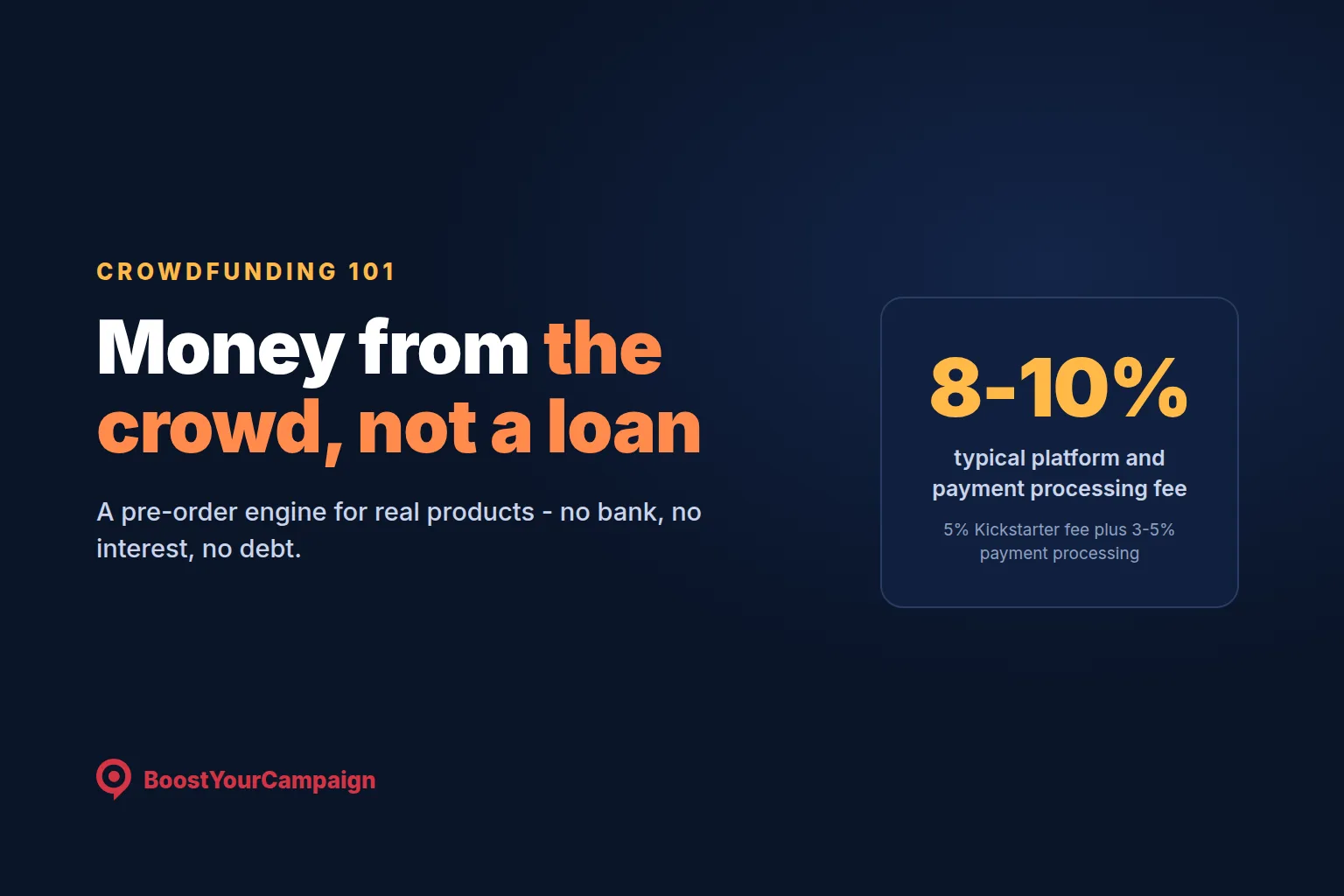
- Fees run roughly 8-10% of what you raise - a 5% platform fee plus 3-5% payment processing, before marketing or fulfillment.
- A pre-launch email list is the strongest predictor of success - campaigns that show up on day one with an audience waiting tend to outperform ones that launch cold.
- Roughly 4 in 10 Kickstarter projects reach their funding goal - it's all-or-nothing, so falling short means backers keep their money.
- Fulfillment, not funding, is where most campaigns actually struggle - getting funded is step one; shipping on time is the harder half.
1) What is crowdfunding
Crowdfunding is the practice of raising money for a project, product, or business from a large number of people, usually online, instead of from a single bank, investor, or lender. Each contributor - a "backer" - gives a relatively small amount, and the total from thousands of backers adds up to the funding a creator needs. What a backer gets back depends on the type: a physical product, a share of the company, the good feeling of supporting a cause, or their money back with interest.
The form most people mean when they say "crowdfunding" - the kind behind Kickstarter and Indiegogo - is rewards-based, and it functions as a pre-order engine, not a loan and not a donation. A creator sets a price for a reward tier, backers pledge that amount before the product exists, and the creator uses the pledged money to fund tooling, manufacturing, and shipping. It's a sale that happens before the product is built rather than after, which means you owe backers a product on roughly the timeline promised, not interest and not equity - a fulfillment obligation, not a debt.
2) How crowdfunding works, step by step
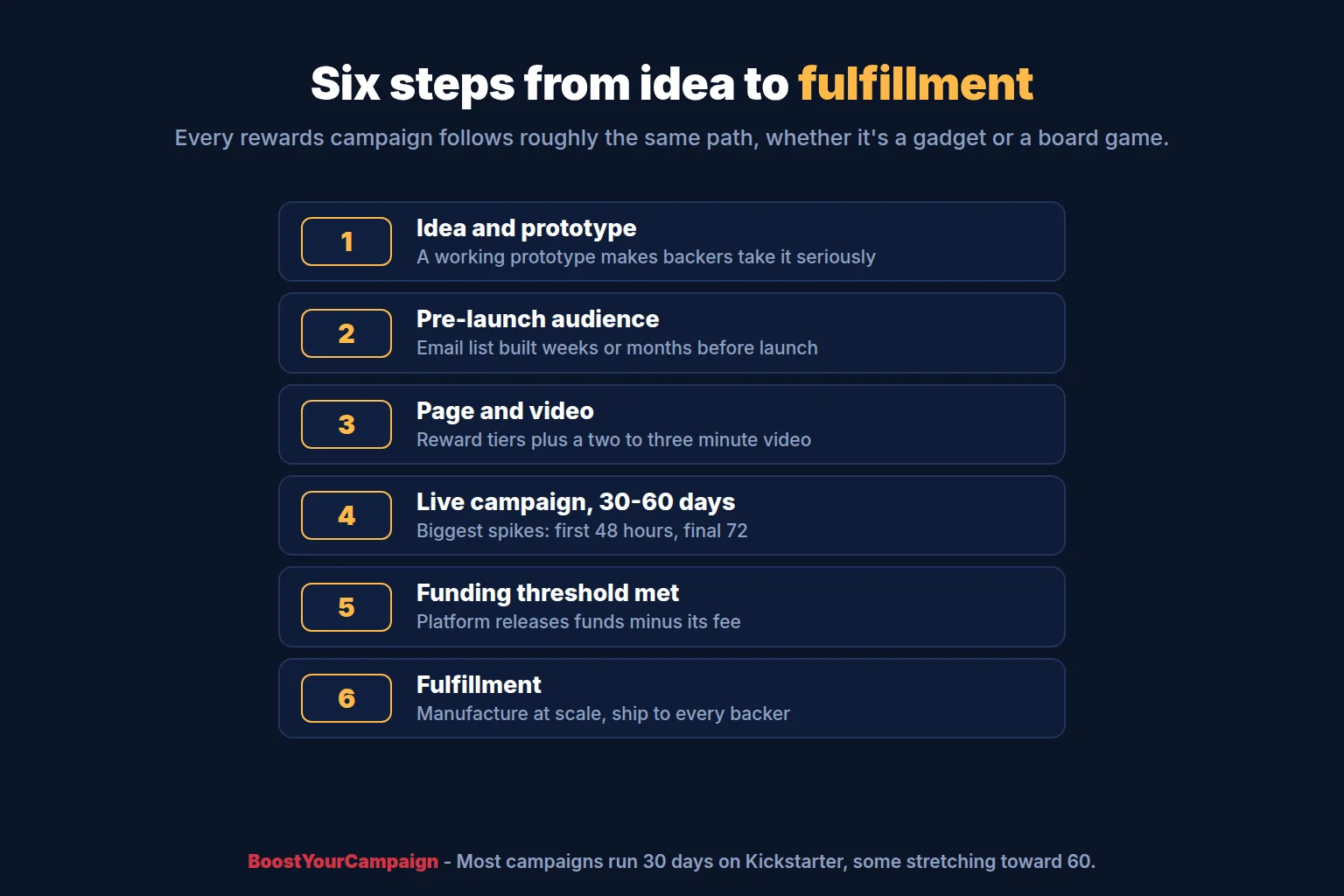
A rewards crowdfunding campaign follows a fairly consistent sequence, and the steps before launch usually decide the outcome more than anything during the campaign itself.
Idea and prototype. The process starts with a working prototype, or at least a convincing, close-to-final render. The gap between a concept sketch and a working prototype is usually the gap between a campaign taken seriously and one that isn't.
Pre-launch audience building. Weeks or months before the page goes live, creators build an email list through a landing page, ads, social content, and press outreach. It's the step first-time creators skip most often, and the audience built here drives the opening-day pledges that shape the platform's discovery treatment afterward.
Campaign page and video. The page - images, copy, reward tiers, and usually a two to three minute video - has to answer what the product is, why it matters, and why the creator can deliver it, in under a minute of scrolling.
The live campaign, typically 30-60 days. Most campaigns run 30 days, some stretching toward 60. The first 48 hours and the final 48-72 hours are usually the two biggest pledge spikes, with a slower middle stretch in between.
Funding threshold and payout. Whether the creator receives the money depends on the platform's funding model, covered in section 8. Once the threshold is met, the platform releases funds minus its fee, usually within a couple of weeks.
Fulfillment. The creator manufactures the product at scale, often through the same factory that built the prototype, then ships it to every backer. This stage regularly outlasts the campaign itself and is where most backer complaints originate, almost always tied to timeline rather than quality.
3) The four types of crowdfunding
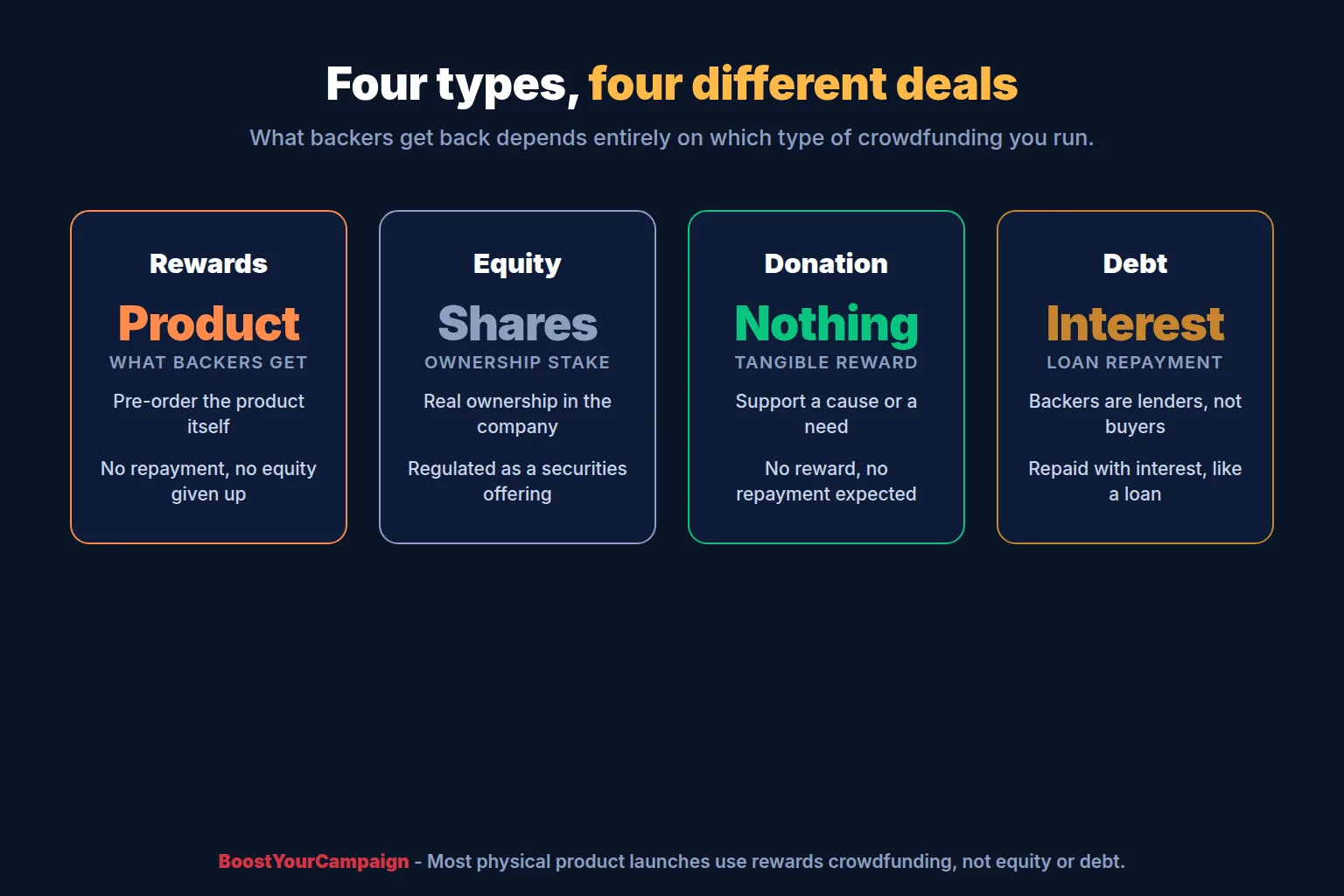
Rewards crowdfunding is the type behind Kickstarter and Indiegogo. Backers pledge money for a product, perk, or experience, not ownership or repayment, usually at a price below eventual retail. It fits physical products, games, and design objects with something tangible to hand over. See our types of crowdfunding guide for the full breakdown.
Equity crowdfunding means backers become investors, receiving shares in the company in exchange for their money. It's regulated as a securities offering in the US, with real filing and disclosure obligations, and fits founders raising capital to build a company rather than fund one production run. Our equity vs rewards crowdfunding guide covers when this route makes sense.
Donation-based crowdfunding asks backers to give money expecting nothing tangible back, usually to support a cause, a medical expense, or a community effort. GoFundMe is the best-known platform here, and it works well for causes but poorly for product launches, since it lacks the reward-tier infrastructure rewards crowdfunding is built around.
Debt-based crowdfunding, or crowdlending, has backers lend money expecting it back with interest, similar to a peer-to-peer loan. It's used for real estate and small business financing far more than consumer products, and it's the one type where "pay it back" is a literal, contractual answer.
| Type | What backers get | Who it suits | Typical platforms | Do you pay it back |
|---|---|---|---|---|
| Rewards | The product itself | Physical products, games, design objects | Kickstarter, Indiegogo, Gamefound | No - you deliver the reward |
| Equity | Shares in the company | Startups raising capital | Wefunder, StartEngine, Republic | No - investors own a share |
| Donation | Nothing tangible | Causes, medical needs, community projects | GoFundMe | No - it's a gift |
| Debt | Repayment plus interest | Real estate, small business financing | Peer-to-peer lending platforms | Yes - it's a loan |
4) The main crowdfunding platforms in 2026
Kickstarter, founded in 2009, remains the platform most associated with rewards crowdfunding and still draws the largest built-in backer audience for design, tech, and creative products. Indiegogo runs a similar model with more structural flexibility, plus Late Pledge (formerly called InDemand), which lets creators keep collecting pledges after the main campaign ends. Gamefound is the default for tabletop and board game campaigns, since its pledge manager is built in rather than bolted on, and BackerKit serves a similar role as a pledge manager many creators layer on top of Kickstarter or Indiegogo. Our Kickstarter vs Indiegogo comparison and Kickstarter vs Gamefound vs BackerKit guide cover the differences.
On the equity side, Wefunder, StartEngine, and Republic are the platforms most startups use for a Regulation Crowdfunding raise; our Wefunder vs StartEngine vs Republic comparison breaks down how they differ. GoFundMe is the dominant name in donation-based crowdfunding, and in Europe, Ulule and Verkami serve a role closer to Kickstarter's for French, Spanish, and other European creators. See our best crowdfunding platforms guide for a broader rundown.
5) What crowdfunding costs
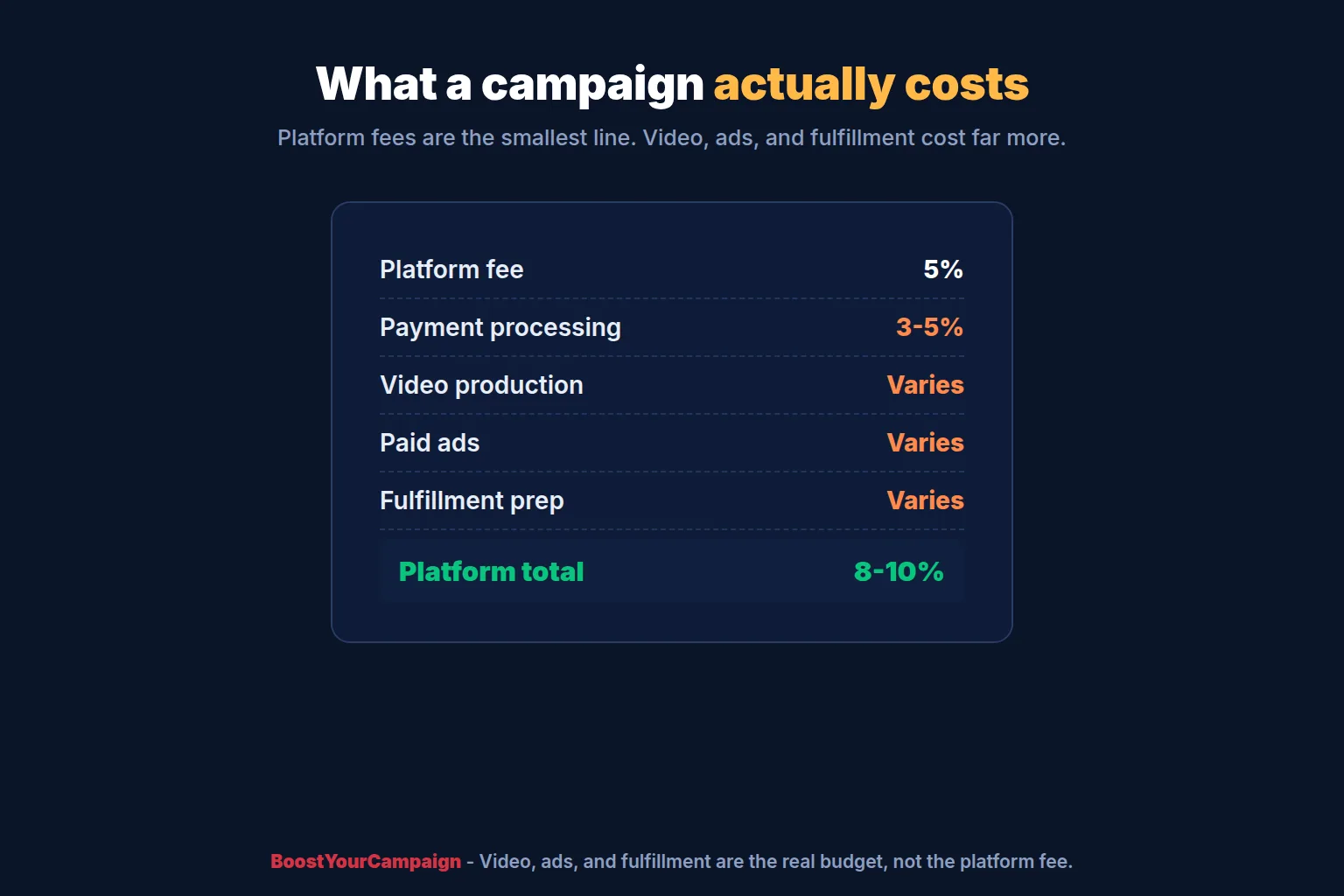
Running a crowdfunding campaign isn't free, for the creator or the backer. Kickstarter charges a 5% fee on funds successfully raised, plus roughly 3-5% for payment processing, so a platform's direct cut typically lands around 8-10% of the total raised. Indiegogo's fee structure runs similarly - just the cost of using the platform and collecting payments.
The larger costs sit outside the platform fee: video production, paid ads, page design and copywriting, PR outreach, and eventually manufacturing and fulfillment once the campaign funds. A modest campaign might spend a few thousand dollars on video and marketing; a campaign aiming for a large, competitive raise can spend well into six figures before a single unit ships. Our guide to what a Kickstarter costs and Kickstarter and Indiegogo fees breakdown go deeper on the line items.
For backers, the cost is the reward tier price plus shipping and, for cross-border orders, sometimes import VAT collected at delivery. There's no platform fee charged to backers directly; it's built into the creator's cut of the raised total.
6) Do you have to pay it back
The honest answer depends on which of the four types you're talking about, and this is the single most common point of confusion about crowdfunding. In rewards crowdfunding, no - you don't pay backers back in cash. You owe them the product they pledged for, on roughly the timeline promised, and once that's shipped your obligation is complete. It's a sale, not a loan.
In equity crowdfunding, there's no repayment either, but something arguably bigger is given up: real ownership. Investors hold shares and participate in future value rather than getting cash back on a schedule. In donation-based crowdfunding, no repayment is expected at all - it's a gift. In debt-based crowdfunding, yes: backers are lenders, and the money comes with interest and a repayment schedule like any other loan.
So "money you never pay back" is true for rewards and donation campaigns in the literal cash sense, misleading for equity, and false for debt-based crowdfunding. Knowing which bucket a campaign falls into avoids a lot of confusion.
7) What makes campaigns succeed or fail
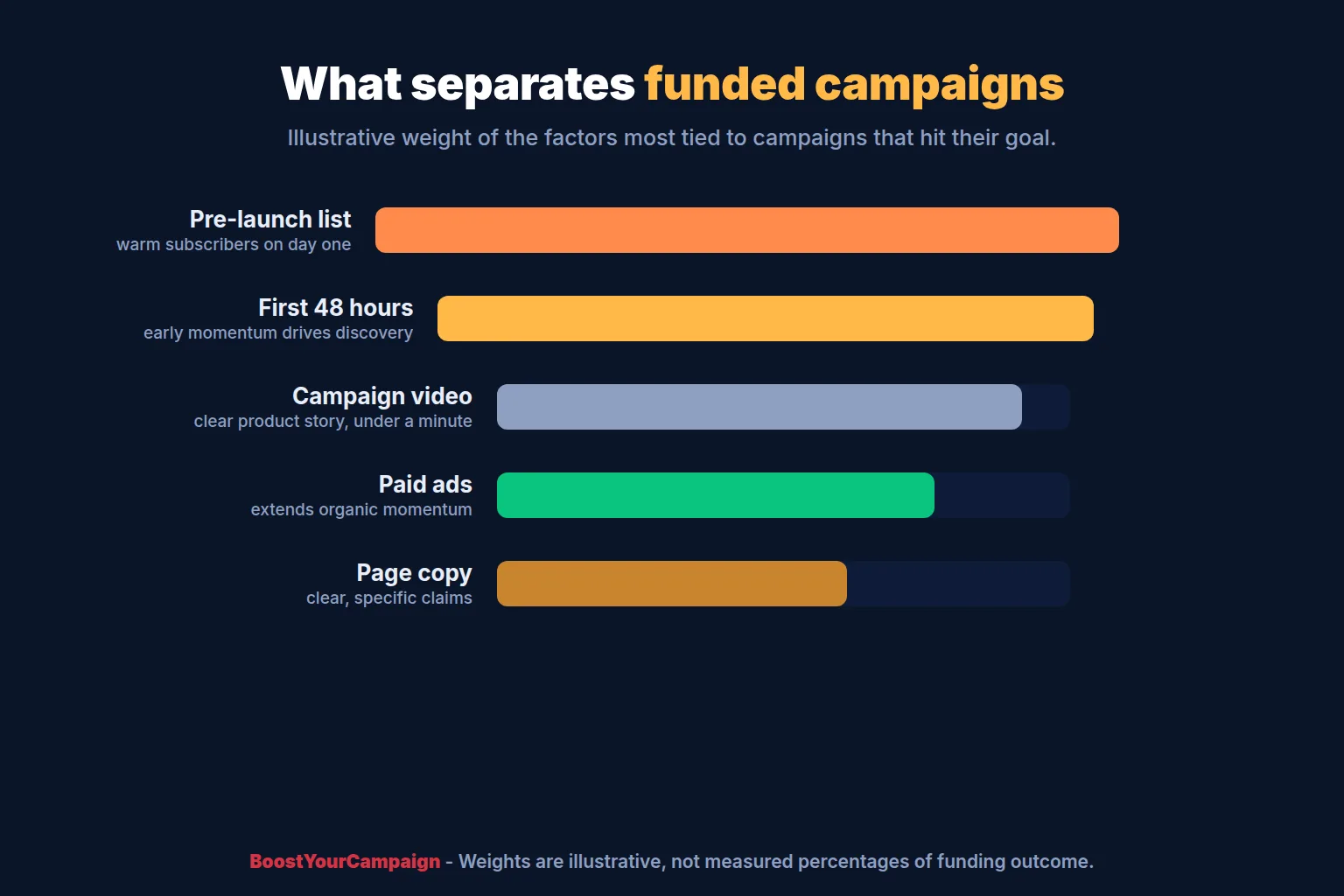
Roughly 4 in 10 Kickstarter projects reach their funding goal, which means most campaigns that launch don't fund at all. The gap between the campaigns that succeed and the ones that don't is rarely the product idea itself - it's almost always preparation and execution around the launch.
The single strongest predictor is a pre-launch email list. Campaigns that arrive on day one with warmed-up subscribers ready to pledge tend to hit a meaningful chunk of their goal in the first 24 hours, and that early momentum is what the platform's discovery algorithm rewards with more visibility to strangers. Campaigns that launch cold are fighting a much harder battle from hour one.
The first 48 hours matter for a second reason: backers on the fence look at how a campaign is already performing before deciding to pledge, so a slow start suppresses pledges that would otherwise have come in. A clear, well-shot video that explains the product in under a minute correlates strongly with conversion, and paid ads targeting people who resemble the audience already converting extend that early momentum. Clear, specific page copy that answers what the product does and why the creator can deliver it rounds out the list.
8) Risks and rules
Funding models differ by platform. Kickstarter is strictly all-or-nothing: if a campaign doesn't reach its goal by the deadline, no money changes hands, and backers keep their pledges. Indiegogo offers keep-what-you-raise on many campaigns, meaning the creator gets whatever was pledged even below the goal, at the cost of a higher fee. Indiegogo's separate Flexible Funding option was retired in October 2025 - it existed as a middle option between the two models, and creators evaluating Indiegogo today should know it's no longer available.
Funds raised through rewards crowdfunding are generally taxable income, since the transaction is legally a pre-sale rather than a gift, so plan for that rather than assuming a Kickstarter payout is money entirely free and clear. On the equity side, Regulation Crowdfunding raises are capped at $5M in any 12-month period under SEC rules, which shapes how much a startup can realistically raise this way versus a traditional funding round.
The most common real-world risk isn't fraud, even though that gets outsized attention. It's fulfillment delay - a creator who funds, then discovers manufacturing or shipping takes considerably longer than promised. Backers are usually patient with honest updates; far less patient with silence. Our guide to what happens if a Kickstarter fails covers the recourse backers and creators have when a campaign can't deliver.
9) Crowdfunding for startups and businesses
Beyond the money, a crowdfunding campaign functions as market validation that's hard to get any other way before launch. A funded campaign proves real people will pay real money for the product at a specific price, a far stronger signal than survey responses. It also front-loads a customer base and an email list a brand-new company would otherwise spend months building from zero.
For hardware and product startups, rewards crowdfunding often functions as the first production run: the funds cover the first manufacturing batch, and the campaign becomes a pre-order sale that finances its own inventory instead of requiring outside capital. Our best crowdfunding platforms for startups guide covers platform choice for this situation.
What happens after the campaign matters just as much as the campaign itself. Most successful creators move to a standalone storefront, usually Shopify, once fulfillment is underway, so they keep selling to the audience the campaign built. Our guide to setting up a Shopify store after crowdfunding covers that transition, and our how to launch a Kickstarter guide walks through the full pre-launch process.
How BoostYourCampaign fits
BoostYourCampaign has run rewards crowdfunding campaigns since 2010, across 4,600+ launches that have raised $734M+ combined, with a 4.9/5 score across 300+ verified reviews. We work across the full path this article describes: strategy and platform choice, campaign page build, video production, ads run on a skin-in-the-game model where our own money is invested alongside the client's budget, PR outreach, and fulfillment through owned US and EU warehouses. Creators who plan fulfillment and the eventual move to Shopify before launch tend to protect margin and keep selling past the campaign's last day.
We're an Indiegogo Approved Agency, a Google Premier Partner, a Facebook Marketing Partner, a Shopify Partner, and an Amazon Partner. If you're deciding what type of crowdfunding fits your product or how to build the pre-launch audience section 7 points to, see our services overview.
Before you launch a crowdfunding campaign
- Confirm you have a working prototype or a near-final render, not a concept sketch.
- Pick the right type - rewards, equity, donation, or debt - based on what you're offering backers.
- Choose a platform that fits your category and region, not just the most familiar name.
- Start building a pre-launch email list weeks or months before the page goes live.
- Budget for the platform's roughly 8-10% cut plus video, ads, and fulfillment separately.
- Decide between all-or-nothing and keep-what-you-raise before you set your goal.
- Get a real fulfillment quote, including a US/EU warehouse plan for international backers.
- Plan the post-campaign move to a standalone store so the audience you built keeps buying.
Frequently Asked Questions
What is crowdfunding?
Crowdfunding is raising money for a project, product, or business from a large number of people online, usually through a platform like Kickstarter or Indiegogo. Depending on the type, backers get the product itself, equity, the satisfaction of supporting a cause, or their money back with interest. Most product launches use rewards crowdfunding, which works like a pre-order.
How does crowdfunding work?
A creator builds a prototype, builds a pre-launch audience, then publishes a campaign page with reward tiers and a video. The campaign runs live for roughly 30-60 days while backers pledge. Once the funding threshold is met, the platform releases the funds minus its fee, and the creator ships the rewards.
Is crowdfunding free?
No. Platforms like Kickstarter charge roughly a 5% fee plus 3-5% payment processing, before video, marketing, ads, and fulfillment costs, which are usually the larger expenses. Backers pay the reward tier price plus shipping, and sometimes import VAT on cross-border orders.
Do you have to pay back crowdfunding?
It depends on the type. Rewards crowdfunding isn't repaid in cash - you deliver the product instead. Equity crowdfunding isn't repaid either, but investors receive real ownership. Donation-based crowdfunding expects nothing back. Debt-based crowdfunding is the one type where backers are repaid, with interest.
What is the most popular crowdfunding site?
Kickstarter, founded in 2009, remains the platform most associated with rewards crowdfunding and typically draws the largest built-in backer audience. Indiegogo is the other major rewards platform, Gamefound leads for tabletop games, and GoFundMe is the dominant name in donation-based crowdfunding.
How much does crowdfunding cost?
Expect roughly 8-10% of what you raise to go to platform fees and payment processing combined. Beyond that, video, paid ads, page design, and fulfillment are the larger costs, scaling with how competitive your category is and how large a raise you're targeting.
Can anyone start a crowdfunding campaign?
For rewards crowdfunding, yes - platforms like Kickstarter and Indiegogo are open to most creators with a real product, though each campaign is reviewed before it goes live. Equity crowdfunding has more legal requirements, since it's a regulated securities offering.
What is the success rate of crowdfunding?
Roughly 4 in 10 Kickstarter projects reach their funding goal, though rates vary by category and by how well-prepared the campaign is. A pre-launch email list, a clear video, and a strong first 48 hours are the factors most closely tied to campaigns that fund.
If you're weighing whether crowdfunding fits your product, or ready to plan a launch properly, get in touch with BoostYourCampaign.
Want results like these for your campaign?
We've helped 4,600+ creators raise over $734M. Let's pressure-test your launch plan and find the highest-leverage fixes before you go live.
Talk to an expert →Get the free 87-step launch checklist
The exact pre-launch, live-campaign and fulfillment steps we use across 4,600+ launches. Free PDF, emailed instantly.
You're in - check your inbox. Open the checklist now ->